




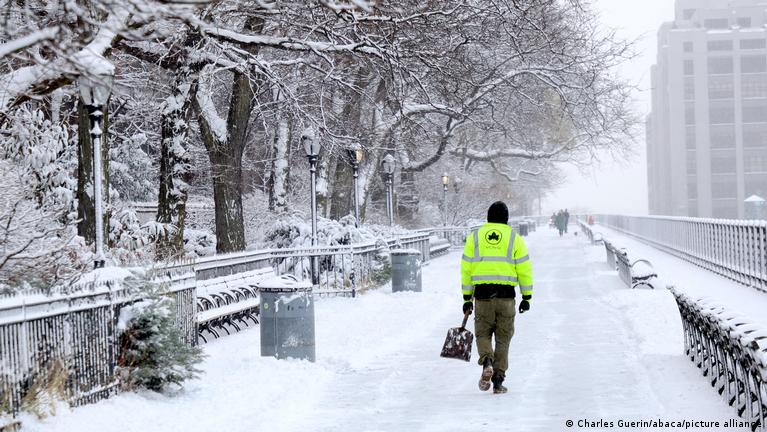
Authorities in New York City on Monday ordered the shutdown of schools and Major road as the city braces up for an imminent massive snowstorm forecasted to hit the Northeast of the United States (US).
Following the forecast, tens of millions of Americans from the US capital, Washington, to the northern state of Maine have prepared for up to two feet (60 centimetres) of snow forecast in some areas.
The National Weather Service (NWS) on its website disclosed that light snow and “freezing fog” with lows of 30F (-1 °C) were recorded in New York in the early hours of Monday, February 23.
According to NWS, blizzard conditions would “quickly materialise” from Maryland up to southeastern New England, making travel “extremely treacherous.”
Snow could fall at a rate of two to three inches per hour at the peak of the storm, with nearly 54 million people in its path, it noted.
In the early hours of Monday, the storm had already begun to hit New York, slashing visibility to the extent that the skyscrapers of Wall Street were barely visible from the adjacent borough of Brooklyn.
The possibilities of Power outages are high as a result of heavy snow and strong wind gusts, forecasters said. Just after 01:39 am local time (0639 GMT) on Monday, nearly 80,000 customers were without power in the state of New Jersey, according to tracking website poweroutage.us.
READ ALSO:
Meanwhile, more than 5,000 flights have been cancelled, data from the tracker FlightAware showed early Monday.
In New York, which has more than eight million residents, Mayor Zohran Mamdani said streets, highways, and bridges would be shut down from 9:00 pm Sunday until noon Monday.
“New York City has not faced a storm of this scale in the last decade,” he said, explaining the state of emergency. “We are asking New Yorkers to avoid all nonessential travel.”
The ban will not apply to essential workers or New Yorkers needing to travel due to emergencies.
Brandon Smith, 33, who lives in Brooklyn, complained that some workplaces had remained open, even if roads were not.
“It’s gonna be difficult for most New Yorkers to get around because we still have to go to work. It’s unfortunate (roads) are suspended as jobs are not gonna stop calling us in,” he said.
Tourists, on the other hand, were delighted by the spectacle of their first experiences of snowfall.
Macarena Gonzalez, who came from Chile, said that she knew it was going to snow but didn’t realise to what extent, he said, “I’m happy, it’s a great experience,” she told AFP on Sunday while exploring Times Square.
The NWS warned that heavy snow, high winds, and low visibility were “expected to cause dangerous to impossible travel” conditions.
Gusts of up to 60 miles (100 kilometres) per hour were expected late Sunday and into Monday, the NWS said.
New Jersey Governor Mikie Sherrill declared a state of emergency beginning midday Sunday, freeing up funds and allowing the swift deployment of resources to address the weather crisis.
In Boston, Mayor Michelle Wu closed all public schools and municipal buildings on Monday.
“We ask everyone to plan, stay safe and warm, and stay off the roads to help our public works and public safety efforts,” Wu said.
The NWS said “moderate to major” coastal flooding affecting waterfront roads and properties was possible from Delaware up to Cape Cod in Massachusetts.
The storm comes just weeks after the region recovered from another devastating winter weather system that was linked to more than 100 deaths.
“The worst is yet to come,” New York Governor Kathy Hochul told a press briefing on Sunday.
“Whatever you need—any groceries, any medicines you need to be refilled at the pharmacy, any pet food you need to have—do it right now.”
Then, she advised, “Just settle in.”
“Watch some more Olympics, read a book, catch up on the news, call your family members, call your moms — especially your moms.”








