


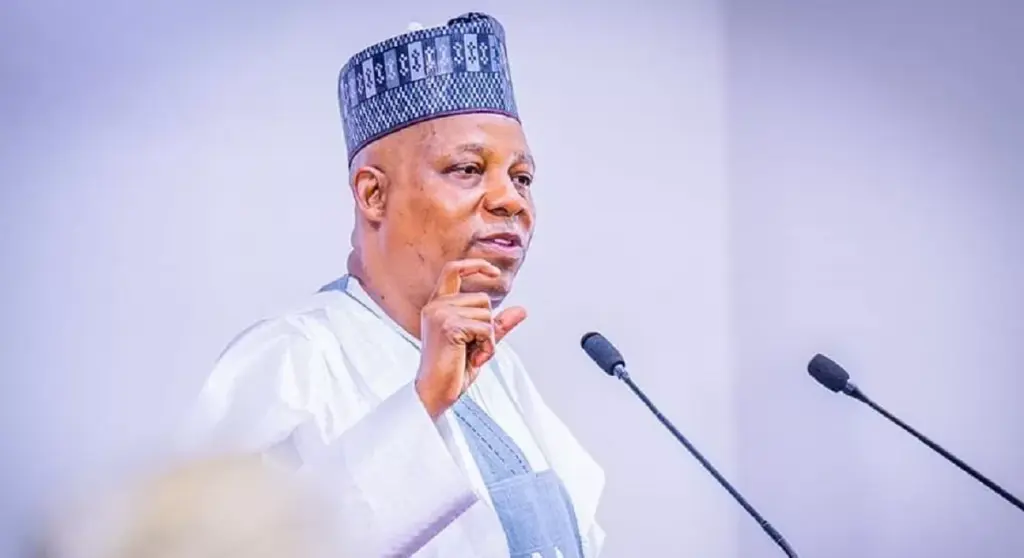
Vice President Kashim Shettima is set to chair an inter-ministerial framework that will coordinate Nigeria’s growing research and innovation collaboration with the European Union (EU), as both sides move to expand joint projects across key sectors.
This comes as Nigeria consolidates its position as one of Africa’s leading participants in the European Union’s flagship research funding platform, marking a significant milestone in the country’s drive to internationalise research and strengthen innovation partnerships.
The announcement was made at the Nigeria-EU Science and Innovation Day held at the Wole Soyinka Centre for Culture and Creative Arts in Iganmu, Lagos, where policymakers, researchers, innovators, and private sector actors from Nigeria and Europe convened to bolster institutional partnerships.
Minister of Innovation, Science and Technology, Dr. Kingsley Udeh, who delivered the keynote address, reaffirmed Nigeria’s commitment to internationalising research, deepening global partnerships, and strengthening the national innovation system.
Represented by Permanent Secretary of the ministry, Philip Ebiogeh, Dr. Udeh noted that priority areas for collaboration include agricultural productivity and food security, digital transformation, and emerging technologies. He added that implementation would be coordinated through an inter-ministerial framework chaired by Vice President Shettima.
The minister further highlighted that the Federal Government is advancing plans to strengthen research financing mechanisms and expand international research partnerships to accelerate commercialisation and support enterprise development.
The Head of Delegation of the European Union to Nigeria and ECOWAS, Ambassador Gautier Mignot, emphasised that co-creation is the defining principle of EU-Nigeria collaboration in science and innovation, describing the partnership as one grounded in joint ownership rather than a simple transfer of knowledge.
Ambassador Mignot noted that science and innovation are central to inclusive and sustainable development, particularly in addressing challenges such as food security, digital connectivity, and climate resilience. He added that the European Union’s engagement in Nigeria is structured to reinforce national innovation systems, strengthen institutional capacity, and support research-to-market pathways.
He highlighted ongoing collaboration under the EU’s Global Gateway strategy, including support for digital transformation initiatives, innovation ecosystem development, and creative industry financing frameworks. He also referenced cooperation aligned with national priorities to expand digital infrastructure and strengthen enabling environments for enterprise and innovation.
Speaking at the event, the European Commission’s Director for International Cooperation in Research and Innovation, Ms. Nienke Buisman, noted that Nigeria remains one of the leading African participants in Horizon Europe, the EU’s flagship research and innovation programme.
She emphasised that Nigerian universities, start-ups, and small and medium-sized enterprises are partnering with European counterparts across strategic sectors, including artificial intelligence applications, sustainable agriculture, fintech innovation, and climate adaptation initiatives under the AU-EU Innovation Agenda.
Ms. Buisman described ongoing discussions between Nigeria and the European Union as an opportunity to consolidate existing collaboration within a coherent, forward-looking framework, encouraging stakeholders to strengthen institutional linkages and scale joint research efforts.