

The Senate, on Tuesday, gave its full support to the proposed ₦140 billion 2026 budget of the South East Development Commission (SEDC).
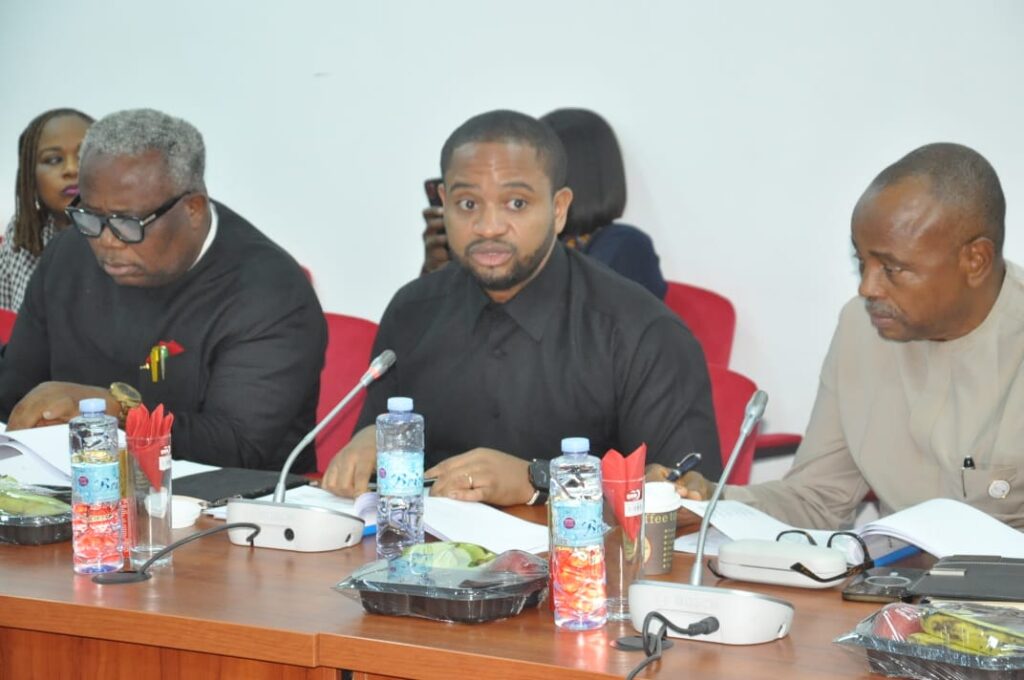
The Senate Committee on South East Development Commission Chaired by Senator Orji Uzor Kalu, expressed the support when the Managing Director/Chief Executive Officer of SEDC, Mr. Mark Okoye, in company with his Management team presented the proposals to the Committee at the National Assembly.
Okoye had presented a comprehensive, outlined a development-driven financial plan hinged on infrastructure renewal, industrialisation, private sector-led growth and regional integration.
According to his presentation, the breakdown
of the ₦140 billion proposal indicates as follows: ₦106.745 billion (76.25%) is allocated to capital expenditure
₦25.955 billion (18.54%) to recurrent expenditure (excluding personnel)
₦7.3 billion (5.21%) to personnel costs
The Commission stated that the 2026 budget was structured around five strategic pillars: infrastructure development, economic empowerment, environmental sustainability, social development, and security/ peacebuilding.
In his presentation, the MD unveiled a long-term roadmap to build a $200 billion South East economy by 2035. Central to this vision is the establishment of a proposed South East Investment Corporation (SEIC), projected to drive a $150 billion capital base and position the region as Africa’s preferred investment destination.
He disclosed that the Commission was targeting a $1 billion regional investment threshold and intends to structure major infrastructure projects to attract international financing rather than rely solely on federal allocations.
Okoye noted that although the 2025 fiscal year recorded zero capital releases, the Commission utilised the period to prepare feasibility studies and “bankable documents” to drive large-scale projects, including a proposed regional gas pipeline network estimated to cost between $1.5 billion and $2 billion.
Key Allocations in the 2026 Proposal include:
Community Social Development Programme – ₦3.3 billion; South East Venture Capital Fund – ₦3.5 billion, Youth Entrepreneurship Programme – ₦2.5 billion; Grassroot Recreation Infrastructure – ₦7 billion; Headquarters and Zonal Offices Setup – ₦2.9 billion, Operational Vehicles – ₦4.1 billion, Climate Sustainability and Green Economy – ₦500 million.
Regional Security Programme – ₦2.5 billion
M.I. Okpara Fellowship (Leadership Development) – ₦660 million.
The lawmakers expressed security and erosion concerns ravaging the region as well as raising concerns about spending priorities and measurable impact.
Senator Tony Nwoye stressed that without security, development efforts would not yield meaningful results, just as he demanded clarity on how the ₦2.5 billion Regional Security Programme would translate into visible improvements, especially in areas severely affected by insecurity.
He also sought details on collaboration mechanisms with existing security agencies.
On the ₦3.5 billion South East Venture Capital Fund, Nwoye warned against politicisation, insisting it must operate strictly on merit to support genuine innovators in commercial hubs such as Onitsha, Aba and Nnewi.
Also, environmental sustainability drew sharp criticism, with lawmakers describing the ₦500 million allocation as grossly inadequate for a region battling thousands of erosion sites, often referred to as Nigeria’s erosion epicentre. Senators urged the Commission to prioritise life-threatening ecological challenges.
Senator Kenneth Eze, urged the Commission to treat public funds with the discipline of a private enterprise. He praised the Managing Director’s strong presentation, but cautioned against spreading limited resources across too many projects, warning that such an approach could lead to abandoned initiatives.
He advised management to match projects strictly with available resources and focus on realistic, measurable outcomes rather than excessive stakeholder engagements and conferences.
Senator Ezenwa Onyewuchi raised concerns over personnel allocations and sought assurances that staff salaries were being paid promptly, warning that unpaid remuneration could undermine morale and damage the Commission’s public image while also calling for transparency in recruitment processes.