
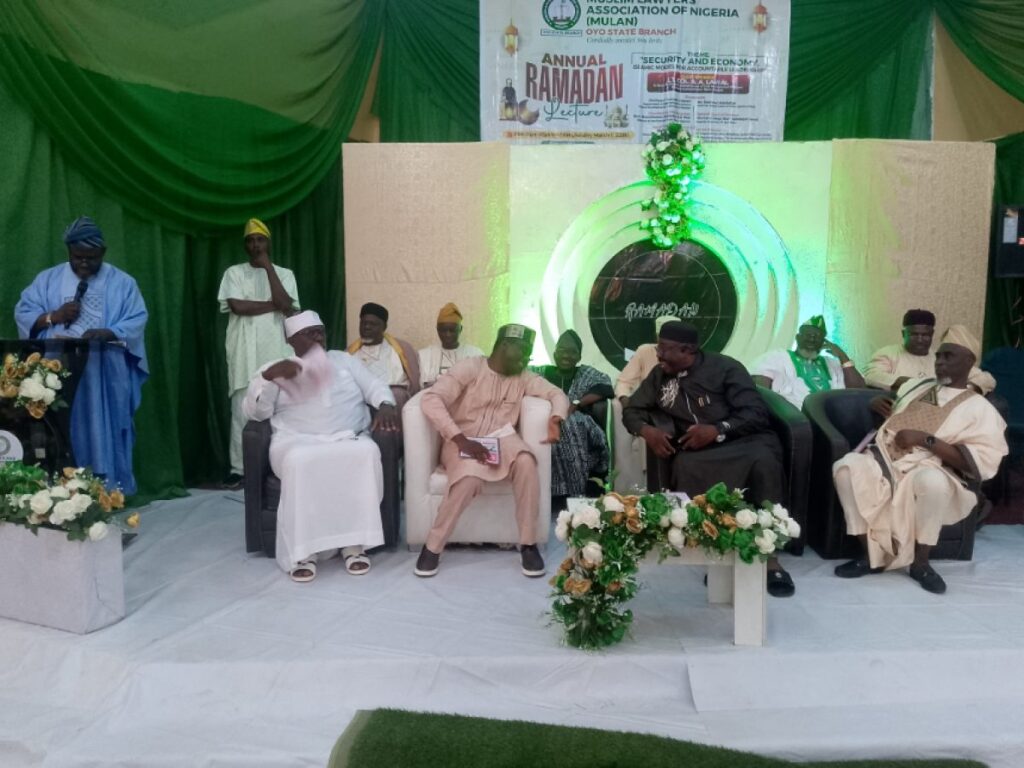
Security experts, academics, and legal practitioners have identified injustice, oppression, and abuse of power as primary drivers of Nigeria’s security challenges, urging governments at all levels to embrace accountability and equitable resource distribution as lasting solutions.
The experts made the declaration at the annual Ramadan lecture organised by the Muslim Lawyers’ Association of Nigeria (MULAN), Oyo State chapter, held in Ibadan.
Speaking as the Guest Speaker, Lieutenant Colonel Adeleke Lawal, the Acting Deputy Director of Islamic Affairs, 2 Division, Nigerian Army, Ibadan, while delivering a paper titled; “Security and Economy: Islamic Model for Accountable Leadership,” asserted that security is intrinsically tied to justice, warning that peace and stability cannot thrive where oppression, discrimination, and abuse of power prevail.
Lawal noted that despite Nigeria’s abundant resources, widespread injustice has left many citizens languishing in abject poverty, a situation he warned undermines national security. He cautioned that when economic power is monopolized by a select few, social unrest becomes inevitable.
“Security and economy are not peripheral issues. They are foundation pillars of civilization. When security collapses, economic life suffocates. When economic injustice spreads, insecurity multiplies. Injustice destroys security because when people are denied fairness, marginalized economically, or treated unequally before the law, resentment grows. That resentment eventually manifests as crime, rebellion, or social unrest,” Lawal said.
He urged public office holders to ensure equitable distribution of resources to reduce social menaces to the barest minimum and emphasized the need for ethical leadership rooted in justice and moral responsibility.
In their contributions, the discussants; Professor Taofeek Yekeen from the Department of Agricultural Extension and Rural Development, University of Ibadan, and Mr. Rasheed Adelakun, Director of the Department of State Service in Oyo State; called on governments at all levels to address systemic imbalances fueling insecurity.
Senator Sharafadeen Abiodun Alli, who chaired the occasion, praised the newly signed Electoral Act, describing it as a significant step toward improving Nigeria’s electoral processes and deepening democracy. He charged the electorate to actively engage their representatives. “As your elected representatives, you can ask questions.
Gone are the days when they said, ‘don’t go out to vote.’ The Electoral Act has taken away the power from politicians who want to rig elections. There is no way now,” Alli stated. Senator Abdulfatai Buhari commended MULAN for its consistent role in defending human rights, describing the lecture as timely and urging the association to sustain its efforts.
The event, held in Ibadan, attracted notable personalities including the Deputy Governor of Oyo State, Barrister Abdul-Raheem Adebayo Lawal, represented by Barrister Kunle Sanni; Hon. Dikhrullahi Adedeji Olajide; former Minister of Communications, Barrister Adebayo Shittu; Chief Imam of Oyo, Sheikh Bilal Akewugberu; MULAN Chairman, Barrister Ismaila Saka; Justice Tajudeen Abdulganiy; Chairman of the Nigerian Bar Association (NBA), Ibadan branch, Barrister Ibrahim Lawal; and Barrister Yemi Akangbe (SAN).