
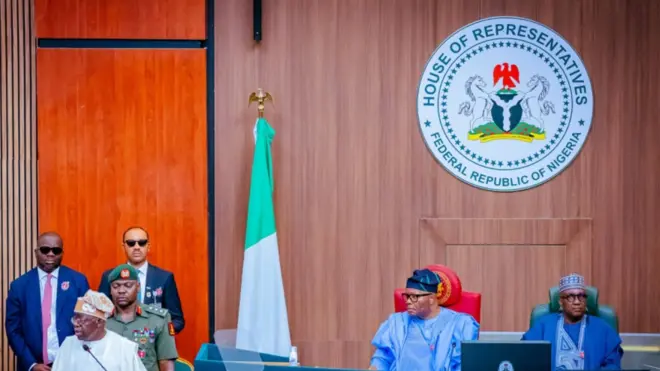
A member of the House of Representatives, Clement Jimbo, on Tuesday backed the removal of indirect primaries in the 2026 Electoral Act, saying it would help in addressing money politics in Nigeria.
Jimbo, representing Abak/Etim Ekpo/Ika Federal Constituency of Akwa Ibom State, made his stance known in an interview on Channels Television’s The Morning Brief.
Speaking on the programme, the lawmaker argued that indirect primaries endangered Nigeria’s democracy.
He said, “If you observe the indirect primaries, it was completely against Nigerians and electorates.
“If you define democracy as the government of the people, by the people, and for the people, if the majority of the people are not participants in electing who becomes their flag bearer, then it wasn’t democracy.”
His comment follows the national debate over the 2026 Electoral Act recently signed into law.
While the previous law allowed parties to pick from direct primaries, indirect primaries, and consensus candidacy, the amended Electoral Act removed the direct primaries option.
Despite arguments by critics, the lawmaker said the National Assembly’s decision reflected the desire of a vast majority of Nigerians.
“Many of the civil societies have equally come to agree that this obnoxious way of electing candidates from political parties through indirect ways is inducing. In the indirect way of electing candidates, that’s where monies are induced,” the Akwa Ibom lawmaker said.
According to him, those who have the most money usually win the indirect primaries because they can buy votes and delegates, claiming that indirect primaries contributed to the rise of godfatherism in Nigeria’s electioneering processes.
“We are saying that since you have as much money as you think you have, you should come and buy all your political party members,” Jimbo said. “Let all of them pay, then we will know that you are very rich.
“Now that we have the opportunity to amend this, we said, ‘No, let the real merit and intent of how we defined democracy come to be. Let the people who elect the officials begin by electing them to become the candidates in the first place.
“So we expunged the indirect way of electing a candidate, which is indirect primaries. Let it be either consensus or direct primaries, where all of the political party members will queue behind who they so choose to become their candidate in the next election.
“We have done that, and you have highlighted section 77, Subsection 1 to 7, which is very critical that the preparation for the election must not start on election day. It begins the moment the Independent National Electoral Commission (INEC) declares the timetable for the election,” he said.
He, however, asked Nigerians, if not all, to applaud the National Assembly for the amendment.
“The Parliament is there to take the interest of Nigerians to the fore; we are elected members of the parliament representing the 774 local government areas in Nigeria.
“We can not just allow an infinitesimal number of Nigerians to take a major decision that will affect the outcome of our collective patrimony. That’s why the National Assembly came in,” he added.