
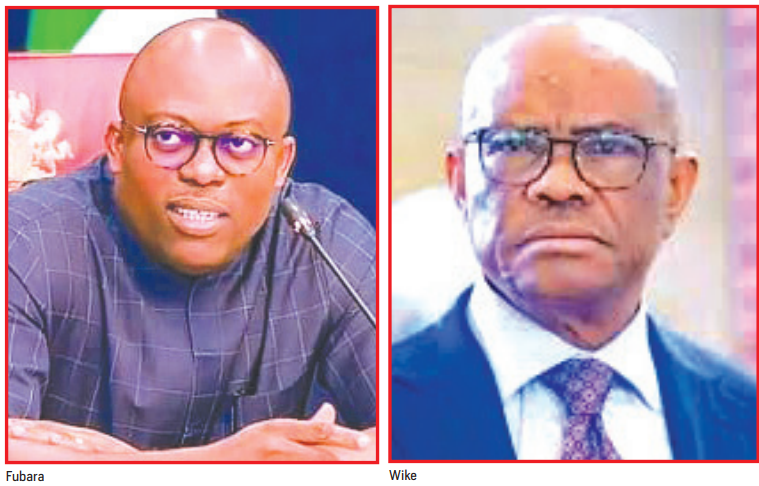
EVINCE UHUREBOR examines how political parties, ethnic and civil society groups are reacting to the feud between Rivers State Governor, Siminalayi Fubara and the Minister of the Federal Capital Territory (FCT), Nyesom Wike, amid growing tensions over governance and party loyalty in the state
Mixed reactions have continued to trail the decision of the Rivers State House of Assembly to commence impeachment proceedings against Governor Siminalayi Fubara and his deputy, Prof. Ngozi Odu. The Assembly activated impeachment mechanisms against the governor over allegations of gross misconduct, including failure to present a mid-term expenditure framework and issues surrounding budgetary processes.
While the decision of the House has deepened political tension in the state, it has also exposed widening cracks across Rivers’ political landscape, with accusations, counter-accusations and calls for restraint dominating public discourse.
This renewed confrontation has pushed Rivers back into the national spotlight, reopening old wounds and raising fresh alarms about governance, loyalty, and political dominance.
As the feud resurfaces with greater intensity, reactions have continued to pour in from lawmakers, party stakeholders, civil society groups, and ordinary citizens who fear the state is once again being dragged into avoidable instability.
Climb down from high horse –Fayose
A former governor of Ekiti State, Ayodele Fayose, in his reaction to the Rivers crisis, advised Governor Fubara to make amends with Wike instead of engaging in political confrontation.
Fayose, who emphasised the importance of humility and reconciliation in governance, said: “Look at Kogi. Why are we not having issues in Kogi? Why is Kogi governor being very humble? Whatever you say about Yahaya Bello, he doesn’t want to hear it. Whatever anybody comes to say to him about Yahaya Bello, he remembers the day Yahaya Bello gave him that platform.”
The Ekiti former governor recalled the advice he gave to his successor, saying: “I told my governor, whatever former Governor Kayode Fayemi, what I’ve done to you, or whatever way you feel, don’t worry about that. Remember the day he gave you that platform. Don’t say ill of him, cooperate with him, and he thanked me for such advice. If it were other people, they would take advantage of the situation.”
He concluded by urging Fubara to respect both constitutional obligations and political mentorship. “Constitution is binding on the governor and on Rivers people. That is the reason why Fubara should come down from his high horse, look for his brother, his leader, the man who was thoughtful enough to say among all the brides, I will marry you.
Embrace peace and end this war now – PANDEFF
Chairman of the Pan Niger Delta Forum (PANDEF) Reconciliation Committee, Chief Kanu Godwin Agabi (SAN), on his part, called on Wike, Fubara and other stakeholders in Rivers State to make sacrifices and embrace forgiveness in order to end the lingering political crisis in the state.
Agabi, who made the appeal while delivering a statement on behalf of the PANDEF Reconciliation Committee, described the crisis as one that has persisted for far too long.
He warned that its continuation will raise serious questions about the commitment of the political actors involved to the welfare of Rivers people and the stability of the nation at large.
The PANDEFF committee chairman, who spoke warmly of Wike, described him as a courageous, patriotic, and already immortalised by his record as governor of Rivers State and current service as FCT minister. Similarly, he expressed personal confidence in Governor Siminalayi Fubara, citing his role in defending the governor’s election petition and appealing to him to honour the bond between them.
Fubara’s 2027 right non-negotiable –Ijaw groups
Speaking at a joint press conference held in Port Harcourt, the Ijaw National Congress (INC) and the Ijaw Youth Council (IYC), strongly opposed the impeachment move, accusing Wike, of escalating political hostilities in the state.
The chairman of INC, Eastern Zone, Abel Peterside; the chairman of IYC, Eastern Zone, Prince Datolu Sukubo and the speaker of the 6th Parliament of IYC, Gabriel Allen, who spoke on behalf of the groups, warned that the situation in Rivers State poses a serious threat to peace and democratic stability.
They recalled the June 26, 2025 peace accord brokered by President Bola Tinubu, describing it as a widely welcomed effort that has since been undermined.
“Rather than allowing the post-agreement phase to consolidate, the minister has chosen a path defined by hostility, public provocations and political interference,” the statement read. They further affirmed Governor Fubara’s political rights ahead of 2027, by saying that no individual may arrogate to himself the power to determine the political destiny of Rivers State.
Parties will not unite under rainbow coalition –IPAC
The Inter-Party Advisory Council (IPAC), through its National Publicity Secretary, Egbeola Martins, told Wike that political parties in Rivers State will not unite under a rainbow coalition for the 2027 general election in the state.
Wike had said that politicians in Rivers State were united under the Renewed Hope Family, tagged: “Rainbow Coalition,” to ensure the re-election of President Tinubu for a second term in 2027. But Martins, who dismissed the claim, described it as misleading and unfounded.
He said decisions on coalitions, alliances, or endorsements can only arise from duly constituted party organs, not from any individual, regardless of his/her position. He further maintained that the minister lacked any mandate from the council or registered parties to speak for them or determine alliances, preferences or candidates for elections nationally.
Martins, however, said that IPAC was aware of some parties independently considering unconditional solidarity support for Governor Fubara to promote peace and stability within the state. He emphasized that such considerations remained exclusive decisions of the affected parties, driven by collective solidarity and commitment to lasting peace, not external pressure or personal interests.
Terminate impeachment process or face recall –Councillors
The Coalition of Councillorship Candidates for Grassroots Governance in Rivers State described the impeachment process against Fubara and his deputy as “lawless, morally bankrupt, and politically reckless.”
The group said will activate a comprehensive recall process against complicit members of the Rivers State House of Assembly across all constituencies if the lawmakers refused to back down on the impeachment process.
It also declared that it is prepared to mobilize ward by ward, street by street, and community by community to reclaim the people’s mandate and expose those who have chosen what it described as “betrayal over representation.”
Put state first above personal ambition –LP
The Rivers State chapter of Labour Party through its chairman, Mrs. Hilda Dokubo, appealed for peace and stability, urging politicians to place the state’s interest above personal ambitions.
Dokubo, who described the impeachment notice against Governor Fubara as a distraction to governance and development in the state, said Rivers should focus on rebuilding after six months of emergency rule marked by instability, hardship and limited development.
Impeachment plot is reckless –Rights groups
The Human Rights Writers Association of Nigeria (HURIWA), in a statement signed by its National Coordinator, Comrade Emmanuel Onwubiko, rejected the impeachment plot, describing it as “reckless, unconstitutional and morally indefensible.” HURIWA accused the Rivers lawmakers of acting as proxies and urged President Tinubu to urgently intervene to halt what it termed a manufactured crisis.
Similarly, the Rivers Peace Initiative, in a statement signed by its Convener, Obinna Ebogidi, warned that the impeachment notice represents a serious escalation capable of plunging Rivers State into renewed instability. The group cautioned that impeachment is a grave constitutional instrument and must never be perceived as a tool of political pressure.
APC divided on Rivers crisis
In his response, the National Vice Chairman of the All Progressive Congress (APC), South-South, Victor Giadom, advised Governor Fubara to go through Wike to win anything in the state. Giadom, who made the statement during Wike’s “thank you” visit to the people of Gokana Local Government Area of Rivers State, described Wike as a “dependable leader” in Rivers politics, with assurance that there would be no political force in Gokana other than Wike.
“I guarantee, on behalf of my brothers, that Gokana people are for Wike and Tinubu, and nobody will challenge Wike’s influence in Gokana. The Deputy Speaker, Rivers Assembly, Dumle Maol, on his part, assured Wike that the people of Gokana would be with him every step of the way. Also, the chairman of Gokana Local Council, Confidence Deko, pledged total support to Wike, saying: “This local government is for you because of what you have done for us.
Please tell Tinubu that the people of Bokana are appreciative of him.” However, in a surprising twist of events, the Rivers State chapter of the APC, led by Emeka Beke rejected the impeachment move against Governor Fubara. Speaking through its spokesperson, Darlington Nwauju, the party said it would be “totally untenable” to remain silent while internal crises from the Peoples Democratic Party (PDP) are allowed to destabilize an APC-led government.
He argued that the impeachment threat, largely centered on budgetary issues, was unnecessary and that there is an existing one-year budget approved under emergency rule in June and July 2025, which runs until August 2026. The constitution also allows a six-month spending window into a new fiscal year. Nwauju warned APC lawmakers in the Assembly to resist external pressure, stressing that the party would not allow the government to be destabilized “through fratricidal disagreements.”
As reactions continue to pour in, Rivers State appears caught in a web of competing interests – legislative authority, executive survival, ethnic mobilization, party discipline and federal influence. Whether the impeachment process proceeds or stalls, analysts agree that without urgent restraint and credible mediation, the state risks another prolonged season of political uncertainty, with governance, development and public confidence hanging in the balance.