



FELIX NWANERI writes on inducement of voters with cash by agents of political parties in return for votes, which has eroded the confidence of many in the electoral process
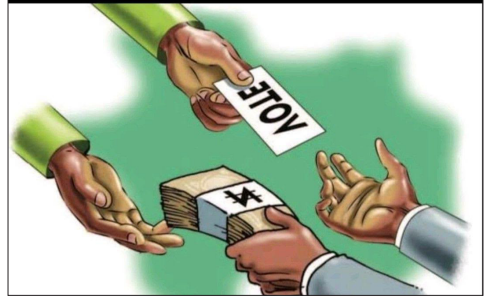
Inducement of voters with cash has always been associated with Nigeria’s elections, but it seems to have taken the centre stage and has consequently become the major determinant of electoral contests, thereby gradually eroding the peoples’ confidence in the electoral process. This ugly trend has persisted despite the fact that the nation has strengthened its electoral laws and invested in biometric technology, and there is no doubt that it is has not only become a norm, but the major determinant of electoral contests given the outcomes of recent elections in the country.
While most recent cases were recorded during the by-elections for unoccupied seats in the Senate, House of Representatives and state Houses of Assembly across 12 states on August 16, 2025 and the November 8, 2025 governorship election in Anambra State, reports from last weekend’s council elections in the Federal Capital Territory and byelections Kano and Rivers states, show that vote buying has come to stay.
There were reports of massive vote buying and the major culprits were the leading political parties despite repeated warnings by the chairman of the Independent National Electoral Commission (INEC), Prof. Joash Amupitan and the law enforcement agencies. Recall that Amupitan had declared ahead of the Anambra governorship election that “votebuying undermines democracy and erodes public confidence in the process.
We have issued strict directives to all our officials, and any deviation from the Electoral Act or INEC guidelines will attract severe sanctions.” Before now, voters were asked to flag or take pictures of thumbprinted ballot papers as proof of voting a specified political in what was termed “see and buy,” but the trend has changed to cash for votes ahead of election or on election day.
While vote buying is not limited to the off-cycle governorship elections but also prevalent during general elections, it hit an all-time high during the 2023 general election as the National Bureau of Statistics (NBS), in a report titled “Corruption in Nigeria: Patterns and trends third survey on corruption as experienced by the population,” said the elections recorded 22 per cent of vote buying, which is five per cent higher than the 2019 general election with 17 per cent. The agency disclosed in the report released on July 11, 2024 that 22 per cent of Nigerian citizens reported that they were personally offered money in exchange of a vote before or during the 2023 general election, while nine per cent were offered another favour.
The report stated: “This represents an increase in both types of vote buying compared with 2019, when personal offers of money were reported by 17 per cent and personal offers of other favours were reported by four per cent of citizens. “Furthermore, in 2023, 10 per cent reported that they were not personally offered money or another favour in exchange for their vote, but that instead another member of their household was approached, compared to five per cent in 2019.”
The NBS, however, said its survey revealed that some of the voters were not influenced by their voting decisions even after collecting money or favour. Breaking down the prevalence of the vote buying zones, NBS stated that there were minimal to no changes in SouthWest, South-South and North Central parts of the country between 2019 and 2023. The North-West, however, increased from 23 per cent in 2019 to 44 per cent in 2023. The North-West, on its part, recorded “a relatively high share of 55 per cent of citizens who were offered money or another favour in exchange for their votes.”
Vote buying is also evident during the candidates’ nomination process by political parties as delegates, who decide the respective flag bearers of the respective parties usually go for the highest bidder among the aspirants. The delegates, who become the most sought-after brides during the primary elections, usually see it as opportunity to make money. This explains they demand for all sorts of gratification from aspirants in return for votes. What happened at the 2023 presidential primary elections of the All Progressives Congress (APC) and Peoples Democratic Party (PDP) comes handy in this regard. Analysts captioned what transpired at the shadow polls of the two leading parties as “dollar rain.”
Presidential aspirants of the PDP were said to have paid between $10,000 and $20,000 per vote. Possibly, it was the “dollar rain” report that attracted officials of the EFCC to the Velodrome of the MKO Abiola Stadium, Abuja,venue of the presidential primary won by former Vice President Atiku Abubakar. Although there was no report of any arrest, one of PDP’’s presidential aspirants, Mazi Sam Ohuabunwa, who confirmed inducement of delegates, said the delegates could not resist the $10,000, $15,000 and $20,000 offered to them by the ‘’four leading contestants.” In a “thank you message” to his supporters after the PDP presidential primary, Obuabunwa, particularly noted that the effect of money was overwhelming in the choice made by the delegates.
The message read in part: “It is clear that the effect of money was overwhelming in the choice made by the delegates. It was also clear that the delegates could not resist the lure of $20,000, $15,000 and $10,000 dollars offered by the four leading contestants. We were aware that money would be a factor, but we had hoped it would not be the exclusive factor.”
Vote-buying undermines democracy and erodes public confidence in the process
Another aspirant, Mohammed Hayatu-Deen, who pulled out of the race at the eve of the party’s special national convention, also cited monetization of the process as reason why he bowed out. “I joined the contest as a democrat, with an open mind to keenly contest and accept the result of a process that is fair, credible and transparent. It is therefore based on personal principles and with great humility that have decided after wide consultations to withdraw from this contest which has been obscenely monetized,” he said.
There were also claims of inducement of delegates at the APC special national convention that held on June 8 and 9, 2022, at the Eagle Square Abuja, and which saw the emergence of the then national leader of the party, Asiwaju Bola Tinubu (now president) as the party’s candidate. While leaders of the two leading parties denied monetization of their nomination processes, many Nigerians had no option than to believe the claim of “dollar rain” when a video of a PDP delegate from Kaduna State, who donated part of the proceeds he received from aspirants to his constituents surfaced online.
The delegate, Tanko Sabo, said in the video that he donated over N12 million he got from the party’s presidential primary to the less-privileged in the Sanga Local Government Area of Kaduna State. He added that he was not afraid that the EFCC might come after him and that he had no fears or apologies for living up to the promise he made to his constituents, when he was seeking to be elected as a national delegate.
Sabo was emphatic that he and other party delegates were relentlessly courted by aspirants, with some of them offering them hotel accommodations at excessive rates. His words: “Immediately I got to Abuja, some of the aspirants started calling me and some of them gave me N400,000 or N500,000 to go and lodge in any hotel of my choice. But I slept in my car instead of looking for a luxurious place to sleep. “I prefer to eat noodles and pepper soup than to dine at the Hilton for more than N20,000 per plate.
I am not afraid of the EFCC because I spent the money I collected on my people. Will EFCC tell me I didn’t do well by paying school fees for orphans and hospital bills for elderly people who have no means of livelihood? I satisfied my conscience and all my people are happy.”
While the Electoral Act (as amended) clearly criminalize the act of vote buying as bribery and conspiracy, however, like other electoral offenders, the relevant agencies appear to be handicapped, when it comes to prosecution of persons involved in inducement of voters and this could be blamed on lack of capacity on the part of INEC given the large number of people involved.
It against this backdrop that some stakeholder, who spoke on the prevalent vote buying trend, warned that it constitutes a threat to free, fair and credible elections in Nigeria, particularly as the nation inches close to the 2027 general election. Labour Party’s presidential candidate in 2023, Peter Obi, who lamented the impact of vote buying on the nation’s electoral process, while reacting to the outcome of the August 16, 2025 by-elections, warned that the culture of selling and buying of votes is already destroying Nigeria from within.
He likened the trend to a “slow poison” that kills both democracy and development unknowingly, insisting that those who bought votes are not being generous, but merely purchasing the license to loot public funds. His words: “They invest in bribing of voters today only to plunder schools, hospitals, roads and jobs tomorrow.
They are not leaders; they are licensed looters.” Obi further stressed that those who sold their votes were not victims alone; they were also accomplices. “Every time you trade your ballot for money, you mortgage your children’s future for crumbs. You sell away the hospital bed that may save your life, the classrooms that should educate your children, and the jobs that should lift your family out of poverty. “If your vote was worthless, no one would pay for it.
The real power is not in their money, it is in your conscience, your courage, and your choice,” he said. He called on Nigerians to resist the politics of bribery and rise above temporary gains, warning that the nation faced a stark choice of either to remain trapped in poverty through vote-selling, or break free by electing leaders who built rather than loot. “A new Nigeria is possible but it will only be born the day we stop auctioning our future for cash,” he averred.
A former Secretary General of Conference of Nigerian Political Parties (CNPP), Willy Ezugwu, who also spoke on the issue, told New Telegraph that while vote buying is not entirely new in the polity, it portends great danger to the electoral process. His words: “It is worrisome that we have graduated from ballot snatching and writing of fictitious results to vote buying. This means that only those who looted our treasury will continue to win elections.
I call on the electoral umpire to make a bold statement ahead of the 2027 general election by bringing to justice all electoral offenders in the just concluded by-elections. “Effective prosecution of electoral offenders will be the first step towards stamping out vote buying, undue influence, intimidation, snatching of ballot boxes and all other forms of electoral offences in the country.”
No doubt, Nigeria has made significant gains in enhancing the legal framework to guide against vote buying through the Electoral Act, however, there is need to address some of the notable inconsistencies, which drive up cost of elections for parties and candidates as well as prevent credible candidates from running for political offices.








