
Following the enactment of the Petroleum Industry Act (PIA), which provided for the Host Communities Trust Fund, there are indications that a new vista has been opened in the relationship between oil producing companies and their host communities.
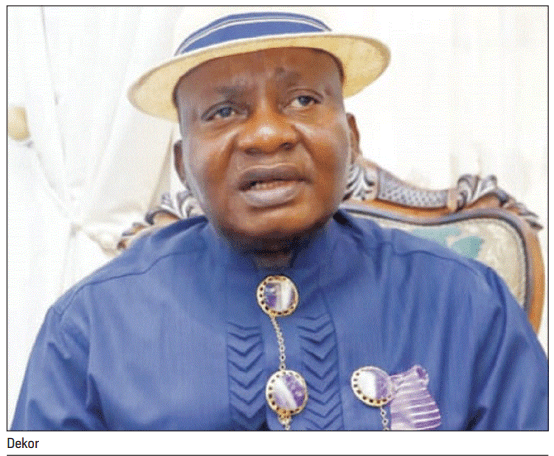
In this chat, the chairman, House of Representatives Committee on Host Communities, Hon Dumnamene Dekor, tells ONWUKA NZESHI that while the legislation has brought some relief, there are still some gaps in the law and its implementation
As chairman of the House Committee on Host Communities, what are the responsibilities of your committee?
The Committee on Host Communities, in the first place, came into existence in the 9th Assembly and I always give credit to the then Speaker and presently the Chief of Staff to Mr. President, Hon. Femi Gbajabiamila, who, after getting to see and understand the yearnings of the people from the oil producing communities, the level of abject poverty they were going through, the kind of suffering, death, diseases, and all of that, decided to put a committee on the host communities in place. By the grace of God, I was privileged to also serve as the pioneer chairman.
It is a legislative response to the sufferings of those who come from where we have oil in Nigeria. And we give thanks to God that this committee is in place. Also, in the 10th Assembly and in the wisdom of Mr. Speaker, Hon. Tajudeen Abbas, he also found me worthy to chair this committee. So, principally, the committee was put in place to address all those injustices and all those denials of the people in the oil producing areas.
The committee has a wide range of activities. Let me just mention one; every fund that is accruable to host communities in Nigeria, we oversight the implementation and everything about those funds. We also have to look at the 13 per cent derivation. Secondly, we have welfare and protection of the rights of the oil mineral producing communities as our responsibility. We ensure the implementation of agreements with host communities by both government, public, private, and international organisations.
Your committee also oversights the 13 per cent derivation funds to the host communities; what exactly do you do in this regard?
Of course, you are aware that in most states, the funds just come and they are deployed, not minding whether the host communities feel the impact of that particular fund. We also receive petitions from host communities as well as oversight the implementation and utilisation of host communities’ funds. In the present PIA, we have what we call the three per cent funds for the host communities. We also oversight the Hydrocarbon Pollution Remediation Project (HYPREP) know in most places as the Ogoni cleanup.
Amongst other things, these are the things the committee has to do. And by the grace of God, we are alive to our responsibilities. We do this through, of course, receiving of petitions. We also ensure that we do our routine oversights. We do a lot of engagements with the oil companies. We call them settlers, who operate in these areas. Some people say they are difficult.
If you do and overfly from Port Harcourt and you are going to Delta or Bayelsa, you will weep for this country. You will understand that people are living just by the grace of God
But, you see, we are just moving from the era of agreements and Memorandum of Understanding (MoU) to a new era. During the era of MoUs, it was like oil companies were giving out something to the communities. They were just giving them what they felt was good for them by way of Corporate Social Responsibility (CSR). But as it is now, there is a law that makes it mandatory for the oil companies to cede three per cent of their Operating Expenses (OPEX) of the previous year to the community.
There is a structure on ground to manage the funds. We have the Board of Trustees. We have all kinds of small bodies that look into the implementation of that fund. Flowing from this, you start by putting the Board of the Host Communities Development Trust in place, which, of course, is supposed to emanate from the people.
The people are the ones who will determine who will superintend over their funds. So, when these structures are put in place, then you have the needs assessment. The people are the ones who determine what they want in terms of projects and programmes. All these are done and under the supervision of the regulatory agency – Nigeria Upstream Petroleum Regulatory Commission (NUPRC), and we directly oversight them. So, we make sure these funds get to them.
There are areas where there are still disagreements over who heads what aspect of the Trust and some are in courts. We’re also trying to use various mechanisms to ensure that these Trusts are put in place, so that the people can have direct benefits. I always want to make reference to the Obagi area in River State, where Total Energies is operating and we’ve been able to go to look at the projects they have been able to put our feet down to ensure that the communities get better deals.
What is your assessment of the implementation of the PIA so far?
Every law comes with its own challenges. We have some grey areas in the law, which we are also pushing forward for amendments. But I think so far, so good because generally, you can see that the issue of communities and the companies having conflicts has drastically reduced. So, that tells you that the implementation is making some good impact. I think we have very few areas that are not yet covered. But so far, we have well over a hundred of such community trusts. Some of the Host Community Development Trust (HCDTCs) are in clusters of communities put together.
Take for example, you have a cluster of communities within an area that forms a Trust and then the way the funds are allocated to each of the communities is dependent on the impact of the oil company’s activities in that community. When a pipeline crosses your community, you would not be expecting the same level of development as where you have a flow station. So, I think that implementation is ongoing. It is a work in progress.
Do you also monitor what is going on with the 13 per cent derivation, which is managed by the Niger Delta Development Commission (NDDC)?
We have a joint committee of the Senate and the House of Representatives, and it is ongoing. What measures have you put in place for the communities to ensure that they don’t get cheated by the oil companies? We do a lot of engagement. Some communities, as we speak, have refused to even access their funds because they feel that what they are getting is not commensurate with what they ought to get. But the law spells out what constitutes the three per cent. There is an investigation that is ongoing.
It came through a referral from the plenary and it is being handled by my committee. We’re winding up for the year, so we’ll come into it full blast next year. We have started the baseline study. The Nigerian Upstream Petroleum Regulatory Commission (NUPRC) has furnished us with all the information we need, and with the information we are asking for from the settlers, so that we will be able to understand where there are shortfalls in payments.
The law makes it very clear that if you are supposed to put your Host Community Development Trust in place within a period, and you have not done so, there are penalties. Those penalties are paid to the government. So, we are going to look at all those issues and ensure that no Trust is underpaid. Every Trust will get what is their due. And if it is an area where they get more, we will thank those settlers. But we believe that there are some of areas where there is underpayment. It is an investigation, so we will not say anything until it is concluded.
Today, the oil bearing communities have the NDDC, the Host Communities Trust Fund and the South South Development Commission. How do you think we can harmonise these bodies to get the best out of them?
I think there is the need for synergy such that if the Trust is desirous of having a water project at point A, NDDC ought not to do a water project at that same place. Rivers State government, for example, or Delta State government, whichever state government, ought not to do that.
So, there must be a way of ensuring that their budgets and their proposals are seen in terms of what they have in mind for capital projects or services, so that there will not be any repetition. Take for example, if a Trust decides to give scholarships and they have 10 students they are giving scholarships, the South-South Development Commission ought not to give scholarships to those 10 students. It can go for projects for different sections of the society.
But I can assure you that with what I see coming from the Trust, that is funded by the Total Energies, within a period of five years, there will be tremendous improvement in infrastructure and in the life of those who live in and around those areas. So, if all other Trusts are doing that, it means that the development within those areas will take a very dramatic leap.
Beyond the work of the committee, what are you doing for your constituency?
My constituency is very large. We have about two large local governments. In fact, I always take pride in saying that my local government is one of the largest local governments in this country and I stand to be corrected. That local government has well over 100 autonomous communities. Gokana also has well over 50 communities. Now, what has been the case? In the 8th Assembly and the 9th Assembly particularly, we used to have what is allocated for every constituency. I think as at then it was N100 million for capital projects. Sometimes, we could use them for training projects and programmes.
I’ll just give you a very clear case. With our tax system in this country, we have 13.5 per cent tax which is made up of 7.5 per cent as Value Added Tax (VAT), five per cent as withholding, and one per cent as stamp duty. That gives you 13.5 per cent. If you take away 13.5 per cent from N100 million, you’ll be left with about 86.5 per cent. Now, whoever the agency or the ministry or the parastatal will award that contract to, is a company and that company will do a mark-up. So, assuming they do a mark-up of 25 or 30 per cent, it will be of that N86 million.
So, technically, what will be left for the development of that constituency is as paltry as maybe about N60 million or thereabout. So, in an area where you have over 200 communities, what do you think that can do? In most cases, what we do is to also see how we can attract some projects and programmes to your area. We have been doing that in terms of schools buildings and roads.
We know that real oil thieves exist, and have been robbing us as a people, but we should not join them because we are endangering our lives and our environment in the process
We have a road and a bridge that is ongoing that we will prefer and we pray that when the contractors are done, we will be able to call Nigerians to come and join us in celebrating that particular road for the impact it will have on the people and the community When you go beyond that, you also see empowerment projects and programmes that have been done.
We have a training centre, which was built and handed over to the community. It’s to train people in agro-allied activities, including fish culturing and other aspects of agriculture. We also have been providing and facilitating access to credit because that’s one of the biggest problems of my people.
They are interested in going to farm, they are interested in going to do other businesses, but there is no credit. So, how do they get these funds? Our job is to ensure that we provide the opportunity and facilitate these things for them to get them. I can tell you we have been able to drive home some good funds into the constituency, which of course, is touching the lives of the people.
But sadly, like it’s seen in most places, when you bring out motorcycles, tricycles and all other things within the limits of the funds that are available to your constituents, you hardly find them multiplying. So, we also call on the young people who benefit from some of these things to also understand that if you have it today, you have already taken the chance of someone else. So, if you make good use of your own, you can also expand. Maybe, somebody will also be covered. So I think so far, so good. It’s also a work in progress.
When you started as chairman, House Committee on Host Communities, what did you meet, and how is it now?
Like I said earlier, it’s one of the youngest committees in the House of Representatives, but the impact has been far-reaching. And that’s why I said that every Host Community’s Development Trust that is being run today, the multiplier effect on the communities is enormous. It is enormous in the sense that it is life-changing. There were some places where you had just one teacher in a whole primary school. Intervention is also coming from these Trusts. There are some places where they don’t even have seats, desks and even a roof over their heads.
These interventions are also coming in such areas. I can tell you that the PIA is a revolutionary law that has been put in place, and I give kudos to the 9th Assembly for being able to do what we had to do to get it off the ground, because the oilproducing areas are beginning to see the impact of what is produced at their backyards. Yes, it’s not enough, because I’m one of those who proposed that it should have been better, and I still maintain that it will be better, but it’s a launch pad. So, I believe when the amendments come, maybe, we will tinker with that. If you give them 10 per cent, it is not too much.
I say so because if you do and overfly from Port Harcourt and you are going to Delta or Bayelsa, you will weep for this country. You will understand that people are living just by the grace of God. And that takes us to the area of oil theft. I also call on those who engage in this artisanal refining of crude oil to desist from it. We know that real oil thieves exist, and have been robbing us as a people, but we should not join them because we are endangering our lives and our environment in the process. So, I commend Tantita Security Services.
Without Tantita, I don’t know what would have become of the Niger Delta. Before Tantita came on board, everywhere you go, you see oil flowing on the river, and that takes away the aquatic life. That’s why I also commend HYPREP for what they are doing in Ogoni land because you can now find oysters, periwinkles and mudfish around the coastlines. And if you go into the creeks of Ogoni land, it’s an ongoing project. If you go into the creeks, you will see that the place is being redeemed.
They have planted millions of mangroves and the mangrove life is coming back. The oil that used to flow all over the place on bodies of water is not everywhere anymore. And that brings us to calling on the polluters of Ogoni land, Shell or Renaissance or whatever name they are called to fund that project more. We also extend the call to the Federal Government. I know that Mr. President has decided to take the burden of the Ogoni’s by the interventions he is making and we believe that some funds will be released to the HYPREP.
I also commend the management of HYPREP as at today, under the leadership of the Minister of Environment and also request that they should do more because there is renewed vigour in the way things are done on that project. You can feel it, you can see it. So, these are some of the things that this committee is struggling to do and it is because of the support of the leadership of the 10th Assembly under our amiable speaker and members of the 10th Assembly who at all times have given us every support to enable us deliver.
Has there been any challenge?
Yes, too many challenges because when you find or there are perceived infractions and some of these companies are invited, they are a bit very elusive but we are happy they are beginning to get to understand the roles that we are playing to help them to operate and remain at peace with the host communities.