
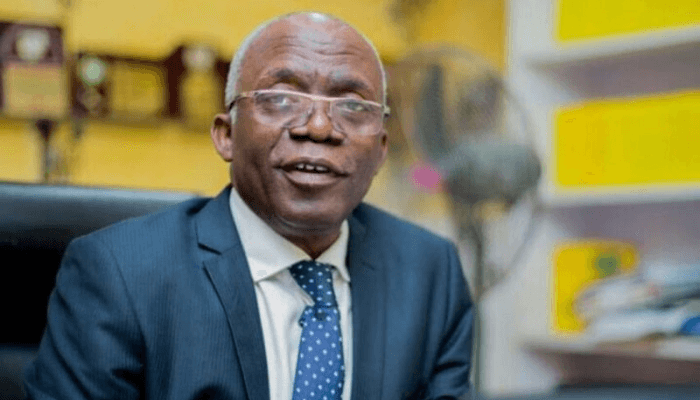
Femi Falana is a Senior Advocate of Nigeria (SAN)). In this interview, he speaks on the Supreme Court ruling affirming the constitutional power of the President to declare a state of emergency and its implication on the country’s democracy, among other issues, ANAYO EZUGWU reports
The Supreme Court in its judgment on the constitutional power of the president to declare a state of emergency in any state to prevent a breakdown of law and order or a descent into chaos and anarchy said the President can use his discretion as section 305 of the Constitution does not specify the exact nature of the extraordinary measures. What could be the implication of this judgment to the polity?
I think in fairness to the Supreme Court, the justice that delivered the leading judgment, the Hon. Justice Muhammad Idris, did send out what is regarded as summary judgment. Unfortunately, most commentators have not bothered to read the judgment. Yes, there’s no doubt that the court did say or did confirm the powers of the president to adopt extraordinary measures to restore law and order in any state where a state of emergency has been declared.
There was no doubt before now that the president could deploy forces or take other steps to restore law and order. What has always been controversial is the extent of the powers and the Supreme Court made a point that the provision of the Constitution in section 305, has not set out the extent of the powers that the president can exercise.
But in the majority judgment, Justice Idris did say that unlike the constitutions of India and Pakistan, section 305 of the Nigerian Constitution does not expressly confer power on the president to assume or temporarily displace executive or legislative institutions of a state. And his lordship went further to say that this omission, in other words, the omission to empower the president to dissolve democratic structure, is deliberate and that it reflects Nigeria’s constitutional commitment to federalism and the autonomy of state governments.
Earlier than that conclusion, the court had also heard that the three tiers of government in Nigeria, the federal government, the state government and local government, are independent autonomous tiers and that none is superior to the order. In other words, the Supreme Court was simply following its earlier decisions to the effect that governors of states cannot suspend or remove democratically elected chairmen and councilors.
In like manner, the Supreme Court has now reiterated its position that elected public officers cannot be removed, cannot be dissolved or suspended or displaced except in accordance with the provisions of the constitution. So, I would therefore urge Nigerians to study the judgment very well.
The president has enormous powers to ensure that law and order or constitutional order is restored. But that does not empower the President to remove elected governors and legislators
In fact, for the avoidance of doubt in what has been regarded as a minority judgment, Justice Obande Oguiya did not in any way prevaricate. His lordship made the point that there’s no provision of the constitution that allows or empowers the president to remove elected public officers.
What the Supreme Court did not do, and I think this was deliberate, was to pronounce on the merit or otherwise of the imposition of emergency rule in Rivers State. It might be said that it has become academic because the governor has since resumed his duties. I’m talking of Governor Fubara but the other confusing part of the judgment is where the Supreme Court challenged the locus standi of the plaintiffs that is the 11 attorneys general that filed the case.
I’m saying this is worrisome because in the case of the Attorney General of the Federation and Attorney General of Abia State and 35 states, decided in July last year, the locus standi of the Attorney General of the Federation was challenged. But the Supreme Court said no, that the Attorney General has the locus standi to file the action on behalf of the 774 local governments.
So, if that was so, I was of the opinion that the court should have been consistent and uphold the locus standi of the 11 attorneys general that filed this very historic case. But unlike 2004 and 2006, when the emergency rule was challenged in Plateau and the Ekiti states, this time around, the Supreme Court went beyond its previous position by simply saying here, since you have no locus standi, the court has no jurisdiction. But the Supreme Court went further and it’s only the Supreme Court that can do that by making policy pronouncement on Section 305 of the Constitution.
The judgment showed that the plaintiffs did not demonstrate the existence of an actionable dispute between them and the federation to warrant the exercise of the court’s original jurisdiction. You want to explain that further and what they were trying to say?
The court is trying to say that with respect to the position of emergency rule in Rivers State and the suspension of Governor Fubara and other elected officials in that state, that the action of the President or the decision of the President on Rivers State did not create a dispute between the plaintiffs, that is the 11 attorneys general and the Attorney General of the Federation. But the plaintiffs did say that any governor in Nigeria has interest and then an actionable case, with respect to what happens in Rivers State.
More so, that the Attorney General of the Federation, a few days after the declaration of emergency, did say that we have only taken care of Rivers State and we can deal with any other governor. So, that already created fear, rightly so, in the minds of the plaintiffs by saying it could be our turn, therefore, it is better to prevent the political holocaust that may occur in our states.
So, with profound respect, I do not agree with the Supreme Court that there was no dispute between the plaintiffs and the Federal Government. Certainly, there was a dispute. And then the governors do not have to wait before taking an action. They don’t have to wait for their own removal or declaration of emergency in their states before rushing to court to prevent what they regard as constitutional heresy.
If that’s the case and this is the apex court, how is the anomaly going to be corrected?
Well, when you lose a case in the Supreme Court, you simply tell your client, if he asks you, where do we go from here? You say, that is the end of the road. Appeal lies with the Almighty God. But in this particular case, what we may have to do, the Supreme Court has already provided some guide, so that when next the president of Nigeria has cause to declare a state of emergency, there shouldn’t be any controversy.
Again, as I did say, the leading judgment of the court has stated very clearly that section 305 of the Constitution does not confer power on the president to temporarily displace executive or legislative bodies in the state. And for me, that is the most important part of the judgment.
The other areas that we disagree with has to do with whether the plaintiffs have locus standi or not, whether the court has jurisdiction or not. But in spite of dismissal of the case, the court still went further to dwell, rather in extensive on the merit of the case. That will provide the guide when next the president of Nigeria would have cause to declare state of emergency. That’s the way I look at it.
This is quite mind-boggling to many because the final arbiter says he doesn’t have jurisdiction. It gives cause for a lot of concern. Could you help explain how this can be so, and has there been precedent in Nigeria or anywhere at all in the world and what were the extenuating circumstances that necessitated that precedent?
We must learn to fight when our rights are violated. In the case of Plateau State, it wasn’t the suspended governor that went to court. In the case of Ekiti State, it wasn’t the suspended governor or legislators that went to court. In the case of Rivers State, the governor and the legislators did not go to court.
So, if you agree with the anachronistic doctrine of locus standi that unless you are personally affected in an action taken by the government, you are bound to disagree. In these days of public interest litigation, any concerned member of the public must be able to challenge any constitutional derelict or violation and it’s in the interest of all of us.
The Supreme Court had moved away from the case of Abraham Adesanya and the president. That place occurred in the Second Republic. Even then, there was a minority decision by the then Chief Justice of Nigeria, the late Justice Fatai Williams, who did say that the courts must open its gates and allow aggrieved citizens to ventilate their claims.
In these days of public interest litigation, any concerned member of the public must be able to challenge any constitutional derelict or violation and it’s in the interest of all of us
And it is better to do that than to drive them underground where revolutions are made. The Supreme Court went further, in the case of Fawehinmi and Akilu, Justice Ese, put it in his own usual manner by saying that whereas in the United Kingdom, the word brother means your blood relation, in an African setting, where we have the extended family system, we are all our brother’s keepers.
Therefore, the Supreme Court has departed from the narrow path in that of trodden on locus standi by now embracing public interest litigation. The Supreme Court also reiterated that position in the case of the Centre for Air Pollution and Nigeria National Petroleum Corporation (NNPC). But recently, the Supreme Court appeared to be moving away from public interest litigation by now insisting that before you can approach the court, the injury suffered by you must be higher than that of other members of the public.
It makes a mockery of the concept of public interest litigation. Nigeria is almost the only country in the Commonwealth that is going back to embracing the very restrictive concept of locus standi. And I do hope that our courts, just like it did last year in the case of local government autonomy, by recognising the locus standi of the Attorney General, ought to have also given locus standi or recognised the locus standi of the 11 attorneys general that approached the Supreme Court on this matter.
Why in the first instance does the Supreme Court give judgments that leave room for those who brought the case to give different interpretations and how unhealthy or otherwise is this for our polity?
I think we all need to read judgments of courts, so that we can understand the reasons for the decisions of the courts. And again, as I did say in this case, as soon as the news went out that the case was dismissed; the impression was given that the Supreme Court had endorsed the suspension of elected governor and legislators.
I’ve taken my time to read the judgment over and over again. While the court recognised the far reaching powers of the president whenever a state of emergency is declared, the president has enormous power to ensure that law and order or constitutional order is restored. But that does not empower the president to remove elected governors and legislators.
That came out very clearly in the majority judgment and the minority judgment of the Supreme Court. Having agreed with that, we then move to the next thing. When a situation like this occurs, where do we go to and where do you go from here? It is to take advantage of other similar cases and I do know that there are many cases currently pending in the Supreme Court where the question of locus standi will be raised again. I mean, I’m just filing a case now.
I lost a case a couple of them on the question of locus standi. The High Court said I had locus standi to challenge the diversion of the funds that should be paid to the federation account. But the Court of Appeal said, ‘Mr. Falana, we commend your effort. However, in view of the recent decision of the Supreme Court in Fawehinmi and Okonjo-Iweala, you no longer have locus standi.’ Again, we are taking that to the Supreme Court, so that the Supreme Court will have the opportunity to review its position on locus standi in the interest of the public, in the interest of all of us
Because if you lock up the gates of the court, citizens will be compelled to take other action that may threaten the security of the state, law and order. And so that is why the question of, and I think it was the Supreme Court again, I think in the case of A.G. Bende and A.G. of the Federation that the floodgates should be opened so that the courts can perform their constitutional role in the constitution to act as arbiters in dispute between citizens and citizens, as well as citizens and government.
What do you make of the issue of justice delayed is justice denied and the fact that the elected governor, deputy, members of the Assembly were removed. How do you correct such ill?
Again, what the Supreme Court is saying is that those who are affected should pick up the courage to challenge their constitutional remover. If it had occurred in Lagos, when President Bola Tinubu was governor, he certainly would have gone to court. If you look at all the actions filed by the Lagos State government against the Federal Government and cases instigated by the Lagos State government against the federal government, they were all meant to strengthen the democratic process.
In fact, I can say without any fear of contradictions that for some of those cases, state governments might even have been declared bankrupt because those cases that were won by the Lagos State government had defined constitutionalism in Nigeria, whether state governments can create local governments, whether state governments can approve building plans in their states, and so on and so forth.
The Federal Government was totally in control of the affairs of our country because we were moving from a unitary system of government under the military junta to a civilian dispensation. But the Lagos State government mobilized all the states to challenge the Federal Government to extend the tenure of chairmen of local government, to conduct local government elections. Others were creation of local governments, seizure of local government funds, control of physical planning in the states, and so on and so forth.
And those cases are redefined. In fact, I say those cases promoted restructuring by litigation. Other states have also followed suit and that is how we have been able to resolve a lot of disputes caused by the military structure because the constitution we have is a unitary constitution. But through cases filed by state governments and some concerned individuals, we have been able to redefine federalism and be able to execute federalism from the unitary structure in Abuja.