


The Centre for Energy Governance and Public Finance Accountability has strongly rebutted claims by the African Democratic Congress (ADC) regarding President Bola Ahmed Tinubu’s approval for reconciling and removing legacy balances owed by the Nigerian National Petroleum Company Limited (NNPC Ltd) from the Federation Account.
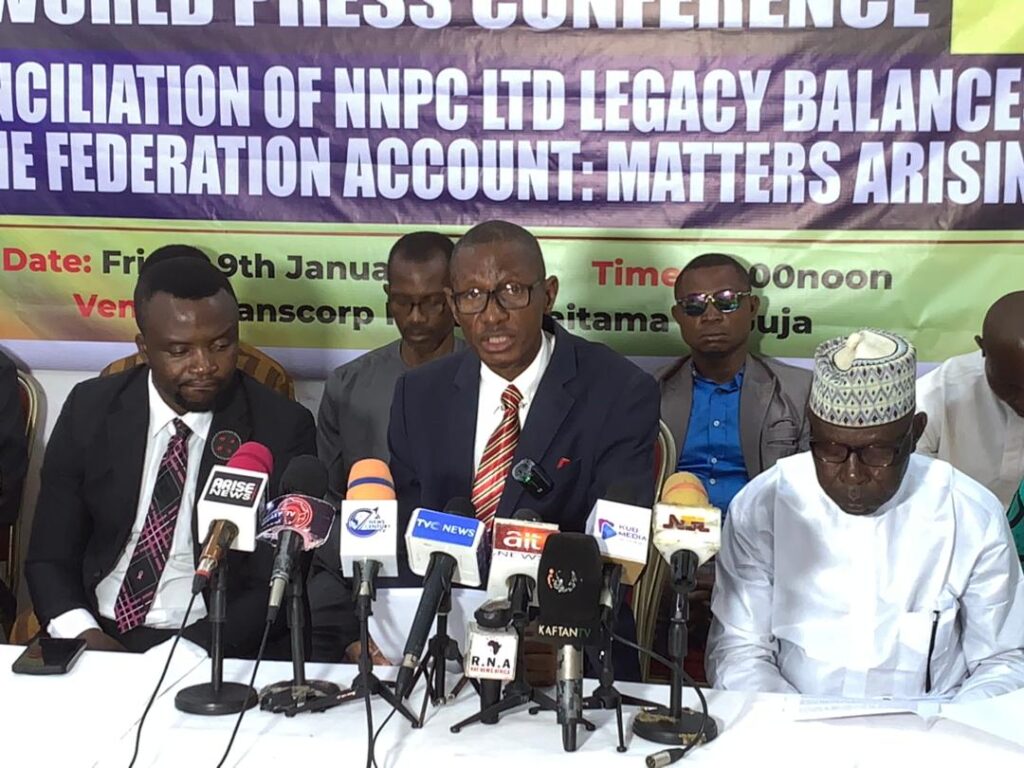
During a press conference held at Transcorp Hilton in Abuja on Friday, the group described the ADC’s allegations as unfounded and misleading, emphasising that the action was not an arbitrary debt forgiveness but a necessary fiscal reconciliation.
The controversy stems from the President’s directive to remove approximately $1.42 billion and N5.57 trillion in legacy entries from the Federation Account books.
These balances, accumulated over decades, include unresolved disputes from production sharing contracts, fuel subsidy obligations, and royalty assessments predating the Petroleum Industry Act (PIA).
The Centre argued that maintaining these disputed figures distorted public finances and created unrealistic expectations for revenue distribution among federal, state, and local governments.
Official records indicate that the reconciliation involved key institutions, including the Federation Account Allocation Committee (FAAC), and focused solely on balances up to December 31, 2024.
In his address, Executive Director Dr Opialu Fabian stressed that no actual cash was withdrawn from allocations, as these were not collectible revenues but accounting distortions that had persisted despite multiple audits.
“The Centre for Energy Governance and Public Finance Accountability has convened this important press conference to respond to unfounded claims by the African Democratic Congress (ADC) concerning President Bola Ahmed Tinubu’s approval of the reconciliation and removal of certain legacy balances attributed to the Nigerian National Petroleum Company Limited (NNPC Ltd) from the Federation Account,” the statement said.
“The debate has been framed as a constitutional crisis and a deliberate deprivation of revenue due to states and local governments. Given the gravity of such allegations, it is important to ground this conversation in facts, law, and the historical context of Nigeria’s petroleum revenue administration.
“It is crucial to note that the balances in question are not recent revenues generated under the current administration. They are long-standing legacy entries accumulated over decades, many of them arising before the enactment of the Petroleum Industry Act (PIA).
“These entries stem from unresolved production sharing contract disputes, domestic crude supply obligations under the fuel subsidy regime, royalty assessment disagreements, and persistent reconciliation gaps between NNPC, regulators, and revenue agencies.”
Critics, including the ADC, have invoked Section 162 of the Nigerian Constitution, claiming the President overstepped his authority by approving the removal without broader legislative input.
However, the Centre countered that the section pertains only to valid, payable revenues, not disputed or unverifiable claims that could turn the Federation Account into a “repository for accounting fiction.”
This move aligns with PIA reforms aimed at transforming NNPC Ltd into a commercially viable entity under international accounting standards. By addressing these legacy issues, the administration seeks to enhance fiscal transparency and predictability, benefiting all government tiers through more accurate revenue projections.
“For years, these balances remained on the Federation Account books despite repeated audits and reviews that questioned their accuracy, legal enforceability, and collectability. Treating such disputed figures as assured income created a distorted picture of public finances and fostered unrealistic revenue expectations across all tiers of government,” Fabian added.
“Contrary to claims of an arbitrary executive write-off, the President’s approval followed a formal reconciliation process involving relevant fiscal and regulatory institutions, including presentations made to the Federation Account Allocation Committee (FAAC).
“Official records show that approximately $1.42 billion and N5.57 trillion were removed from the Federation Account books after reconciliation established that these figures were either duplicated, overstated, unsupported by verifiable documentation, or no longer legally recoverable. The directive applied strictly to legacy balances accumulated up to December 31, 2024.”