The Nigeria Labour Congress has rejected the Federal Government’s proposed N6tn bailout for power generation companies, describing it as a short-term measure that fails to address Nigeria’s chronic energy crisis.
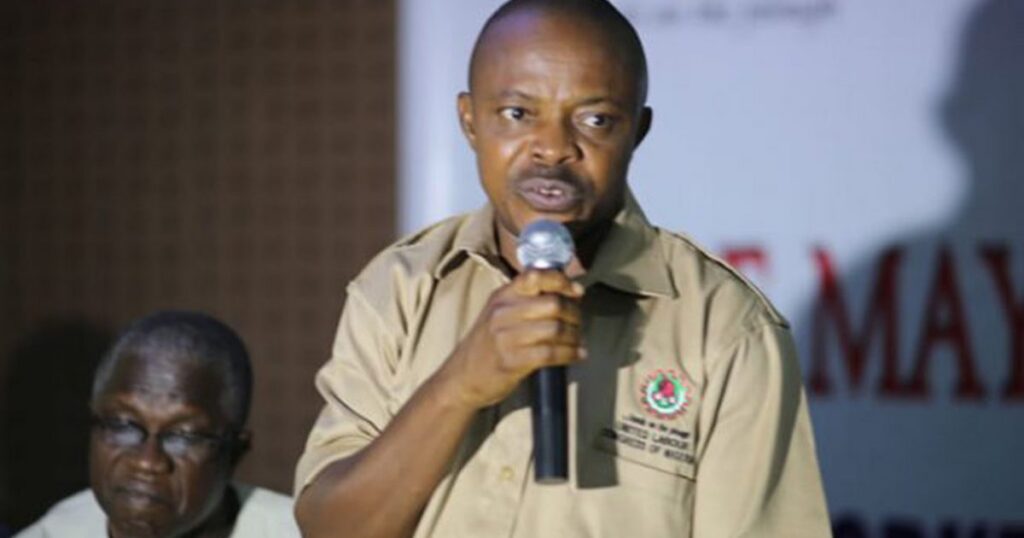
The country’s biggest labour union President, Joe Ajaero, said the nation’s power sector has become a perpetual millstone around the necks of Nigerian workers, manufacturers, and the masses, blaming ruling elites and their allies in the electricity distribution and generation companies for profiteering through phantom subsidy claims and outrageous tariff hikes while ordinary Nigerians are left to “pay for darkness.”
The labour union described the bailout as merely a symptom of a deeper structural rot and called for a radical intervention, the merger of the Federal Ministry of Petroleum and the Federal Ministry of Power into a single Ministry of Energy. According to the NLC, such a merger would break the existing silos, ensure accountability, and prioritise domestic electricity supply over private profit.
“The NLC, therefore, calls on the Federal Government to; initiate the process of merging the Ministry of Petroleum and the Ministry of Power into a single Ministry
of Energy; once again, halt the proposed N6tn bailout to the GenCos.
“Our commonwealth cannot be used to settle a cartel of failed investors; convene a genuine National Stakeholders’ Summit to draft a People’s Power Roadmap that prioritises public ownership, energy security, and the welfare of Nigerian workers and masses,” the union stated in its statement.
Nigeria has faced severe power shortages in recent weeks, though not a total nationwide blackout. Instead, the crisis involves frequent grid collapses, plant shutdowns, and low generation capacity, resulting in erratic electricity supply across many regions.
Up to 16 of Nigeria’s 33 power plants went offline around mid-March 2026 due to gas supply cuts stemming from unpaid debts exceeding N3tn to suppliers. Output dropped to 3,700–4,000 megawatts from recent levels of 4,000–5,500 MW, far below the 13,000+ MW installed capacity. GenCos cite N6.5tn in cumulative debts as crippling operations, worsening the cycle.
“For too long, these two critical ministries have operated in silos, serving the interests of separate factions of the bourgeoisie while the productive base of our economy collapses,” the union said.
“The nation’s thermal power generation, which accounts for the bulk of our grid capacity, is held hostage by gas supply gaps. This gas is controlled by an industry, the petroleum sector, that operates like a rent-seeking enclave with no accountability to the people’s need for electricity.”
The NLC criticised the government for treating gas as a commodity for export to generate foreign exchange for elites, while the Power Ministry struggles to secure feedstock to keep the lights on. The union said the Petroleum Ministry prioritises the profits of international oil companies and local moguls, leaving the Power Ministry to explain why the grid collapses due to empty or vandalised gas pipelines or reliance on imported diesel and generators.
The labour body argued that a unified Ministry of Energy would ensure one minister is accountable for both petroleum extraction and electricity generation, ending the era where ministers blame each other or cite market forces and global volatility.
It said such a merger would allow holistic energy planning, prioritise gas for domestic power, and create jobs through industrialisation.
Ajaero said a unified ministry would also facilitate fair electricity pricing by ending the “cost-reflective” model that forces Nigerians to pay for inefficiency and greed, instead introducing service-reflective tariffs tied to actual service delivery.
The union cited the Dangote-NUPENG dispute as an example of monopoly influence in downstream petroleum and energy pricing, warning that private interests continue to dominate the sector.
“Electricity is a social service and a fundamental right, not a luxury commodity to be traded on the various capitalists’ markets,” the NLC said. “The failed privatisation experiment of 2013 has proven that the private sector cannot, and will not, solve Nigeria’s power crisis.”
The N6tn bailout relates to claims by GenCos for unpaid debts from the federal government, arising from electricity subsidies and invoices processed through the Nigerian Bulk Electricity Trading Plc since 2010. Monthly invoices for power supplied to the national grid average N280bn, but payments have often covered only around 65 per cent of the amount billed.
The GenCos argue that these unpaid debts threaten electricity supply reliability. Critics, including the NLC, say the claims are excessive and unjustified, noting that the power sector was privatised in 2013 for N400bn, yet generation capacity remains below pre-privatisation levels.
Last year, President Bola Tinubu approved N2.8tn in verified payments after a tripartite audit reduced the N6tn claim by more than half, rejecting unverified portions. This includes N501bn already disbursed via bonds under the Presidential Power Sector Debt Reduction Programme, with funds tied to clearing gas debts and infrastructure upgrades.
The NLC urged the government to halt the proposed bailout, initiate the merger of the ministries, and convene a national stakeholders’ summit to draft a “People’s Power Roadmap” that prioritises public ownership, energy security, and the welfare of Nigerian workers and citizens.
“The working class and the people of Nigeria cannot continue to be hostages to the artificial scarcity created by the decapitation of our national resources,” Ajaero said. “It is time to unite the ministries, unify the vision, and take back the power sector for our nation.”