
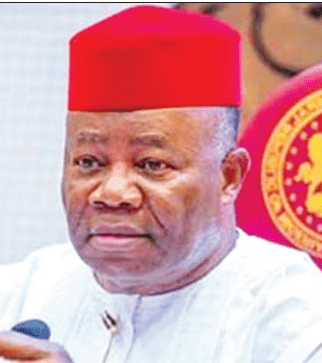
Senate President, Godswill Akpabio, has reacted to the widespread criticism against the National Assembly over it cooperation with the executive, arguing that collaboration with arms of government, not confrontation is essential for national progress.
Akpabio made this remark after President Bola Tinubu presented the 2026 Appropriation Bill to a joint sitting of the National Assembly.
While giving his welcome address, Akpabio noted that the widespread scepticism about the legislature’s posture, but insisted that nations progresses when institutions work in synergy under the Constitution.
“Many in our country view the patriotic collaborative work between the National Assembly and the Executive arm as a sell-out by the parliament.
“But history is unambiguous on one enduring lesson: nations advance when the Executive and the Legislature work in concert, and they falter when the two become locked in hostility,” he said.
READ ALSO:
Speaking to lawmakers, diplomats, and senior government officials, Akpabio described the 2026 budget presentation as a defining moment in Nigeria’s reform journey, warning that prolonged executive–legislative rivalry has historically undermined governance across civilisations.
“It is pertinent to note that history has often distilled its lessons into simple truths. One of them is this: great nations are not built by perfect conditions, but by leaders who make hard choices together,” he added.
He made reference to the decline of the Roman Republic to budgetary standoffs in the United States to illustrate the costs of institutional conflict.
“Across history and continents, the pattern remains consistent: when the organs of state treat each other as adversaries, the nation pays the price. But when they act as partners under the Constitution, stability deepens, reforms take root, and progress becomes possible,” he said.
The Senate President further framed the national budgets as mirrors of a country’s values and priorities, adding that the 2026 Appropriation Bill should be viewed beyond numbers.
“Budgets tell a story. Show me a nation’s budget, and I will tell you its priorities, its fears, and its hopes.
“The 2026 Appropriation Bill you are about to present is, therefore, far more than a compilation of figures. It should be a statement of intent—a reflection of priorities, a record of difficult choices, and a roadmap for the next phase of Nigeria’s national renewal,” he said.
Relating the budget against Nigeria’s current realities, the Senate President acknowledged pressures on households and businesses, the anxieties of young people, and persistent insecurity across parts of the country.
“Families have felt the strain of rising costs. Businesses have adjusted to a changing economic environment. Insecurity has tested our collective resolve and reminded us that peace is not a gift we inherit, but a responsibility we must constantly defend,” he added.
Still, he struck an optimistic tone, insisting that Nigeria’s history is defined by resilience rather than retreat.
He said, “Yet history teaches us something enduring: Nigeria does not retreat in the face of difficulty—we confront it… From one generation to the next, this nation has survived storms not by surrendering to despair, but by standing together, reforming what must be reformed, and renewing our commitment to justice, inclusivity, and progress.”
He further endorsed the reform trajectory of the Tinubu administration, particularly the 2025 budget, which he said required political courage to tackle long-delayed structural weaknesses.
According to him, the reforms are beginning to yield results.
“As a result, we are now witnesses to measurable gains. Government revenues are improving. Public finance is being managed with greater discipline and transparency… Nigeria is regaining confidence—within its borders and in the eyes of the international community,” he said.
Highlighting the role of the 10th Senate, Akpabio said the upper chamber had recorded one of the highest legislative outputs in Nigeria’s history over the past year, passing bills across security, economic reform, governance, judicial administration, elections, infrastructure, and social protection.
However, he cautioned that legislative success must translate into improved living conditions for citizens, noting that insecurity and unemployment remain pressing challenges.
Akpabio also commended Tinubu for Nigeria’s swift response to threats against democracy in the Republic of Benin.
In closing, the Senate President employed the metaphor of the baobab tree to underscore the long-term nature of reform and budgeting, urging unity of purpose between institutions.