


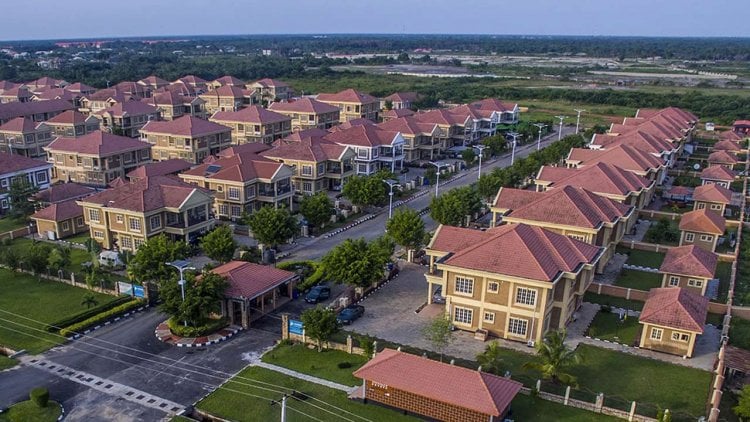
Stakeholders in the real estate sector have opined that rising inflation and worsening housing affordability in 2025 significantly undermined investment, construction activity, and demand across Nigeria’s real estate sector.
In an exclusive interview, the Chief Executive Officer of McYouniverse Group, Michael Egbekoya, said the average national housing prices rose by an estimated 15 per cent to 25 per cent year-on-year.
According to the developer, prime locations (Ikoyi, Victoria Island, Maitama, and Banana Island) saw higher increases, while peri-urban and emerging areas recorded moderate growth.
He said, “There was no widespread price crash, but affordability pressure intensified. Importantly, the increase was not purely demand-driven; it was largely cost-push inflation. Prices went up in luxury residential properties and short-let and serviced apartments and commercial real estate in prime business districts. In this area, the prices rose by 25 per cent to 40 per cent, and this was as a result of high demand from expatriates and diaspora buyers and short-let profitability (especially in Lagos and Abuja). In low-income residential estates, prices didn’t skyrocket.
“Regarding affordable housing, it remained severely inadequate. Most developments labelled ‘affordable’ were only affordable to upper-middle-income earners. Entry-level home prices in many cities still exceeded five to seven times average annual income, far above global affordability benchmarks. Government-led affordable housing schemes existed but did not meet scale demand. Affordable housing existed in concept, not in sufficient volume.”
While addressing the rental market, the McYouniverse boss asserted that rental prices increased sharply in 2025, often faster than property sale prices.
He continued, “Estimated rental growth: 20 per cent to 35 per cent in major cities; 30 per cent to 45 per cent in high-demand urban neighbourhoods. This was as a result of high homeownership barriers, migration into cities, increased construction costs passed on to tenants, and short-let conversions reducing long-term rental supply.
“Construction material costs were one of the biggest pressure points in 2025. Estimated increases: Cement: 20 per cent to 30 per cent; Steel and reinforcement bars: 25 per cent to 40 per cent; Finishing materials (tiles, fittings): 30 per cent, especially imported items; Labour costs: 15 per cent to 20 per cent. Exchange rate depreciation, energy and transportation costs, import dependency, and supply chain inefficiencies were factors responsible for the hike in construction materials. These factors also contributed to delayed projects and reduced developer margins.
“Nigeria’s housing prices in 2025 did not collapse, but neither were they driven by speculative excess. Instead, price increases were largely inflation-led, reflecting rising construction costs, currency pressures, and structural supply shortages, while real affordability continued to deteriorate for the average Nigerian.”
In a similar vein, an estate surveyor, Olorunyomi Alatise, said the Nigerian housing sector in 2025 experienced a continued severe imbalance between the interplay of the forces of demand and supply, with affordability becoming the central issue plaguing the sector.
He said, “Due to rapid population growth, urbanisation and the strong youthful demographic, housing demand has been on the increase, especially in major cities like Lagos, Abuja, Port Harcourt and Kano, as more than half of Nigerians now live in urban areas, thereby mounting pressure on the limited housing supply.
“Also, for cities like Lagos, the year witnessed the proposition of some laws, such as the Lagos Tenancy Law, which is aimed at bringing sanity to how real estate is transacted in Lagos. If laws like this are fully enforced, and other categories of government follow this path, we could experience some sanity in the way real estate is transacted. If not, the status quo remains.”
Meanwhile, the treasurer of the Nigerian Society of Engineers, Victoria Island Branch, Babatunji Adegoke, said in 2025 Nigeria’s housing sector continued to struggle significantly against an already well-documented housing deficit.
He said, “Demand consistently outpaced supply, driven by rapid urbanisation, population growth, rising construction costs, and limited access to affordable finance. While there were pockets of private sector activity, these interventions were insufficient to meaningfully close the gap, particularly in the affordable and social housing segments. Looking ahead to 2026, several trends are likely to shape the sector. Housing units are expected to become more compact, as larger living spaces increasingly become a luxury for a smaller segment of the population. We will also see increased development in emerging and peri-urban locations, as infrastructure expansion improves access to previously underserved areas and affordability pressures push households away from major city centres.
“Importantly, housing prices are unlikely to decline. The rising cost of construction materials, energy, and financing continues to exert upward pressure on development costs. The new tax policy is also set to impact construction costs, as higher taxes on building materials are expected to increase development expenses further. Unless there is deliberate policy intervention, particularly around infrastructure provision, alternative building materials, and housing finance, affordability will remain a major challenge in 2026.
“In 2025, rising construction costs, including cement, steel, energy, and new taxes, pushed housing further out of reach for most Nigerians. With household incomes lagging behind these increases, low- and middle-income families struggled to afford decent accommodation, highlighting the urgent need for policy and financing interventions to improve accessibility.”