
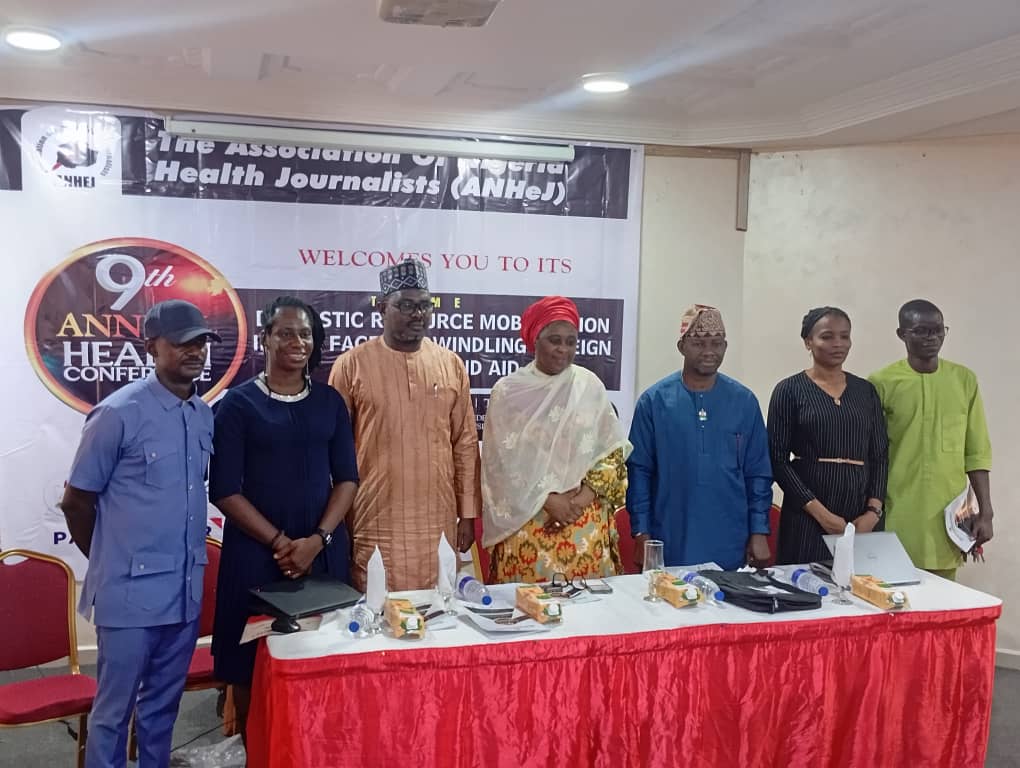
The Special Adviser to the President on Health, Dr Salma Anas, has warned that donor fatigue was already affecting essential interventions and could jeopardise progress toward Universal Health Coverage UHC), if the country fails to take ownership of its health system.
Dr Anas, who spoke at the 9th Annual Health Conference organised by the Association of Nigerian Health Journalists (ANHEJ) on Friday in Abuja, themed, Domestic Resource Mobilisation In The Face of Dwindling Foreign Grants and Aid,” insisted that Nigeria must urgently shift away from dependence on foreign donors toward sustainable domestic financing.
Describing the media as vital partners in driving public awareness and accountability for health reforms, she urged stronger collaboration to promote policies that prioritise sustainable funding, noting that Nigeria must strengthen its capacity to independently finance quality healthcare for all citizens.
According to her, global funding priorities have changed, leaving Nigeria exposed and forcing the country to confront a fundamental truth about the fragility of its donor-dependent system.
She said: “For decades, development partners have been indispensable allies in our fight against infectious diseases, maternal mortality and child survival; however, the global landscape is changing, donor fatigue is real, and there is no more speculation.”
Dr Anas noted that while donor-funded programmes, particularly HIV, immunisation and maternal health, have saved millions of lives, several partners have scaled down or exited.
The consequence, she said, is a dangerous financing imbalance that leaves Nigerians vulnerable the moment external support declines.
“It’s like we are planning on resources we don’t own..You can’t plan on someone’s resources and be comfortable that they will always be there. When these funding schemes close, the system breaks down, and vulnerable communities suffer.”
Dr Anas lamented that more than 70% of total health expenditure in Nigeria comes from out-of-pocket payments, pushing millions into poverty every year.
“A significant portion of the remaining funding comes from foreign grants, another signal, she said, that the country must “take ownership” of its health destiny.
She added that over the last three years, health allocations have increased marginally but remain “fundamentally insufficient” to meet national needs.
According to her, President Bola Ahmed Tinubu’s Renewed Hope Health Agenda places domestic resource mobilisation at the core of reforms aimed at building a resilient, equitable and integrated health system.
“Our mission is clear,.to build a resilient, equitable and integrated health system. The cornerstone of this mission is domestic resource mobilisation.
‘”We must turn this necessity into our great opportunity for self-reliance.”
Dr Anas commended the National Assembly for proposing an increase in the Basic Health Care Provision Fund (BHCPF) from 1% to 2% of the Consolidated Revenue Fund, describing it as a potential game changer saying, “When it happens, it will instantly double resources for our poorest citizens.”
She also announced ongoing reforms including the strengthening of BHCPF accountability under BHCPF 2.0, expansion of health insurance.with nearly 20 million Nigerians now enrolled, and policy measures to curb waste and improve efficiency.
Sugar tax, local production, and medical tourism reforms
The presidential aide confirmed intensified efforts to scale up the sugar-sweetened beverages tax in line with WHO recommendations of up to 50%, emphasising that the levy should be earmarked strictly for health.
“The link between sugar consumption and non-communicable diseases is clear: diabetes, hypertension, stroke, and cardiac arrest. Increasing the tax will save lives and generate much-needed health funding.”
She highlighted ongoing investments in local production of medicines, vaccines and consumables, noting that each factory commissioned saves Nigeria foreign exchange and strengthens self-sufficiency.
On medical tourism, Dr Anas said improved private and public facilities are beginning to attract foreigners, saying, “In Abuja, facilities like Nisa Premier and Nizamiye are already attracting patients from outside Nigeria. Much more is happening in Lagos and Sokoto.”
While outlining federal reforms, the adviser to the President stressed that real progress depends on state governments, which shoulder responsibility for primary and secondary healthcare.
“Each state must allocate at least 15% of its budget to health..The federal government cannot implement alone. The real delivery of healthcare happens in the states.”
She further urged states to scale up their own health insurance schemes, complement BHCPF allocations, and deploy innovative financing tools.
Dr. Anas charged journalists to partner with the government in driving public awareness, supporting legislative reforms, and championing domestic resource mobilisation
“You are not just reporters you are critical analysts for the health sector. You are custodians of accountability. Use your platforms to track the money, demand utilisation reports, educate citizens and hold government accountable at federal, state and local levels.”