



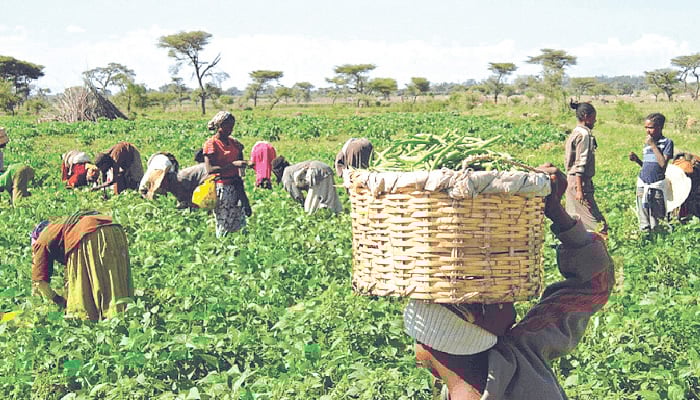
Nigeria’s agriculture sector recorded a turnover of N101.46tn in 2025, up from N96.46tn in 2024, as annual real growth rose to 2.92 per cent from 1.69 per cent, based on an improved investment drive, The PUNCH reports.
The National Bureau of Statistics’ Gross Domestic Product figures for the full year 2025 showed a 5.18 per cent increase in the sector’s nominal contribution to GDP year-on-year, reflecting what stakeholders believe is driven by renewed investor interest amid favourable government policies, including importation waivers.
A breakdown of the 2025 performance showed that crop production led the sector with N64.41tn, livestock contributed N25.66tn, forestry generated N6.47tn, while fishing accounted for N4.92tn, bringing total turnover to N101.46tn.
In 2024, crop production stood at N61.92tn, livestock at N24.80tn, forestry at N5.28tn, and fishing at N4.46tn, with the sector posting a total turnover of N96.46tn.
The sector grew by 4.00 per cent year-on-year in real terms in the fourth quarter of 2025, higher than the 2.54 per cent recorded in the corresponding period of 2024, and contributed 27.55 per cent to aggregate GDP for the year.
In a phone interview with The PUNCH, Chairman of the Lagos Chamber of Commerce and Industry’s Agriculture and Allied Group, Tunde Banjoko, attributed the improved performance largely to private sector investments and policy signals that boosted confidence.
He said, “We can attribute this growth to the investments in agriculture from the private sector in recent times. We’ve seen a lot going into processing, palm plantation, cocoa plantation, and cocoa processing. There is a bit of confidence in some of the policies of the government, and the importation waivers that ran through 2024 and into 2025 also contributed to all that. The growth was largely driven by the private sector and maybe some foreign portfolio investments into agriculture.”
But Banjoko warned that the importation policies created mixed outcomes for local farmers, stating, “We didn’t balance it because some of those policies did not favour local farmers. Most of the importation done last year crashed food prices in the local markets.
“While importation favoured those who supplied to factories at good rates, local farmers didn’t benefit, and many were discouraged from producing.”
He added that the government must now shift focus to protecting local producers while sustaining investor confidence.
He counselled, “We have to make policies that favour local production. We should consider programmes like a competitive board structure where farmers know how much they will sell a ton of maize at harvest at a guaranteed benchmark price.
Even if the government decides to import, local farmers should still be able to sell at agreed prices. We should balance it while bringing in investors and ensuring stable local production and processes.”
Similarly, in a February policy brief, Director of the Centre for the Promotion of Private Enterprise, Dr Muda Yusuf, maintained that the Federal Government’s food security strategy had produced unintended consequences despite easing food inflation.
He said, “The Federal Government’s recent food security strategy has produced troubling trade-offs and unintended consequences. While consumers have applauded the sharp decline in food prices and the moderation in food inflation, investors and producers in the agricultural sector are lamenting heavy losses arising from the collapse in prices of key commodities.”
Yusuf stressed the need to balance affordability with farmer protection. The CPPE director said, “There is an urgent need to strike a sustainable balance between keeping food affordable for consumers and protecting farmers’ incomes and safeguarding investment in agriculture. Nigeria cannot afford a policy regime that undermines confidence and discourages investment in one of the most strategic sectors of the economy.”
He warned that recent import surges in staples such as rice, maize, and soybeans caused serious dislocations.
Yusuf added, “Recent import surges of food crops have inflicted severe hardship on farmers, weakened incentives to produce, and undermined Nigeria’s broader food security objectives. Although consumers have welcomed the decline in food prices, the long-term consequences are adverse because farmer incomes fall, production declines, and investment confidence weakens.”
The economist called for a rules-based Farm Price Stabilisation and Farmer Income Protection Framework to prevent import-induced price crashes, protect livelihoods, and strengthen value chains.
These analysts maintained that the 2025 figures highlight agriculture’s resilience and its central role in the economy. They warned that sustaining the growth trajectory will depend on policy recalibration that supports both consumers and producers.