
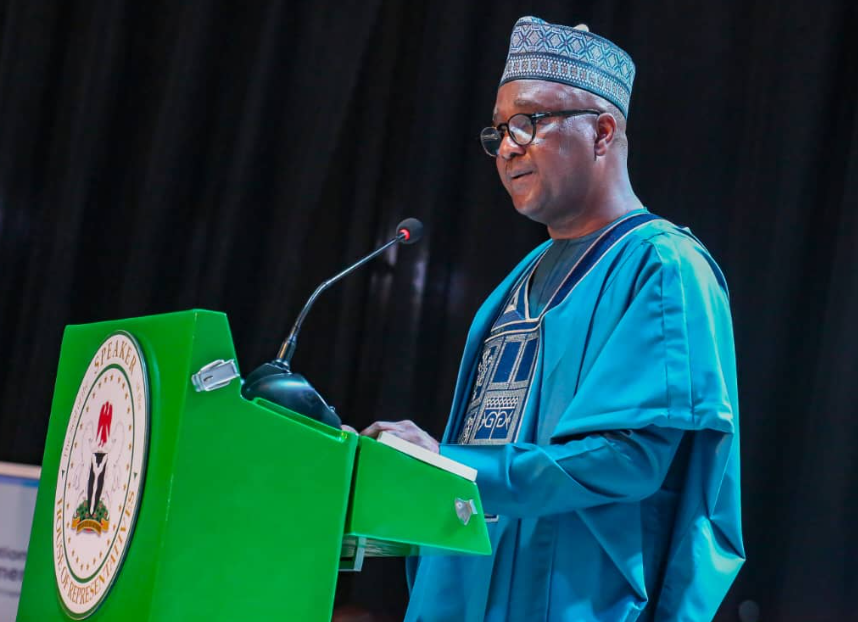
The Speaker of the House of Representatives, Abbas Tajudeen, has said that the National Assembly is committed to continuous tax reforms as a strategic tool to support Nigeria’s energy transition and climate responsibility.
He said this on Monday at the one-day policy dialogue with legislators on taxation for a fossil fuel phase-out, held in Lagos.
The PUNCH reports that at COP26, Nigeria announced its commitment to carbon neutrality by 2060. An Energy Transition Plan was unveiled shortly after to achieve the goal whilst also meeting the nation’s energy needs.
Abbas, represented by the Chairman of the House Committee on Media and Public Affairs, Akin Rotimi, said, “Energy transition remains a priority that cannot be deferred. Nigeria stands among the nations highly vulnerable to climate change. Desertification, flooding, oil pollution, erosion, and biodiversity loss continue to pressure our environment, our food systems, and our livelihoods. The legislative agenda of the People’s House affirms that climate responsibility and economic stability must advance together.
“Agenda 8 on climate change and environmental sustainability underscores this commitment. The House is focused on strengthening the NSW Act. It is also enforcing compliance with the Climate Change Act of 2021 and reviewing the National Climate Change Policy and Response Strategy.
The House works to speed up renewable energy adoption, address gas flaring, and support the restoration of communities damaged by industry. The House is also committed to understanding the implementation of Nigeria’s Energy Transition Plan, developed after COP26.”
He highlighted the central role of fiscal policy in achieving the energy transition: “As the nation works towards a cleaner and more resilient energy future, fiscal policy sits at the centre of this transition. The House of Representatives recognises that tax legislation can direct investments, encourage innovation, and discourage environmentally harmful practices. We can also support the expansion of renewable energy, widen access to clean technologies, and ensure that the costs and benefits of the transition are shared equitably among all stakeholders. The House of Representatives remains committed to examining how fiscal tools can strengthen coherence, close policy gaps, and advance low-carbon development. Our responsibility is to provide the legal and oversight frameworks that support national goals while ensuring that no community or economic sector is left behind. We also recognise that millions of Nigerians depend on traditional energy value chains for their livelihoods. The shift to cleaner alternatives must therefore protect the vulnerable and create new opportunities for jobs and industrial growth. The progress being made on Nigeria’s tax reform agenda, led by the Executive and largely supported by the Legislature, deserves recognition. The tax reforms enacted in this Assembly reflect a significant shift in Nigeria’s governance framework. These reforms are not limited to technical adjustments. They promote a more efficient, transparent, and investment-friendly tax environment that supports growth, equity, and long-term stability.”
He added, “The National Assembly also recognises that no law, including tax law, is static. Our responsibility is to continually refine and strengthen our tax framework in response to changing realities as Nigeria navigates the global energy transition and fiscal policy becomes even more strategic. Distinguished ladies and gentlemen, we appreciate the leadership of CISLAC and the broader civil society for sustaining this conversation. Your work ensures that evidence-based ideas inform legislation and that public policy remains connected to citizen priorities. The House values this partnership and will continue to draw from your expertise, research, and insights.”
In his comments, the Chairman of the House Committee on Foreign Affairs, Oluwole Oke, commended civil society for its continued advocacy: “So I must commence first with commendation of CISLAC and its partners for consistently and permanently encouraging the commitments of the co-ordinates that are the most critical on issues that border on good governance, sustainability, and the future of our world. In Nigeria, we see increased mining of coal, which has come with significant environmental and infrastructural breakdown. Generally, there seems to be a resurgence in the world’s reliance on fossil fuels. We, therefore, must deliberate on these issues and come up with a strategy on where we want to stand as a country, as a people and as a parliament. Overall, we must not lose sight of the fact that we need to preserve the planet, because it is the only habitat we have and the only place for generations of people to live and thrive.”
Opening the dialogue, Executive Director of CISLAC, Auwal Musa (Rafsanjani), called the attention of the lawmakers to the activities of companies, saying, “We know that fiscal policy, especially tax incentives, is one of the most powerful levers governments can use to shape economic behaviour around the world. Countries have developed incentives to accelerate renewable energy, stimulate green industries and encourage divestment from fossil fuels. Nigeria must not be left behind. CISLAC has also conducted a study that assesses taxes, such as incentives and holidays, in the country.
“However, incentives are fully effective only when they are well designed, transparently administered, and closely overseen, and this is where the National Assembly has a vital role to play. So, the lawmaking, which they have been doing, the oversight, the budget, and the appropriation – and through these, we make progress. We believe that the legislature effectively helps address these challenges that we see. Actually, the tax incentives that have been given without any proper framework, we’ve had companies just register and get tax incentives or tax holidays; after the expiration period, they change the name and apply again, and they get another one. In other words, the country is losing while the companies are making more money.”
On legal reforms, he said, “As you know, lawmaking is not static. It’s dynamic. If there are gaps in any law that has been passed, it can be addressed. So, it’s not a problem, as long as there’s justification for them to review whatever law has been passed. That is why we in civil society, in CISLAC, are always working with the legislators, because we cannot change anything. It is their responsibility. So that’s why you see we bring all the relevant committees in the assembly.”
Director of Policy Planning and Strategy at NEITI, Dr Bassi Dieter, said that Nigeria walked a tightrope between energy security and energy poverty. “We need to look at our energy security and our energy poverty. These are critical things to balance out. But we also have an opportunity in energy transition based on rare earth elements, lithium and rare earth minerals. For developing a new economy around those, but we need to do it smartly. We don’t need to export our minerals raw; we need to do it in-country. Have a refining capacity in-country. Develop our value chain for this sector. Having EVs, develop batteries in-country. We need to retool our industries to be able to adapt to the dynamics of the change coming into play now. We don’t have to reinvent the wheel, but we can be able to see how we can diversify. Having local content development in those aspects. How can we transform technology for these critical stakeholders, especially those in the sector?” he said.
On the country’s ability to meet its net zero target, Dieter said, “It is attainable. I wouldn’t say it’s not attainable. The good thing is that we can do a reassessment anytime we have a conflict. But we’ve set a target. Indices are there. What we need to do is have effective governance. The government needs to commit to those indices. The government needs to finance those indices. And as a country, like you said, how do we achieve those indices if we don’t have proper funding in the sector? We have an opportunity to get external funding. And we have funding options. And also, the area of green bonding. This is something that is critical.”