
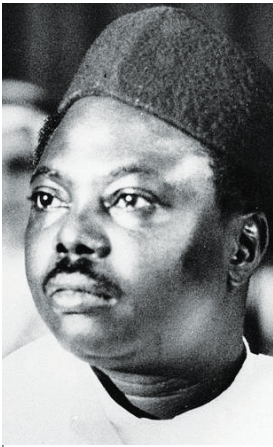
Fifty years after his death, the legacy of General Murtala Ramat Mohammed remains deeply etched in Nigeria’s political history as one of the country’s most influential, and shortest-serving, military leaders.
General Mohammed, who became Nigeria’s Head of State in July 1975 following a bloodless military coup that ousted General Yakubu Gowon, was assassinated on February 13, 1976, during an abortive coup attempt in Lagos. Mohammed’s rise to power came at a time when Nigeria was grappling with post-civil war reconstruction, economic management, and questions about the future of military rule.
Within a short period, he gained a reputation for decisive leadership and a no-nonsense approach to governance. His administration initiated reforms in the civil service, anti-corruption efforts, and a transition programme intended to return the country to civilian rule.
Though he ruled for barely seven months, Mohammed’s bold style and populist posture endeared him to many Nigerians, earning him a lasting image as a leader determined to reset the nation’s direction. But sadly, on the morning of February 13, 1976, Mohammed was killed in Lagos when soldiers led by Lt. Col. Buka Suka Dimka attempted to overthrow his government. The coup ultimately failed, but it resulted in the death of the Head of State and several others.
Following the failed coup, the military swiftly regained control, and the then Chief of Staff, Supreme Headquarters, Lt. Gen. Olusegun Obasanjo, succeeded Mohammed as Nigeria’s Head of State. Half a century later, Murtala Mohammed is still remembered for his firm leadership, nationalist rhetoric, and commitment to restructuring governance.
His administration is often credited with setting the tone for reforms that later shaped Nigeria’s transition to civilian rule in 1979. Several national monuments and institutions, most notably the Murtala Muhammed International Airport in Lagos, continue to bear his name, reflecting the enduring respect for his role in Nigeria’s political evolution. Fifty years after his assassination, the legacy of General Murtala Ramat Mohammed remains one of the most powerful and enduring in Nigeria’s political history.
Though his tenure as Head of State lasted barely seven months, his leadership style, reformist zeal, and nationalist vision left an indelible mark on the nation. Mohammed is widely remembered for his boldness and decisiveness at a time when Nigeria was in urgent need of direction. Upon assuming office in July 1975, he moved swiftly to restore discipline and confidence in governance.
His famous broadcast to the nation signaled a clear break from the past, emphasising accountability, efficiency, and service to the people. One of his most enduring contributions was the purge and reform of the civil service.
Though controversial, the ex- ercise was aimed at sanitising public institutions and improving efficiency. It reinforced the principle that public office is a trust, not a privilege—an idea that continues to resonate in discussions about good governance today. Mohammed also set Nigeria firmly on the path to civilian rule.
His administration initiated a clear transition programme, laying the groundwork for the handover to a democratically elected govern- ment in 1979. This commitment to returning power to civilians distinguished him among military rulers and strengthened Nigeria’s democratic aspirations.
In foreign policy, he projected Nigeria as a strong and principled African state. His outspoken opposition to colonialism and apartheid elevated Nigeria’s standing on the global stage and positioned the country as a leading voice in African liberation struggles.
His stance helped define Nigeria’s foreign policy identity for decades. Beyond policies, Mohammed’s personal style; simple, direct, and uncompromising; endeared him to many Nigerians.
He was seen as a leader who meant what he said and acted with urgency, earning widespread public trust despite his short time in office. Today, his name lives on in national institutions and monuments, most notably the Murtala Muhammed International Airport in Lagos.
More importantly, his ideals of discipline, patriotism, and purposeful leadership continue to serve as a benchmark against which Nigerian leaders are measured.
The enduring legacy of Murtala Mohammed lies not in the length of his rule, but in the clarity of his vision and the courage with which he pursued it. Five decades on, he remains a symbol of decisive leadership and national renewal in Nigeria’s political consciousness.
General Mohammed’s brief but impactful tenure as Nigeria’s Head of State between July 1975 and February 1976 produced some of the most far-reaching structural changes in the country’s history; most notably the creation of new states and the decision to establish Abuja as Nigeria’s new Federal Capital. Before he came to power, Nigeria operated a 12-state structure created by General Yakubu Gowon in 1967.
However, persistent complaints about marginalisation, administrative inefficiency, and uneven development across the regions continued to grow.
Recognising these tensions, Mohammed set up panels and consulted widely on how to re- structure the federation for better governance and national unity. Acting on the recommendations, his administration announced the creation of seven addition- al states in 1976, increasing the number from 12 to 19 states.
The new states were: Bauchi, Benue, Borno, Imo, Niger, Ogun and Ondo. This restructuring became the foundation for Nigeria’s present federal system, which has since expanded to 36 states. Another landmark decision of Mohammed’s administration was the establishment of Abuja as Nigeria’s new Federal Capital Territory (FCT).
Before then, Lagos served as the nation’s capital. However, Lagos faced serious challenges including severe congestion, limited land for expansion, security concerns and its location in the far South West, which many considered regionally biased To address these issues, the government set up the Justice Akinola Aguda Panel to recommend a more central and neutral location.
Following the panel’s report, Mohammed announced in 1976 the decision to move the capital to Abuja, located near the geographic centre of the country. The reasons included neutrality; no dominant ethnic ownership, central accessibility from all parts of Nigeria, availability of land for planned development and security advantages.
The Federal Capital Territory was then carved out, and planning for a modern, purpose-built capital began. Although Mohammed did not live to see its completion, Abuja was officially inaugurated as Nigeria’s capital in 1991. Despite his short time in office, Mohammed’s actions laid foundations that still define Nigeria’s governance and national geography today.
Historical Significance at 50
Marking 50 years since his assassination offers an opportunity for reflection on leadership, national unity, and the dangers of political instability.
Mohammed’s brief tenure underscores how leadership impact is not always measured by time in office but by the boldness of vision and the willingness to implement change.
Today, debates about governance, institutional reform, and national cohesion frequently invoke his legacy; proof that five decades after his death, Murtala Ramat Mohammed remains a defining figure in Nigeria’s modern history.