

Recent political conversations around the zoning arrangement in Nasarawa State have been dominated by narratives suggesting that the governorship rotation must return to Nasarawa West because the zoning system supposedly began from that zone.
A careful look at the political history of the state shows that this claim is largely a misrepresentation of events. When Nigeria returned to democratic rule in 1999, the idea of zoning the governorship along senatorial districts was not a formally established political agreement in Nasarawa State.
There was no documented consensus among political actors or stakeholders that power should begin from any particular zone or that Keffi or the Western zone had a predetermined claim to the first shot at the governorship. At the time, the political field was open and competitive. Several aspirants across different political platforms presented themselves for leadership.
Among the notable figures were Aliyu Akwe Doma of All Peoples Party (APP), while the Peoples Democratic Party (PDP) had Sabo Ago, Haruna Abubakar, Amos Idakula, Solomon Ewuga, Abdullahi Adamu, Dalhatu Arab and Ahmadu Abubakar from Keffi, who had just returned from the United States; with what many observers considered one of the most detailed manifestos of the period. Following the highly disputed PDP primaries; and after due internal consultations, the party eventually settled for Abdullahi Adamu as its governorship candidate (after a fiercely contested disputation with Solomon Ewuga).
The decision initially generated tension within the party, with Ewuga, who was reportedly robbed by the party leadership, considered a political realignment with Aliyu Akwe Doma. However, party leaders persuaded him to accept the position of deputy governor, by leveraging on his strong grassroots support, to strengthen the party’s electoral chances. This political compromise proved effective.
The PDP went on to secure victory at both the state and national levels in the 1999 elections, ushering in the first civilian government of Abdullahi Adamu from Keffi, Nasarawa West senatorial district, in this Fourth Republic in Nasarawa State. It was only towards the end of Governor Adamu’s tenure in 2006, that discussions around equitable power rotation began to gain traction. Political stakeholders began to emphasize the need for broader inclusion and fair representation among the senatorial districts.
Within this context, Aliyu Akwe Doma, from Doma, Nasarawa South Senatorial District, who had previously contested on the platform of the APP, in 1999 and 2003, later joined the PDP, contested with Solomon Ewuga, Labaran Maku, Polycap Azige and Tanko Baba Abdullahi, among others from both Nasarawa North and South, and eventually emerged victorious, after yet another highly disputed PDP party primaries, as governor from the Nasarawa South. His emergence was widely interpreted as part of the evolving effort to balance political representation across the state.
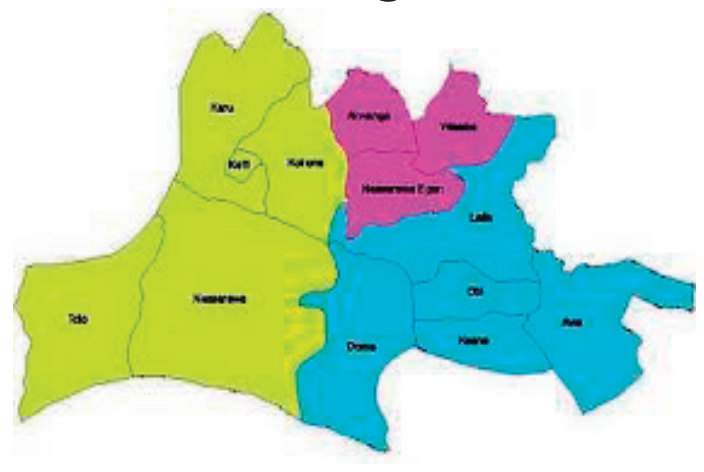
Over time, this principle of zoning or political power rotational leadership amongst the three senatorial districts in Nasarawa State took centre stage in the political conversations around political culture and power equation of the state. This process that eventually allowed all the three senatorial districts to produce governors culminated in the historic emergence of the present Governor Abdullahi Sule leadership of Nasarawa North; after the zone had waited for two decades for this opportunity.
Against this historical backdrop, the current claim that justice and equity demand that the next governorship must automatically return to Nasarawa West, is an opportunistic and morally dishonest political argument, rather than a historical fact. It is a fact that Nasarawa West never supported the emergence of the governorship candidate of Engr. Abdullah A Sule in 2019.
Their acclaimed political leader, Sentor Abdullahi Adamu and other political actors never supported the then Governor Umar Tanko Al-Makura decision to adopt this power rotation amongst the three senatorial zones. It’s also a fact that Ahmad Aliyu Wadada, Arch Shehu Ahmad Tukur, Muhammad Ja’afar and Muhammad Musa Maikaya fiercely contested the APC governorship primary election with the aspirants from Nasarawa North Senatorial District inspite of the pleading of the then Governor Umar Tanko Al-Makura g to allow Nasarawa North have a shot at the governorship.
The truth remains that all three senatorial districts have now had the opportunity to occupy the highest political office in the state. In that sense, the fundamental objective of equitable representation has already been achieved. Consequently, the suggestion that zoning must necessarily restart from the Western zone as the only pathway to justice or fairness oversimplifies the evolution of Nasarawa’s political history. In reality, political transitions often follow a natural sequence where a new cycle begins from the point where the previous one ended.
If such a pattern emerges again, it does not invalidate the principle of zoning nor undermine the spirit of equity. It simply reflects the dynamic nature of democratic politics. Another dimension often introduced into the debate is religion. In some political conversations, subtle arguments are made suggesting that zoning should not begin from Nasarawa North. Beneath these arguments is sometimes an unspoken concern about ethnic and religious identity. Such narratives risk deepening unnecessary divisions and misrepresenting the diverse ethno-religious and political character of the zone.
They are often accompanied by stereotypes portraying certain ethnic groups, particularly the Eggon, as politically domineering or unstable due to past security challenges such as the year 2013–2014 Nasarawa State crisis. These portrayals are misleading and unfair. Nasarawa North, like every other zone in the state, is home to diverse communities and has made significant contributions to the political and social development of the state.
Similarly, arguments that Nasarawa North Senatorial zone lacks demographic strength because it is believed to consist of only three local government areas are factually inaccurate and overlook the broader ethno-religious demographics, balance and political realities of the state demographics and voting tendencies. Ultimately, the debate about the future of leadership in Nasarawa State should be guided by truth, inclusiveness, and respect for the state’s political evolution.
Zoning was never a rigid arrangement that began from a predetermined zone; rather, it evolved as a political understanding aimed at promoting fairness and stability. As the state looks ahead to future elections, political actors and commentators must avoid narratives that distort history or inflame sectional sentiments. The focus should instead remain on competence, justice and fairness, inclusivity, unity, and the collective progress and peaceful coexistence in Nasarawa State.