
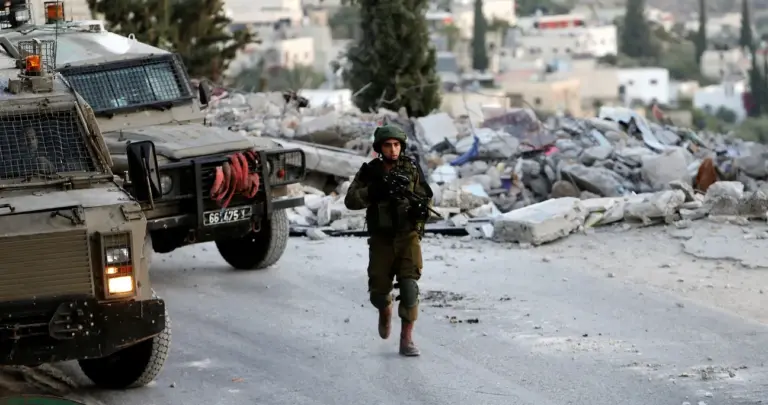
Prominent scholars and administrators operating in the country’s foreign affairs community have reacted to the ongoing war in the Middle-east which has pitted the United States of America (USA) and the State of Israel against the Republic of Iran.
Those who spoke with the Saturday Telegraph separately yesterday urged the Federal Government to utilise the opportunity provided by the crisis to ensure internal cohesion as well as to assert itself in the international community as a valued and respected global player.
While a former Minister of External Affairs, Professor Bolaji Akinyemi’s views were sought in his podcast thruoghmyeyes monitored by our correspondent, a former Permanent Secretary in the Ministry of Foreign Affairs, Professor Gods know Ighali, as well as a former Director-General of the Nigerian Institute for International Affairs, Professor Bola Akinterinwa, conveyed their views in separate telephone calls.
Bolaji Akinyemi Professor Akinyemi blamed the Federal Government for not doing enough to build confidence within the country because the country is split in half by adherents of Christianity and Islam, who see the crisis through different lenses. “We should have anticipated the reactions of the Nigerian Shiites.
I am saying so because this will not be the first time that there will be demonstrations concerning what’s going on in the Middle-East. “I would have thought that the foreign minister or even the president himself should have addressed the nation.
There should have been an anticipatory action by the people who are in charge of managing our affairs. They should have addressed the nation,” he said. While stating that, though the situation could still be savage, he, however, urged that the country should be non-aligned and effectively play a mediatory role in the global arena. “We should play an active part in the United Nations to make sure that the issues don’t get out of hand,” he stated.
Ighali On his part, Ighali, who is currently the Chairman of Pan-Niger Delta Forum (PANDEF), stated that the crisis presented several dimensions to the country, but that a lot of efforts should be made by the government in the area of confidence building. He listed those dimensions to include socio-cultural and the economy, saying, “Wars, anywhere in the world, have implications both at the local level and far level.
At the local level, there’s a lot of pain, destruction, and deaths, but it reverberates to affect everybody. Even a communal crisis between two communities will affect everybody. “When there’s war between two countries, it affects every member of the global community because they are connected one way or the other because the world has become a global village, but in the case of the Middle East situation, it affects Nigeria in various ways.
“I’d like to talk from the sociocultural point of view. As you know, Iran is a strong Shiite country. We have Shiites as a population in Nigeria, and also Iran, at a larger level is an Islamic country. “We have a lot of Muslims in Nigeria. So they are people of faith, and Israel itself is a country where a lot of Christians see it as holy land.
“So there’s a religious, sociocultural dimension that’s what you see people already demonstrating, and there are people in some parts of Nigeria who feel that Israel has not done anything wrong, but in some other parts of Nigeria, they feel that Israel and America are wrong to have attacked Iran.
“If you look at it again at that sociocultural level, Nigerians are living in the Middle East. There are large numbers in almost every country; you have a large number of Nigerians. “So it is not leading to a situation where Nigerians are being displaced.
We have a lot of Nigerian professionals who are working there in different capacities in the oil and gas industry, working as medical doctors, professionals in construction. “A lot of them will be displaced now because nobody knows how far this will go, especially when Iran is becoming an adopted institution of attacking friendly countries to America and Israel.
So even in Iran itself, there are a lot of Nigerians who are working there, living there. So this will affect Nigerians. “The government is now, I believe, bothered about getting our people to come back home until there is renewable peace in that place.
Those are consular sociocultural implications, and these people have to be displaced, thankfully. “On the economic level, both Nigeria and Iran, and Nigeria and the other countries that are affected are oil-producing. Members of OPEC who produce oil, and Iran is very important.
“Third largest oil producing country in the world, so to that extent, these disruptions in the economy and particularly the disruptions of the movement of oil and gas products around the Gulf of Hormuz, where products pass through, have affected the price of oil.”
He however lauded the Federal Government for having managed the situation so far but added that “If I was to advise government, perhaps I would go further by saying an appropriate person, maybe the minister of foreign affairs or the minister of information or the spokesman of the minister of foreign affairs, should be able to talk to Nigerians to say that this peace is not correct.
It’s a problem between Nigeria and any other country. “A religious war between different peoples is serious. Nigeria’s concern is for peace, and we are working with the international community, particularly through the framework of the United Nations, to get peace.”
Akinterinwa Akinterinwa, on his part, called for the sustenance of the foreign policy being championed by the Tinubu-led government, which he termed ‘strategic autonomy.’ “Well, I would simply say that the current foreign policy direction of President Bola Ahmed Tinubu should be sustained, and that is the foreign policy direction of strategic autonomy.
“You need to build a self-reliant autonomy. You need to build capacity on how to make a nuclear bomb. How to make a nuclear bomb for war and a nuclear bomb for peace, and that is what they are fighting Iran for. You see, some people have nuclear capability,” he said.
He further added that “Self-reliance at the nuclear family, at the street level, at the community level, at the local government level, and at the state level,” he said, adding that “Nationally, you will be able to boast to the whole world that, look, we are Nigerians.”








