

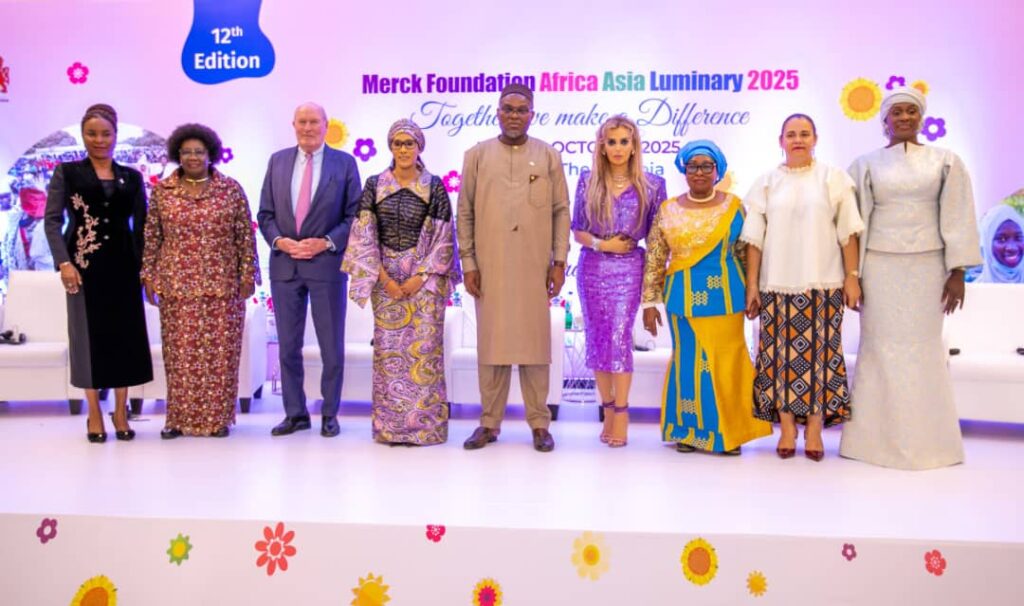
The Merck Foundation has reaffirmed its partnership with African First Ladies to drive key initiatives in girls’ education, healthcare access, and women’s empowerment across the continent.
Speaking at the 12th Merck Foundation Africa Asia Luminary, co-chaired by the First Lady of The Gambia, Madame Fatoumatta Bah-Barrow, in Banjul, the Foundation’s CEO, Senator Dr. Rasha Kelej, described the collaboration with nearly 30 African First Ladies as a “powerful force for change.”
Kelej highlighted ongoing programmes that provide scholarships and specialized training for healthcare professionals, support for infertile women, and campaigns against gender-based violence and child marriage.
She disclosed that the Foundation has awarded over 2,400 scholarships to doctors and healthcare providers from 52 countries in more than 42 underserved and critical medical specialties, producing the first oncologists, diabetologists, fertility specialists, and embryologists in several African nations.
“Before our intervention, some countries like Burundi, Liberia, Sierra Leone, and The Gambia had no specialists in key fields such as oncology, fertility, or ICU care,” Kelej said.
“Patients either had to travel abroad or had no access to treatment at all. These scholarships have transformed patient care in public health institutions across the continent.”
According to her, The Gambia alone has benefited from 94 scholarships, a significant number relative to its population.
Kelej also reaffirmed the Foundation’s commitment to girls’ education through its “Educating Linda” initiative, which provides scholarships to thousands of disadvantaged girls to complete their schooling.
“In partnership with the First Lady of The Gambia and other African First Ladies, we offer 40 annual scholarships to high-performing but underprivileged girls, ensuring continuity as each set graduates,” she explained.
Chairman of the Merck Foundation Board of Trustees, Prof. Dr. Frank Stangenberg-Haverkamp, emphasized that the Foundation’s long-term goal is to transform healthcare systems by building sustainable local expertise, reducing medical tourism, and saving lives.
“Africa carries 24% of the world’s disease burden but has only 2.9 healthcare workers per 1,000 people,” he lamented.
“Our scholarships bridge this gap. Many of our alumni are now the first specialists in their countries, we are literally making history together.”
He added that the Foundation’s training programmes now cover 44 medical specialties, including oncology, endocrinology, cardiovascular medicine, clinical psychiatry, and neonatal care.
In his address, President of The Gambia, Adama Barrow, lauded African women for their leadership and resilience, reaffirming his administration’s commitment to promoting women’s participation and girls’ education.
“We have introduced free education for girls and are working to increase women’s representation in Cabinet, Parliament, the Judiciary, and the security services,” he said.
Represented by Vice President Mohammed Jallow, Barrow praised the Merck Foundation for its role in strengthening healthcare systems, reducing infertility stigma, and empowering girls through education.
The First Lady of The Gambia, Madame Fatoumatta Bah-Barrow, revealed that about 100 Gambian doctors have benefited from the Foundation’s training scholarships, significantly improving the nation’s healthcare capacity.
“Together, we are empowering professionals, uplifting women, and giving the next generation of Africans a healthier, more hopeful future,” she said.
“As First Ladies, we are not just symbolic figures; we are caregivers and advocates using our platforms to amplify the voices of the vulnerable and ensure no one is left behind.”