
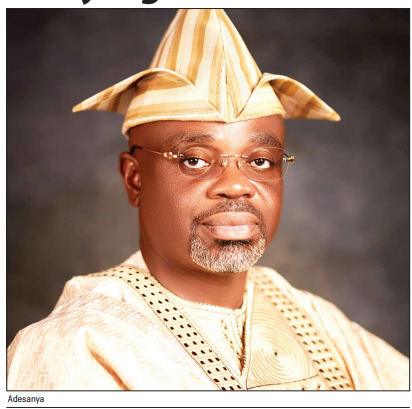
Air Vice Marshal Olatokunbo Adesanya (rtd) is a former directing staff at the Armed Forces Command and Staff College. In this interview with Emmanuel Onani he speaks on national security, ongoing military operations and other national issues
In your opinion, would you say the political authorities at the federal, state and local government levels are doing enough to alleviate the sufferings of the people?
That will always be a subjective question, but it doesn’t matter how well they are doing, there is always room for improvement. My personal opinion is that at the federal level, the government has done a lot to address macroeconomic issues.
But this macroeconomic progress that has been attained is yet to reflect at the microeconomic level. So, the generality of the populace is still facing a lot of hardship. I think more effort needs to be put into ensuring that whatever resources have been gotten from the macroeconomic level equally translate to the microeconomic level.
And whether we like it or not, one of the areas to ensure this is subsidies, where necessary. But these subsidies should be well monitored to avoid the corruption, which is what actually kills government efforts at providing subsidies.
At the state level, unfortunately, many people are not even aware of the separation of powers, to know the responsibilities of the states and the local governments, so that people can put pressure on their state and local governments to do more. So, I think more needs to be done, especially at the state and local government levels.
The Armed Forces of Nigeria has been involved in ongoing counterinsurgency and counter-terrorism operations in the North-East and other theatres. What strategies do you think could be deployed or adopted to bring insecurity to its barest minimum?
The situation we’ve had in Nigeria for the past few years in terms of insecurity has been quite unfortunate and I know that a lot of efforts have been put in towards making the situation better, but the desired outcome has not yet been realized.
I believe that for us to be able to overcome these security challenges in Nigeria, we need to adopt, like I have always said, an all of-government approach which will involve both kinetic and non-kinetic measures.
Much emphasis has been placed on the kinetic aspect, which is essentially military operations, while little or nothing has been done about the non kinetic approach. The main security challenge we have in Nigeria could be described as asymmetric, and of course, we have much of it being insurgency.
What is the root cause of the insurgency?
We have things like poverty, illiteracy, issues of ungoverned spaces, underemployment, unemployment, poor healthcare and the rest.
So, what do you think should be done?
What should be done is adoption of on-kinetic measures to address these issues, which now involve not just the military but the entirety of government, both at the federal, state and local governments. A lot should also be done to involve community leaders, so that at the end of the day, we’ll be addressing the issues of security, unemployment, poverty, illiteracy, underemployment, lack of healthcare, underemployment and ungoverned spaces.
I’m just trying to abridge it because it’s quite a loaded question. Then, on the kinetic means being adopted, I think certain changes could be made in that respect. But certainly, we must still intensify the kinetic approach. However, the kinetic operations must be intelligence-led and we should also employ as much technology as possible.
One of those things that we should be actually looking at is the use of unmanned aerial vehicles as well as unmanned combat aerial vehicles. The unmanned aerial vehicles, known as UAVs, would essentially be there to be eyes on the ground. I’m talking of UAVs that can be in the air for quite a long time.
That’s those with quite a high endurance such that they can be in the air, monitoring essentially the vast spaces that we have and where we have this security challenges. And then, we have the unmanned combat aerial vehicles that can provide quick reaction anywhere we have incidents and activities taking place.
These are just some of the measures that could be adopted. And then I talked about intelligence. When it comes to asymmetric warfare, a key aspect is intelligence, which will not just be limited to human intelligence, but also electronic intelligence. All these should be well coordinated and government must demonstrate sufficient political will to deal with this issue.
The reality is that we must realise that Nigeria is at war, and when a nation is at war, it should largely dedicate sufficient resources to fight the war. So, we cannot continue to use the same budgetary approach for the military as if we are not at war.
It could take a lot, but it is better that we spend this much. If we say that we are spending too much on addressing security challenges, then we should ask ourselves:
What is the cost of insecurity in terms of human lives, economic loss, and the rest. So, these are some of the things that I can immediately think of. But like I said, it’s more or less an abridged response.
As a retired senior officer with an unblemished record of service, would you say that the synergy among the three services – Nigerian Army, Nigerian Navy, and Nigerian Air Force, is satisfactory enough given allegations of rivalry as it were?
I know that some years back there were reported allegations of rivalry among the services. While one might not have empirical evidence to be able to say whether they were true or not, but in the past few years, especially among the last set of service chiefs, I saw a clear case of coordination under the leadership of the former Chief of Defence Staff, General Christopher Musa.
So, I think, from what I can see from my side, there were no issues of rivalry. If anything at all, there was so much coordination and due credit was only being given to the right service.
Again, I think the only thing that could cause rivalry is where a service tries to give an impression that it is the only one involved in securing any victory.
But then, we know that in this case, we have even the non-military forces, the security agencies, contributing their own part, and then the military is also contributing its own part.
The President has appointed a new set of service chiefs. What, in your opinion, should they do differently, to stem the tide?
I think this gives me an opportunity to talk more about what I said earlier. The military services are essentially responsible for prosecuting the kinetic aspects of the operations against insurgents – counter-insurgency operations.
I think one of those areas that we have got it wrong is spending so much on fighter aircraft, for example, as opposed to may be tactical fighter helicopters, which I believe are more relevant when it comes to counterinsurgency and asymmetric warfare.
Similarly, I know that efforts have been made to procure drones as the unmanned combat aircraft. I think we should be investing more in this. Then the services should also focus a lot on acquiring intelligence, and this they need to do together with inputs from the other security agencies as well as locals, so that every operation will be based on intelligence.
I also believe that they should, especially the ground forces, make more use of the air assets that are available. I think it’s sad to imagine that we still have a situation where ambushes are recorded when we have an Air Force. I expect that before any movement of our ground troops, there should be adequate reconnaissance to ensure that the grounds are well secured.
What, in your opinion, could be the overall strategy in dealing with insecurity in the country?
I should just go back to overall strategy for combating this insecurity. In the past, we have had occasions where terrorists were arrested, but not convicted.
So, what is the Ministry of Justice doing? That’s why I talked about the all-of-government approach. Justice is meant to serve as a form of deterrence. When I say terrorists, it includes bandits and hostage takers.
The Nigerian Air Force did not record a single air mishap in two years. What could be responsible for the feat, and what should be done to sustain this?
I think we should give kudos to the Air Force leadership for having attained that feat. But it is not to say that crashes are abnormal. For any nation that has an Air Force, the possibility of air crashes or air mishaps will always be there.
In fact, the more air operations are conducted, the more we have the likelihood of air crashes. We saw at the recent Dubai Air Show where we had a very experienced commander from the Indian Air Force who lost his life in an air crash.
It’s just one of those unfortunate things. But I believe that what the (Nigerian) Air Force has done, and what every nation does in order to minimize air crashes, is to improve its safety procedures. We have what we call the Directorate of Safety in the Nigerian Air Force. And I believe that a lot is being done in terms of safety courses.
I believe that as much as possible, they are also adhering to safety procedures that have been established. I believe these are the things that have been responsible in the past few years for no air mishaps. All I can say is that whatever measures have been adopted, they should sustain them, and where necessary, improve on them.
How central is leadership in that regard?
Leadership is key and quite central in the fight against insurgency. In fact, leadership is at the heart of the fight against insurgency. Where leadership is incompetent, then the likelihood of any success is limited. It is leadership that is responsible for coordination. It is leadership that is responsible for facilitating the provision of the necessary resources to prosecute war.
It is leadership that is necessary for instituting adequate welfare measures that will ensure that the morale of the fighting troops is high and is sustained. It is also leadership that will ensure that discipline is very well taken care of because discipline is an essential part of any fighting force.
So, it is important that the leadership be bold, that the leadership be competent, that the leadership be focused, and that the leadership should also provide the necessary coordination that is necessary to ensure good success of the fighting forces.
The reality is that any directive from the President, whether verbal or written, carries equal weight. Once the president of a nation makes a pronouncement, either verbal or written, it more or less translates into policy.
It then behooves his cabinet members to ensure that it is well developed as a policy, written down, and adequately disseminated to all those who are responsible for initiating the policy.
It behooves them to also ensure that they monitor adherence to the policy. The President is just one human being. He cannot be everywhere. He only needs to make the pronouncement, either verbal or written, and it is the duty of his team to ensure that it is successful and that he is adequately briefed.
Do you think the security dhiefs need a timeline for insecurity to be brought to its knees?
From history, when it comes to asymmetric warfare, it is difficult to actually eradicate completely asymmetric warfare. So, while I may not subscribe to a timeline being given to security chiefs, clear objectives could be given to them, military objectives that this and this must be achieved, and of course, within certain timelines.
But it is not about saying that all the challenges must be eradicated within a particular time. That might be impossible. But certainly, when clear military objectives are given, and timelines given to those military objectives, it will have an overall effect on the elimination or reduction of the insecurity that we have.
But when you give objectives, it also means you must give the resources for them to be able to achieve the objectives. So, objectives must be given, resources must be provided, and the achievement of those objectives, or the meeting of those objectives, must be monitored such that when they fail, then appropriate action can be taken.
The Nigerian Army has established an air wing, which many think is the job of the Air Force. Also, the Navy and the Air Force have Special Forces units. Is this a healthy development?
What is happening is not an aberration. It is actually the norm.
Yes, we have the Army, primarily responsible for ground operations, Navy for maritime operations, and then the Air Force for aerial operations, however, even in line with global standards, we have what we call the Army Aviation Wing, and this wing is responsible for providing quick air support to ground forces. They are responsible for even tactical movement of troops within battle areas. We have what we call the air portable battalions.
We have the air mobile and others within the Army. We have amphibious units within the Army that are placed on both the land and river end of maritime area. So, it’s perfectly normal. The Aviation Wing also has little drones that do the kind of surveillance I talked about before any unit moves.
We could even have helicopters that can quickly move troops; helicopters that can do search and rescue as well as helicopters that can actually do casualty and medical evacuation. What they will do is that they will provide quicker response than what they possibly might. This will now leave the Air Force now to focus on more important targets.
The Army, Navy and Air Force have continued to issue statements on operational successes. This is despite the establishment of the Directorate of Defence Media Operations. Is it healthy as far as information coordination is concerned?
It is healthy to some extent. Even though we have what we call joint operations, we have what we call single service operations. Joint operations would normally involve more than one service.
It could be the Army and Navy or Army and Air Force or Navy and Air Force. When it comes to joint operations, it then behooves only Defence Headquarters to issue statements on operations. But when it is a single service operation, the respective service officers will issue statements on operations.
We must realise that Nigeria is at war, and when a nation is at war, it should largely dedicate sufficient resources to fight the war
And you need to also know that these statements that are issued are also forms of advocacy. If, for example, nobody ever hears the Army or the Navy or the Air Force stating that this is what they have done, when it’s time to argue for resources to be given, people might wonder if you have given anything.
The Military is involved in internal security operations across the six states of the Federation and the Federal Capital Territory. Does this suggest a subtle vote of no confidence in the Nigeria Police Force?
It isn’t. Ordinarily, the Nigeria Police Force is responsible for internal security, being the lead agency in internal security operations but there’s also a constitutional provision that whenever the police is overwhelmed, the military could be deployed. However, there is a procedure for that to be achieved. The military now can be called upon to complement the police. It is part of internal security operations.
Given the present situation, would you say the military is overstretched?
Clearly, there is no doubt that the military is overstretched. You know that we have a situation where virtually every region of the nation is facing one form of threat or the other. We have the banditry in the North-West. We have insurgency in the North-East.
We have the various clashes that are going on in the NorthCentral. We have the agitations in the South-East. We have the maritime related challenges in the South-South and the South-West also has its own bits of criminality here and there. And in all these, like I said, the military has been involved. So, you find the Army, Navy and Air Force involved in all these.
Meanwhile, our focus should be on defending the territorial integrity of Nigeria, especially from external aggression. Nigeria has a vast landmass; that is why it appears as if the insurgents keep on having a field day because the armed forces and maybe even the police are unable to occupy every territory.
Now, what do the insurgents do? Their aim is to cause embarrassment to the government of the day. So, they look for anywhere where you do not have sufficient personnel on the ground and they go there and attack. They look for a school that’s in a remote place; they go there and kidnap. But nobody wants to hear about excuses because the life of every individual is important.
Nobody wants to know whether that kidnapping took place in a defended place or whether it took place in a remote place. The important thing is Nigerians have been kidnapped or Nigerians have been killed. I think even the government is aware of the fact that the military is our treasure.
That’s why I seriously commend and appreciate the recent directive given by the President for the recruitment of more personnel by the armed forces as well as the police and the Department of State Services. I know that there are quite a number of Nigerians who are willing to join the military, so it is an opportunity for them and I believe it will go a long way in addressing the issue of the armed forces or other security personnel being overstretched.
What would be your advice to some retired officers that seem to be having financial challenges, and how should officers prepare for retirement?
You know, after commission and sometimes even during training, we are told that we should start preparing for our retirement right from day one. Everybody knows that retirement will come someday, so prepare right from the beginning. But the reality is that most people still do not prepare even though they are aware that they should be preparing.
For the officers, the main path to becoming an officer is through the Nigerian Defence Academy, which is a degree-awarding institution, which means that most officers are at best or at worst, first degree holders; while many go on to add various postgraduate degrees to their initial degrees.
All these are aimed towards positioning and preparing personnel for a good retirement. But one area that I think many officers do not key into is investment in the Nigerian Stock Exchange and the various financial instruments that are available – Federal Government bonds, treasury bills and shares of listed companies.
These are areas that I think officers need to begin to look at. Certain measures will be taken to ensure that officers take a portion of their salary every month and invest in the right instruments. It has been proven worldwide that stock investment is always proves rewarding. It is a longterm investment, not a short-term investment. So, for anybody who starts his career and begins to invest, after 30 years or 35 years of service, he should have something that will make his retirement much more worthwhile.
On a lighter note, how has life been in retirement?
I will say that life has been good. One of my philosophies in life is that life is good; it doesn’t matter what the situation is.
One of the things I’ve also done for myself is that I invested a lot in the stock exchange, and it has proven to be useful. I also believe that it’s not more about what comes in; it is about how you manage what will go out.
If you can minimise your expenses within the resources available to you, you’ll always be a happy person. But once you try to do beyond the resources available to you, then life cannot be sweet for you. So for me, life is good