
…Deepens Water Sector Reforms
The Lagos State Government has intensified efforts to improve access to potable water and modernise critical water infrastructure across the state through strategic rehabilitation projects, technology-driven reforms and expansion of water distribution networks under the administration of Governor Babajide Sanwo-Olu.
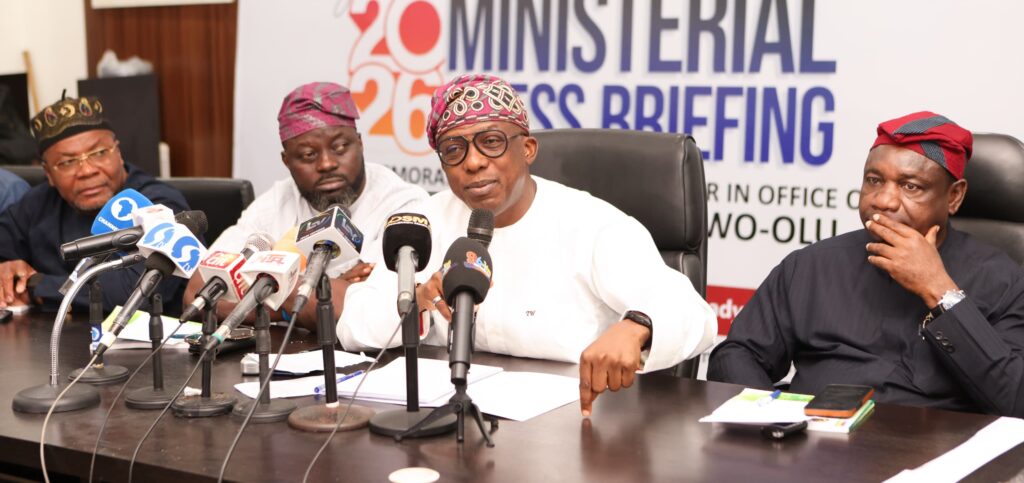
Commissioner for the Environment and Water Resources, Mr Tokunbo Wahab, disclosed this during the 2026 Ministerial Press Briefing held at the Bagauda Kaltho Press Centre, Alausa, where he outlined key achievements recorded in the water sector and the regulatory interventions being championed by the Lagos State Water Regulatory Commission (LASWARCO) and other agencies under the ministry.
Wahab said the state government remained committed to ensuring that residents have improved access to clean, safe and affordable water through sustained investments in waterworks rehabilitation, pipeline expansion and smart infrastructure management systems.
According to him, the administration has continued to prioritise long-term water sustainability as part of broader efforts to strengthen public health, environmental governance and urban resilience in Africa’s most populous city.
Highlighting one of the landmark achievements in the sector, the commissioner revealed that Governor Sanwo-Olu recently commissioned the rehabilitated one-million-gallon-per-day Akilo Mini Waterworks in Ogba, describing the project as a major milestone in the state’s drive to improve water access in densely populated communities.
He explained that the rehabilitated facility is expected to significantly improve potable water supply to more than 100,000 residents in Agege, Ogba, Ojodu and adjoining communities, many of which have experienced growing pressure on existing water infrastructure due to rapid urban expansion.
Wahab noted that the intervention forms part of a wider strategy aimed at decentralising water supply and boosting efficiency in service delivery across various parts of the state.
The commissioner also disclosed that substantial progress had been recorded on the Adiyan Phase II Water Treatment Plant, one of the largest water infrastructure projects currently being undertaken by the Lagos State Government.
According to him, the project is designed to produce 70 million gallons of water daily upon completion and has already achieved about 98 per cent pipeline installation completion.
He expressed confidence that the project would be delivered later in 2026, adding that the completion of the Adiyan Phase II scheme would significantly strengthen water distribution capacity across Lagos and reduce pressure on existing supply systems serving highly populated districts.
Wahab stated that the additional output from the Adiyan facility would play a critical role in addressing growing water demand triggered by population growth, industrial activities and expanding residential settlements across the metropolis.
In a major technological shift aimed at modernising water infrastructure management, the commissioner announced the deployment of robotic crawler technology by the Lagos State Water Corporation for underground pipeline inspections.
He described the innovation as a breakthrough in water infrastructure maintenance, noting that the technology would improve leak detection, reduce water losses and enhance operational efficiency in the management of underground pipelines.
According to Wahab, the adoption of smart monitoring systems reflects the Sanwo-Olu administration’s commitment to integrating innovation and digital solutions into public service delivery.
He explained that the deployment of advanced inspection technology would help government agencies detect faults early, minimise pipeline failures and improve response time to maintenance challenges, thereby ensuring more reliable water supply services for residents.
The commissioner further stated that ongoing reforms in the water sector were aligned with the administration’s THEMES Plus Agenda, particularly in the areas of infrastructure renewal, environmental sustainability and improved quality of life.
He stressed that the Lagos State Water Regulatory Commission, LASWARCO, continues to play a critical role in driving regulatory oversight, service improvement and sustainable water governance across the state.
Wahab reiterated the commitment of the state government to expanding potable water access while strengthening the infrastructure required to support Lagos’ rapidly growing population and economic activities.
He added that the government would continue to invest in modern water systems, innovative technologies and strategic partnerships capable of guaranteeing sustainable water supply for present and future generations of Lagos residents.