


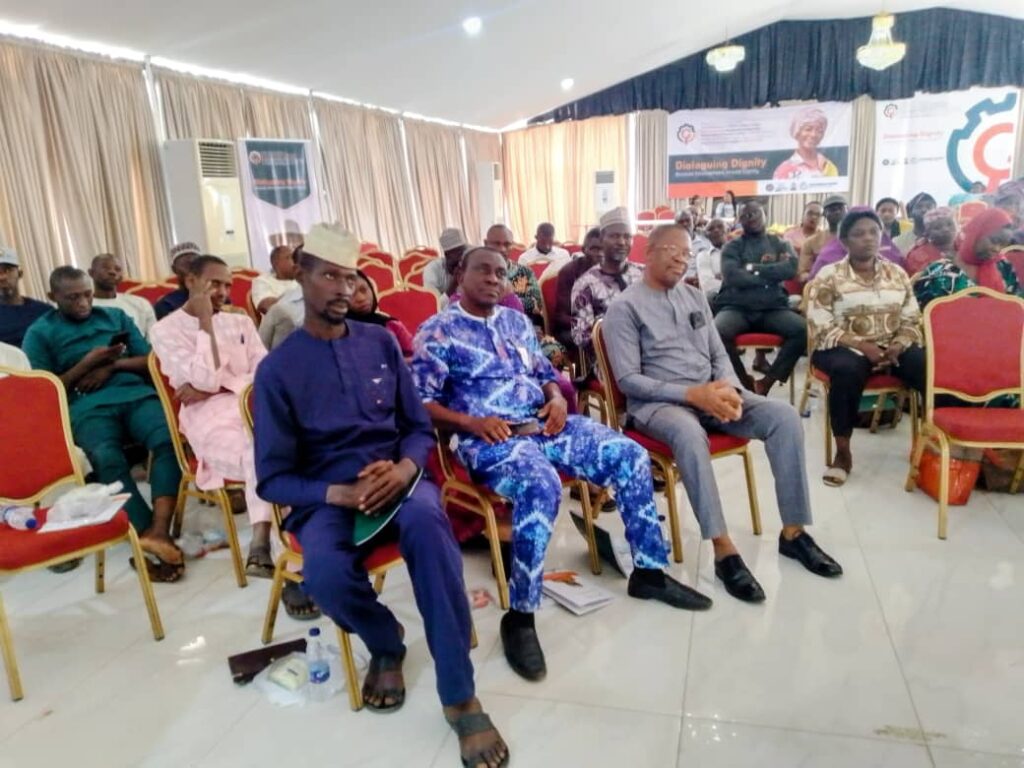
The Kogi Livestock Productivity and Resilience Support (L-PRES) Project has emphasised the importance of dignity and respect in its operations, with facilitators stressing the need to protect vulnerable groups from gender-based violence (GBV) and sexual exploitation.
Speaking at a sensitisation workshop on GBV and the Prohibition of Sexual Exploitation and Abuse (PSEA) on Wednesday in Lokoja, the State Project Coordinator (SPC), Abdulkabir Onoruoyiza Otaru, urged participants to adopt a “humane depth” in their work.
Represented by Alexander Atama, the SPC said the “Dialoguing Dignity” training aims to equip participants with the skills to promote dignity in every aspect of their work.
He stressed that the Kogi L-PRES Project is prioritising dignity and respect in its efforts to boost livestock farming in the state.
Otaru emphasised that the project’s success depends on the experience of the most vulnerable persons and called on cluster coordinators to create an environment where women and other vulnerable groups feel safe and included.
The SPC outlined three key aspects of dignity, inclusion, safety, and conduct stressing the need for a “dignity benchmark” in all interactions.
He also highlighted the importance of adopting the Dialoguing Dignity framework, noting that cluster coordinators are the face of the Kogi L-PRES Project.
He urged them to lead with “humane depth,” treating women as partners and vulnerable individuals as neighbours, while upholding the “Do No Harm” principle as a sacred vow to the community.
Facilitators at the training presented papers on key topics, including gender mainstreaming in agriculture with a focus on livestock, considerate inclusion in promoting dignity, restoring human dignity through compassionate approaches, ensuring safety and dignity in livestock management, and considerations for dignifying individuals in the sector.
The presentations were aimed at equipping participants with a deeper understanding of dignity and inclusion in livestock farming.
Idris Muraina, Executive Director of Renaissance Care and Empowerment Foundation (RECEF), cited Chapter IV, Section 34 of the Nigerian Constitution, which guarantees the dignity of the human person, emphasising that every individual matters regardless of gender, age, or disability.
Aisha Abimbola Adaranijo, a lecturer at Federal University Lokoja, highlighted the need to support survivors of GBV and PSEA, noting that “nobody wants to be involved in GBV or PSEA” and urging society to stop blaming victims.
The project aims to create a safe environment where people can report grievances without fear, with facilitators emphasising accountability and the “Do No Harm” principle.
The event concluded with a call to action urging individuals to pledge to respect and protect vulnerable groups, including women, youths, and persons living with disabilities.
Participants, including livestock farmers, key value chain actors, and other community stakeholders in Kogi State, pledged to uphold dignity and safety, repeating the mantra: “Her Dignity, Our Duty. Her Safety, Our Standard. For Every Woman, For Every One.”