
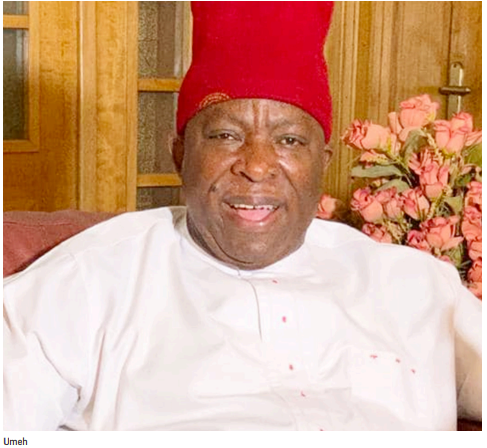
The Senator representing Anambra Central in the National Assembly, Senator Victor Umeh, in this interview, speaks with KENNETH OFOMA on the conviction and sentencing of Mazi Nnamdi Kanu, the leader of Indigenous People of Biafra, (IPOB), to life imprisonment, and how to stop agitations in the South-East
What’s your take on the judgment of Justice James Omotosho that convicted and sentenced Mazi Nnamdi Kanu for life over terrorism charges?
Well, I wasn’t surprised when late in the evening of Thursday November 20, I heard the news of the judgment. I say so because looking at the long-drawn battle, it was obvious that it will end this way.
I look back to the beginning of IPOB, back in 2016 that was when the activities of the group became visible and at some point, early 2016, they had the first confrontation with the Nigerian Army at Nkpor in Anambra State when they had peaceful non-violent demonstration or protest march. But the soldiers fired at them and killed a good number of them that time. I was surprised because I thought that protest was part of democracy.
When people don’t agree with what they are experiencing they can protest. Even today protests still go on in Nigeria.
Outside Nigeria people protest in all democracies, so, I didn’t see why their own case would be met with firing of live bullets that claimed the life of some youths. At that time, I had to go to the radio stations to condemn the killing of the youths. My reason being that by that time there was no case of violence with the IPOB elements.
Again, don’t forget that IPOB, when it was set up had some very prominent Igbo people in it. Two former President-Generals of Ohanaeze Ndigbo, the late Justice Eze Ozobu, the former Chief Judge of Enugu State, was a member of the group. In fact, he had a position given to him in the IPOB. Again late Dr. Dozie Ikedife, who was President General of Ohanaeze Ndigbo associated with them and also took responsibilities.
The reason was that they came up as a group that was protesting the seeming marginalization of Igbo people in Nigeria. So, the movement was largely to stop the marginalization of Igbo people. They were complaining about the ill treatment of the government of Nigeria against the Igbo people of Nigeria. .
So, their takeoff was greeted by a broad spectrum of Ndigbo as people who were fighting for justice for their people. It was in light of that that I also went to radio station to say that the killing was not necessary, it was an action taken too far. I felt that the government didn’t react appropriately.
And when I made that statement on radio, I was arrested by the Department of State Security on the 3rd of March 2016, and I was accused of inciting the youths and IPOB. I was taken on a Hilux Van from Awka right straight to Abuja.
We arrived on the night of 3rd of March. I went through rounds of interrogation by State Security officials. Around midnight I was brought before the then Director General of State Security Service, Alhaji Lawal Daura, who had a personal interview with me. And he accused me inciting young people from the South-East that they were grappling with the problem of Boko-Haram and that I was inciting the youths to establish, in fact I was accused of financing IPOB, an allegation I flatly denied and asked him to show proof because everything they said that I did was the opposite.
I didn’t, just because I said I didn’t agree with the shooting of these youths. After almost two hours of an interview with Lawal Daura, he is alive today, he told me what the problems were. I said he was not getting it right; the government was not getting it right.
If some people are complaining of marginalization, neglect and they have some grievances that the best thing government will do is to call them and dialogue with them, and reassure them over their fears because they were complaining of total shutting out of South-East youths from the affairs of Nigeria and the zone generally in terms of infrastructure development.
I told him this is the crux of the matter. If they are complaining of marginalization which every reasonable Igbo man felt was so at that time that the best thing to do was to call them, it’s not by using the big stick to hit them, listen to them. If they are saying that the youths don’t get access to jobs as they were complaining then you assure them.
If they are talking about poor infrastructure in their zone and scheming out the Igbos in the affairs of governance the best thing you will do is to reassure them, and the government has to change its attitude towards them, that that’s the best way to solve the problem, going that way will not work. After the exchanges he saw reason with me that what I was telling him was real.
He said ‘okay, I would like us to be friends,’ I said very well. He brought out a notepad and wrote his two numbers and gave it to me and told me that he would like us to be in touch.
I welcomed it and thanked him. I was released around 3am that day. And went back to the hotel, the next day I left. And we continued to relate until he was removed as DG SSS unfortunately.
He took note of all the points I gave him and I told him that if the government changed its attitude towards the people of the South-East zone that this agitation will go down because what people are looking for simply is attention. You don’t need to escalate it to be able to achieve peace. He saw reason with me and we kept in touch.
We became friends really. But progressively the government failed to toe this line that I suggested to them and things continued to worsen. Instead of using dialogue and discussions with relevant people, they levied war on the youths.
So, I will say that the government mismanaged the problem. And that led us to where we are. Check from 2016 till now, its nine years and consistent with my views, both on television, including the senate, in 2018, recall that when the issue of the IPOB started escalating, the Federal Government went to court and proscribed it.
In one of the plenary sessions at the Senate I stood up and asked a question, where in the world have you seen the use of court order to proscribe the grievances of a people where it has worked? If some body is not happy, you order him to be happy with a court order, will that person be happy? When the problem he is complaining about is still there. So that use of court order to proscribe this organization will not lead anywhere.
The best thing for the government to do is to call them together and advise them too and tell them that this is what they should be doing, this is what they should be doing, the government will do this, and the government will do that. That was the approach I expected, but they didn’t listen, they continued.
Consistently, I maintained my view that court order, court action will not solve the problem of IPOB, and rather it will be a positive action of the government directed at their complaints of marginalization. And the government did not read it correctly because they were looking at Nnamdi Kanu as a problem.
So, what was the problem?
It was a collective problem of the people of the South-East. If you watch you will see that eminent people of the South-East had gone to the then President Buhari to ask him to release Nnamdi Kanu to them. Prof. Ben Nwabueze, the very popular Constitutional lawyer, former President General of Ohanaeze Ndigbo led a delegation of Igbo leaders that included Chief Emmanuel Iwuanyanwu, Chief Chukwuemeka Ezeife of blessed memory. All of them were in that delegation to the Villa where they asked for the release of Nnamdi Kanu.
If they were seeing Nnamdi Kanu as a miscreant or trouble provocateur they will not go on a delegation on behalf of Igbo people to go and ask for his release.
So, it means that they understand what he was doing and that what he was seeking was justice to the people of the South-East of Nigeria. So, the government was adamant about this visitation.
The visits had been done by several groups in the past. So, treating Nnamdi Kanu as a person was a wrong reading of the problem because he has the sentiment of the entire Igbo nation both those in government and those outside Nigeria.
So, the best way to have handled the matter would have been to call him and his group and then meet with them. Government has done that in the past. When the Niger Delta militia people were giving enormous trouble with strong arms in the Niger Delta, President Ya’Adua, then had to call them and then discussed with them and put in place an amnesty programme.
At that time you see the leaders of the Niger Delta militia wearing chains of bullets around them singing in the creeks. And they were threatening, they were blowing pipelines and all that and the government had to call them instead of levying war on them, the government in its wisdom chose this conciliatory approach. And through that process they laid down their arms, programmes were developed for them, an amnesty programme was put in place to Niger Delta.
When the Boko Haram came up and was ravaging the North East, government didn’t stop there, they didn’t go and carry arms and start pursuing them, they were preaching that they should stop the war against Nigeria and those who accepted government treaties were accepted and given amnesty, they were rehabilitated through various programmes.
At one instance on television, about 1000 people were paraded as having renounced the struggle and they were absolved. So, this is the way to pursue peace.
The use of kinetic approaches will not solve the problem of agitation, particularly when they are ideologically based. When people feel that they are no longer wanted and they are not treated as Nigerians they will continue to fight.
If you ignore them it is dangerous. When it got to a level, I had to come back on television again to say that the worst thing you can do to a man who is aggrieved is to ignore him. If you ignore him, he will continue to do things that will get your attention and that’s how this thing developed, got to a point it reached, the government continued to use force on them and almost a full-scale war was declared.
And the South-East of Nigeria became a theatre of the absurd because the government did not listen to anybody, they did not want to go the way of looking for peace.
What they used in the Niger Delta and the North-East they refused to use it on the IPOB elements; all of them the same type of agitation with different colorations. But as it is now, the government has stretched its own war to the limit.
What impact or move has South-East Senators made?
The senators of the South-East of Nigeria wrote the Attorney General and Minister of Justice when the insecurity became unbearable in the South-East because anything anybody did they will say release Nnamdi Kanu, release Nnamdi Kanu; if you don’t release Nnamdi Kanu we will continue what we are doing.
We tried to intervene to sue for peace, they say ‘release Nnamdi Kanu first.’ It was the first demand all of them were making.
And the majority of the senators, I think about 10 of us, had to go to meet the Attorney General, Chief Lateef Fagbemi SAN. He gave us an appointment and we met with him at a round table. We were led by Sen Enyinnaya Abaribe, the Chairman of the Senate caucus in the 10th Senate.
We went and with our letter of request with a plea that he should prevail on the government to release Nnamdi Kanu, let us see how to recover the ruins in the SouthEast due to the breakdown of security. Everybody is saying release Nnamdi Kanu.
When anybody is killed, release Nnamdi Kanu and all that; criminals joined and as it degenerated it went into kidnapping and all manners of things. Nnamdi Kanu became a topical issue. We requested that the government should be able to use that approach to first of all release Nnamdi Kanu, so that we can go and get our place back in order.
We spent time with him and he told us that he will explore it but that he is not guaranteeing anything. We waited for him and nothing was done because we specifically requested for the government to file a nolle-prosequi to stop it because the government had done it a number of times.
I remember that Sowore was arraigned for treasonable felony, I also know that Sunday Igboho was also charged with treasonable felony; I also recall that at a time 29 people went to the government House Ibadan to demand Oduduwa Republic. Sunday Igboho also went to London, the Nigerian High Commission in London to demand for the Oduduwa Republic.
These are things people do for the government to listen to them and know what they want. Along the line nolle-prosequi was filed in the case of Sowore, along nolle-prosequi was filed in the case of Sunday Igboho and the 29 people that were arrested for declaring a new republic within a republic we are not hearing about them now.
So, we were buoyed with that belief that the government can still do the right thing and help us to achieve peace in the South East. It didn’t work, we waited and the killings continued.
One day myself and Senator Enyinnaya Abaribe sought to see if the National Security Adviser gave us an appointment, Mallam Nuhu Ribadu. I’m saying it so that you know that we have not been sleeping, we have not been resting, we have been following this matter all over to see how we can find a peaceful resolution to the matter.
He gave us an appointment; we went to spend nearly two hours with him in his office arguing this. And we appealed for the government to help the people of the South East, to restore peace and end the carnage going on in Igbo land because of this simple matter.
What is the way forward right now?
I’m just concluding this aspect for you to see the efforts we have made. The national security adviser has a feeling that too many things are involved in the matter.
We said release him, if he continues, you now have other layers of people to hold responsible like some of us who came to plead, you now do your own; if it continues we now say you have tried.
But by keeping him continuously and people rely on his detention to continue to cause problems in Igbo land it’s like we are forgotten, we are not being considered as people that need rescue.
But the court has now delivered judgment, we saw it coming because we were following the developments in the court, we knew it was going to end this way.
And having sentenced him to life imprisonment I will only say that the government still mismanaged the situation because his sentencing to life imprisonment I can tell you does not go well with over 98 percent of Igbo people.
We are the Igbo people you are talking about, and I have been in the leadership position in Igbo land for the last 25, 26 years, so I know the feelings of our people and that’s why sometimes I speak on this matter.
On the 8th of May when President Tinubu went to Anambra state I had to speak on the sideline and I asked President Tinubu to release Nnamdi Kanu; that that was one thing he will do to Igbo people and begin a healing process, begin the process of reintegration of the Igbo people into Nigeria.
The people feel so marginalized they cannot be given the opportunity to aspire to leadership in Nigeria. So when people are frustrated there is nothing you will not expect.
So, I called on him when he came to Anambra State through the sideline that one of the greatest things he will do for our people will be to release Nnamdi Kanu, let’s be on firm ground to begin to arrest the security situation in Igbo land, I did. These things are not heeded; other people do so.









