



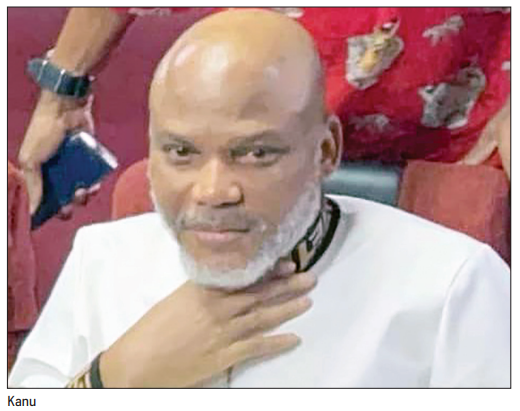
The South East Revival Group (SERG) has expressed deep concern over troubling issues recently raised by the Human Rights Writers Association of Nigeria (HURIWA) regarding the ongoing trial of the detained leader of the Indigenous People of Biafra (IPOB), Mazi Nnamdi Kanu, before Justice James Omotosho of the Federal High Court, Abuja.
In a statement issued by its National Director of Publicity, Hon Nnaemeka Aleke, SERG said allegations of predetermined bias, procedural shortcuts and deliberate curtailment of the defendant’s rights as articulated by HURIWA require urgent national attention given their far-reaching implications on judicial credibility, national unity and democratic stability.
SERG stated that it finds deeply disturbing, the pattern of judicial conduct highlighted by HURIWA, particularly allegations that the trial judge has shown an inclination towards “hurried, choreographed, and restrictive” proceedings.
According to the group, such pattern if left unchecked can send a dangerous message that Nigeria’s courts can be used to legitimise outcomes determined outside the courtroom. The group stressed that a judge’s primary duty is to ensure that justice is not only done but seen to be done, and that any action capable of raising suspicion of bias threatens the nation’s fragile confidence in the rule of law.
“How can a defendant incarcerated for over four years be denied adequate time and opportunity to defend himself When the court appears more interested in rushing to deliver judgement than in addressing fundamental legal objections, Nigerians are justified to worry that justice is being sacrificed at the altar of political expediency,” SERG said.
The group noted that HURIWA’s concerns over the legal nullity of the terrorism charges against Kanu deserves serious judicial consideration, not dismissal, while emphasising that the foundation of any criminal trial must be a valid law as any proceeding anchored on a repealed or non-existent legislation is by definition void. “The court cannot build a judicial edifice on a legal vacuum.
If the charges are indeed rooted in a repealed statute, then the proceedings automatically collapse, and it is the duty of the court not the defendant to raise and resolve that issue before taking a single step forward,” the group stressed. SERG warned that failing to address such a foundational defect amounts to a miscarriage of justice, and raises the undeniable suspicion that the court is working towards a predetermined outcome – an outcome that the law cannot sustain.
SERG echoed HURIWA’s position that the Nigerian government continues to dangerously conflate self-determination with secession, while weaponising criminal laws to silence dissent. The group reiterated that under international law, African regional charters, and the Nigerian Constitution, the right to advocate for self-determination is clearly protected. It said: “No democratic state criminalises peaceful political advocacy.
Global judicial authorities – from the United States Supreme Court in Brandenburg v. Ohio to the European Court of Human Rights – have affirmed that political expression, even if uncomfortable or unpopular, is protected unless it explicitly and imminently incites violence. Mazi Nnamdi Kanu’s speeches and advocacy do not meet that threshold.”
The South-East group warned that labelling political advocacy as terrorism not only violates global norms but sets a precedent that could be turned against any citizen or region seeking constitutional reforms or restructuring. On judicial behaviour that fuels regional alienation, SERG expressed grave concern that the handling of the Kanu case continues to deepen feelings of marginalisation in the South East, raising fears that the judiciary is being used as a tool for political repression.
According to the group, the perception that a court is working “to satisfy certain forces” erodes trust in national institutions and widens the gulf between the state and citizens.” It added that “a nation already struggling with mistrust cannot afford the impression that the courts are not independent,” SERG declared.
“The judiciary is the last hope of the common man. It must not appear captured or compromised—especially in a case with massive national and international attention.” SERG commended the decision of Nnamdi Kanu’s legal team to approach the Court of Appeal to halt what it described as “overt judicial irregularities” and urged the Court of Appeal to exercise its constitutional responsibility with courage and impartiality just as it did in its earlier landmark judgement in favour of Kanu.
“It is time for the appellate court to once again rise to the occasion and restore public trust by ensuring that justice is done without fear, favour, or external influence,” SERG said.
The group also joined HURIWA in calling on the National Judicial Council (NJC) to investigate the conduct of the trial judge to determine whether his actions fall within the acceptable bounds of judicial ethics and independence. SERG concluded that the Kanu case has become a test case for Nigeria’s commitment to constitutional democracy.
According to the group, the issue is no longer just about one man but about whether the Nigerian judiciary can rise above political pressure and affirm its independence. It said: “History will remember this moment. Will Nigeria choose justice or political convenience? Will the courts uphold the constitution or bend to external forces? The outcome of this case will either strengthen the nation’s democracy or weaken it beyond repair.”









