
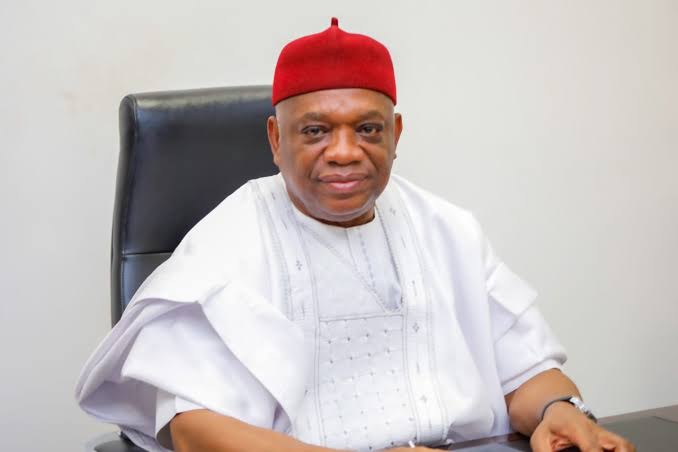
In politics, few exchanges capture the foundational differences between the ruling party and the opposition quite like the recent verbal sparring between two prominent Abia Senators: Orji Uzor Kalu (APC, Abia North) and Enyinnaya Abaribe (APGA/Opposition, Abia South).
Senator Abaribe fired the opening shot, declaring with conviction that the intense economic hardship in the country makes President Bola Tinubu’s re-election in 2027 “impossible.” Senator Kalu, a stalwart and consistent backer of the President, wasted no time in delivering a sharp, comprehensive retort.
His response was more than just a defense of his principal; it was a political masterclass in projecting institutional confidence, asserting that the very premise of Abaribe’s analysis—that Tinubu can be defeated by traditional opposition methods—is fundamentally flawed and disconnected from the deep currents of Nigerian power.
The most striking and confident assertion from Senator Kalu was the phrase that encapsulates his political view of 2027: “Tinubu won’t be contesting the 2027 election with anyone but with Tinubu.” This is not a rhetorical flourish; it is a profound insight into the power of incumbency in Nigeria, a principle that Abaribe’s opposition views struggle to contend with.
What Kalu means is that the primary challenge facing any sitting Nigerian President is internal: the success or failure of their own policies, the unity of their own party, and the strength of the political machine they command. Kalu, speaking from his office in Abuja, framed President Tinubu’s mandate not merely as a political victory but as a “God-sent” intervention, signaling a deep, unwavering belief that the President is driven by a singular purpose that resonates far beyond partisan lines.
For Kalu, the argument is not about the popularity of the opposition; it is about the structural, institutional, and historical difficulty of unseating an incumbent who controls the levers of federal power and a vast, sophisticated political network. In this analysis, Abaribe’s focus on grassroots hardship, while politically relevant, misses the broader context.
Political power in Nigeria is secured through coalition building, institutional control, and the deployment of federal resources and influence—areas where the APC machine, led by a veteran like Tinubu, is virtually unrivaled. Why Abaribe’s hardshipdriven prediction is politically untenable. Senator Abaribe’s argument rests on a simple, democratic premise: Nigerians are suffering, and they will punish the ruling party at the polls.
He claimed the economic collapse and unresolved insecurity would mobilize the masses to ensure Tinubu does not return, even suggesting that Tinubu “never won the 2023 election” in the first place—a settled matter acknowledged by all political actors after the judicial process. While Abaribe’s emotion reflects the genuine pain of many citizens, Senator Kalu’s rebuttal essentially highlights why this grievance-based politics rarely translates into victory against a well-oiled incumbent machine: The Reform vs.
Resentment Gap: Kalu and other Tinubu loyalists argue that the immediate pain (removal of fuel subsidy, exchange rate liberalization) is the necessary cost of long-overdue structural reforms. They see Abaribe’s focus on his so-called present hardship as short-sighted, a failure to acknowledge the long-term vision.
Kalu suggests that by 2027, the results of these tough decisions—infrastructure improvements, economic stabilization—has begin to manifest, neutralizing the protest vote. The Opposition’s Achilles’ Heel: Disunity: Abaribe speaks of an opposition “coalition” united to dislodge the APC, even adopting the African Democratic Congress (ADC) as a potential platform. Kalu’s perspective finds this view highly questionable based on the practical realities of Nigerian politics. The opposition remains deeply fragmented.
The 2023 election demonstrated that the ability of rival opposition leaders (like Atiku Abubakar, Peter Obi, and others) to truly pool their resources and egos remains a profound challenge. Kalu sees a deeply divided field ensuring an easy path for the incumbent, no matter the level of public dissatisfaction. Abaribe’s claim of a consensus, Kalu would argue, has little basis in the long and fractured history of opposition movements in the country.
The Defection Strategy: Absorbing Strength, Not Problems. Senator Abaribe also critiqued the wave of defections to the APC, describing the ruling party as a “giant with feet of clay” that is merely absorbing its future problems.
Here, Senator Kalu’s staunch pro-Tinubu position offers a powerful counter-narrative. Kalu views the defections not as the importing of division, but as the calculated and successful strategy of building an unassailable national coalition. President Tinubu’s political strength has always been his ability to reach across divides and consolidate support. For Kalu, every defection is a vote lost to the opposition and a crucial political operative gained by the APC.