



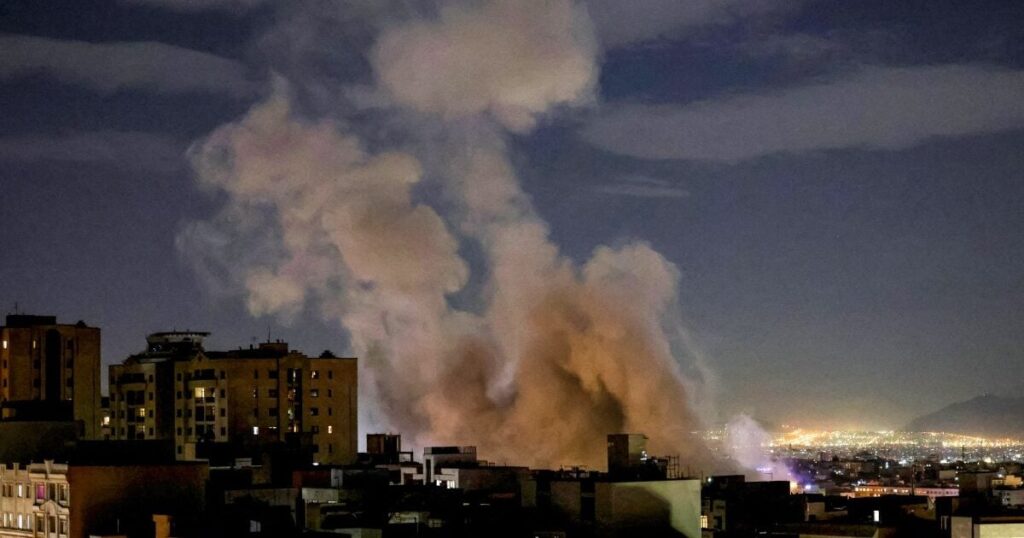
International airlines operating between Nigeria and the Middle East are counting losses running into billions of naira following the escalating conflict involving the United States, Israel, and Iran, which has forced multiple airspace closures and grounded aircraft.
Findings by The PUNCH show that major carriers operating daily flights between Nigeria and key Middle Eastern hubs were unable to operate scheduled services after the crisis intensified, leaving aircraft stranded and passengers disrupted.
Two major airlines flying into Doha, Qatar, and the United Arab Emirates were held back in Nigeria as hostilities escalated, and the airspace in parts of the region was shut.
Checks by The PUNCH revealed that Emirates and Qatar Airways have remained grounded at the Lagos airport due to the closure of the airspace in their home countries.
Both airlines were scheduled to operate high-capacity aircraft on the affected routes. Emirates was billed to deploy its Boeing 777-300ER, with a seating capacity of between 354 and 360 passengers, while Qatar Airways was to operate its Boeing 787-800, capable of carrying between 210 and 250 passengers.
Using the conservative seating figures of 354 passengers for Emirates and 210 for Qatar Airways, a minimum of 554 passengers were expected to depart Nigeria on a single rotation, with the cumulative average put at about 560 passengers.
Further checks on the airlines’ official websites showed that Qatar Airways sells one-way tickets within the range of N1.3m to N1.8m, while Emirates’ fares range between $1,380 and $2,395.
Using the lowest fare benchmarks of N1.3m for Qatar Airways and $1,380 for Emirates, and applying the official exchange rate of $1 to N1,379, an Emirates one-way ticket converts to N1,903,020.
At a seating capacity of 354 passengers, Emirates would have airlifted at least 1,416 passengers out of Nigeria between Saturday and Tuesday across multiple rotations. At N1,903,020 per passenger, this amounts to N2,694,674,320 for one-way trips and N5,389,348,640 for round trips.
Similarly, Qatar Airways, operating at 210 passengers per flight, was expected to transport 840 passengers within the same period. At N1.3m per passenger, the airline stood to generate N1,092,000,000 on one-way trips and N2,184,000,000 on round trips.
Cumulatively, both airlines are projected to have lost an average of N7,537,348,640 within the period under review. Beyond the airlines, the disruption also affects Nigeria’s economy and that of the carriers’ home countries through lost taxes and associated aviation revenues.
Passengers stranded
While airlines grapple with financial implications, passengers have expressed frustration over disrupted travel plans.
Many had arrived at the airport last Saturday with luggage in hand, only to be informed that flights could no longer proceed due to airspace closures triggered by missile exchanges and mounting military tensions in the region.
Some travellers were scheduled to fly through Middle Eastern hubs aboard Qatar Airways and Emirates before operations were abruptly halted. One of the stranded passengers, Dare Olanihun, told The PUNCH that the conflict disrupted a crucial business engagement abroad.
“If I had known that war would break out, I would have travelled earlier. This is a serious blow to me, honestly. Tears dropped from my eyes when we were asked to disembark on Saturday evening,” he said.
Olanihun explained that passengers initially believed the delay would be temporary before airlines later asked them to leave the airport. “This trip would have impacted my professional life greatly, but I can only pray that it is redeemable,” he added.
The aviation crisis followed widespread airspace restrictions across the Middle East. Syria reportedly closed parts of its southern airspace bordering Israel for 12 hours. Jordan conducted defensive drills and intercepted ballistic missiles, while Kuwait shut its airspace after engaging incoming threats.
Russia’s air transport authority, Rosaviatsia, suspended commercial flights to Israel and Iran until further notice, further compounding global aviation disruptions.
The PUNCH had earlier reported that the United States and Israel struck multiple locations across Iran, including Tehran, in what US President Donald Trump described as “major combat operations.”
Iran retaliated with missile strikes targeting northern Israel and US military bases in the Middle East, with both sides continuing exchanges amid heightened rhetoric.
Caterers feel the pinch The impact of the grounding has also extended to airport catering services.
Following an earlier directive by the Minister of Aviation and Aerospace Development, Festus Keyamo, mandating foreign airlines to patronise local caterers for outbound flights, caterers had recorded improved sales.
However, the suspension of flights on affected routes has partially reversed those gains. A caterer who requested anonymity due to the lack of authorisation to speak on the matter said the disruption forced her to resell prepared meals locally.
“Two airlines going to those routes are my customers. As a matter of fact, I had to sell the food I prepared for one of them locally during the weekend. We are praying to God for his peace across the nations of the world, and we are sure that our prayers will be answered,” she said.
Another caterer, Florence, said the conflict had both professional and personal implications for her. “Expectedly, the fight will affect us slightly, but my child is also in one of the concerned countries. I have been fasting and praying since Sunday, and I know that my God will restore peace in the zones,” she said.