

The closure of the Strait of Hormuz by Iran has triggered a sweeping disruption across global shipping and energy markets, energy security, with industry operators suspending voyages and insurers retreating from one of the world’s most critical maritime corridors. The crisis, which escalated after coordinated strikes by the United States and Israel on Iranian targets in late February, has effectively shut down a channel responsible for nearly a quarter of global oil flows.
War-risk premiums have tripled or quintupled due to heightened tension, sometimes reaching one percent of the total vessel value since the beginning of the war three weeks ago, such that the US International Development Finance Corporation now offers financing arrangements to support the provision of marine insurance facilities.
Shipping companies say operations have ground to a halt, with at least, 10 ships belonging to the Danish shipping giant, Maersk Line, reportedly stuck in the Upper Gulf. Danish shipping giant Maersk, alongside MSC, CMA CGM and HapagLloyd, have suspended transits through the Gulf, citing “unacceptable risk exposure” to vessels and crew.
“It’s a complete operational freeze,” said Lars Jensen, a container shipping analyst. “When you remove Hormuz from the equation, you are effectively cutting off a major artery of global trade. There is no scalable alternative route.” Vincent Clerc, CEO of Maersk Line, said “this evolving situation in the Middle East has created significant operational challenges for international shipping.
With the current security environment surrounding the Strait of Hormuz, and with transits through the Bab el‑Mandeb Strait being suspended as a precaution, vessels are being rerouted and cargo is being staged through alternative hubs.” Clerc said Maersk Line has temporarily suspended cargo services to the Gulf due to the ongoing war, especially since Iran’s proxies operates near Yemen.
The company added that, “This situation disrupts supply chains, impacts businesses, and creates uncertainty for logistics professionals and customers alike. War brings significant negative consequences not only to economies, but also to people and livelihoods across regions.” Despite the uncertainty, the company said worldwide operations continue working around the clock to keep supply chains moving and adapt operations as the situation evolves.
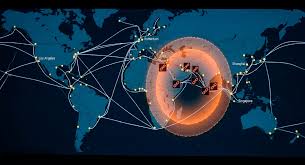
Industry estimates indicate that more than 1,000 vessels remain stranded or delayed, while tanker traffic has collapsed. Diversions around Southern Africa are adding up to two weeks to voyage times, tightening capacity and pushing freight rates sharply higher. Beyond logistics, safety concerns are mounting.
Maritime security consultant, David Smith, warned that the threat environment has fundamentally shifted. “We are seeing a combination of missile risks, drone activity and electronic interference. Even with naval escorts, confidence is extremely fragile,” he said. “One major incident could shut down traffic indefinitely.”
If shipowners are grappling with physical risk, insurers are confronting a crisis of liability. Major protection and indemnity providers, including Gard and Skuld, have either withdrawn or sharply limited war-risk cover in the region, effectively rendering voyages through the Gulf commercially unviable. “Risk in this environment is no longer conventionally priceable,” said Marcus Baker, global head of marine and cargo at Marsh.
“We are approaching a point where insurers cannot quantify exposure with any confidence.” War-risk premiums have surged from below 0.5 per cent of vessel value to as high as 3 per cent, multiplying costs several-fold and forcing charter renegotiations across the market. The broader economic implications are already reverberating.
According to the United Nations Conference on Trade and Development (UNCTAD), the disruption threatens to destabilise energy supply chains, push up food production costs and intensify global inflationary pressures. Oil prices have surged past $100 per barrel, with spikes nearing $126, raising concerns among economists about a renewed energy shock.
“This is not just a shipping crisis—it is a macroeconomic event,” said Fatih Birol, Executive Director of the International Energy Agency. “A prolonged disruption in Hormuz could slow global growth, particularly in energy-importing economies across Asia and Europe.” Nigerian analysts say the ripple effects could be significant for Africa’s largest economy, despite its status as a crude exporter.
“Higher oil prices may boost Nigeria’s fiscal revenues in the short term, but the net effect is negative when you factor in imported refined products and logistics costs,” said Bismarck Rewane, Chief Executive Officer of Financial Derivatives Company “It could worsen inflationary pressures and strain household purchasing power.” Emerging markets are especially vulnerable. Higher fuel costs, rising freight rates and supply chain delays could compound inflation and weaken already fragile currencies.
“There is a real risk of stagflationary pressure building globally,” said Razia Khan, chief economist for Africa and the Middle East at Standard Chartered. “Transport costs feed directly into food and consumer prices, and that has immediate social and economic consequences.” Maritime stakeholders also warn that Nigerian trade flows could face indirect disruptions.
“The increase in freight rates and insurance premiums will inevitably be passed on to import-dependent economies like Nigeria,” said Dr. Eugene Nweke, a maritime economist and former president of the National Association of Government Approved Freight Forwarders. “Even if cargo is not routed through Hormuz, the global supply chain effect means higher landing costs at Nigerian ports.”
Legal experts also warn that the blockade raises serious questions under international maritime law, particularly the principle of transit passage under the UN Convention on the Law of the Sea, though enforcement remains uncertain amid escalating military tensions. For now, industry players are bracing for a prolonged disruption. Shipping lines are redrawing global routes, insurers are tightening underwriting standards, and energy markets are pricing in sustained volatility.