



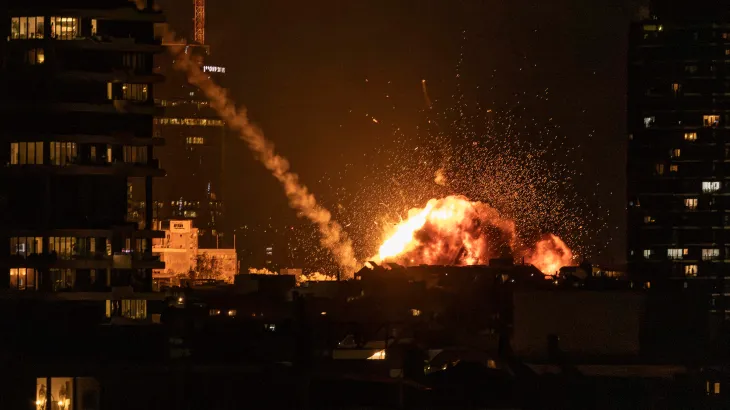
Iranian Supreme Leader, Ali Khamenei, was killed in an Israeli strike Saturday as part of a massive joint military operation between the U.S. and Israel, Israel’s ambassador to Washington told U.S. officials. An Israeli official confirmed that Khamenei died, according to Israeli intelligence.
The 86-year-old Khamenei led Iran for 35 years, making him one of the world’s longest-serving authoritarian rulers. His death is a massive blow to the regime and could accelerate its collapse, which U.S. and Israeli officials have stated as a goal of their operation.
Khamenei’s killing sets off an immediate succession crisis with no clear answer. Under Iran’s constitution, a council of clerics is meant to select a new supreme leader but Israel’s strikes also targeted senior Islamic Revolutionary Guard Corps (IRGC) commanders and political leaders, leaving the regime’s chain of command in disarray.
Israeli officials say they assess the Iranian minister of defense and the commander of the IRGC were also among those killed in targeted strikes on Saturday. Between the lines: Whether the IRGC moves to seize control or whether the strikes create the popular opening Israeli Prime Minister Benjamin Netanyahu and President Trump have both called for remains unclear.
Israeli officials said Israel targeted Khamenei’s sons, but intelligence assessments suggest they survived the strikes. Mojtaba Khamenei, one of the supreme leader’s sons, had been widely discussed as a possible successor to his father.
Khamenei took power in 1989 following the death of revolutionary founder Ayatollah Ruhollah Khomeini, and spent 35 years consolidating near-total control over the Iranian state. Iran’s exiled former crown prince Reza Pahlavi, a leading opposition leader who has organized mass protests against the regime, also called for the Iranian people to take to the streets.
Pahlavi urged Iranian security forces: “Join the nation and help ensure a stable and secure transition. Otherwise, you will sink with Khamenei’s ship and his crumbling regime.” Meanwhile, massive military escalation in the Middle East triggered a widespread airspace shutdown yesterday, severely disrupting global aviation.
The crisis began following joint United States and Israeli strikes on Iranian targets, including Tehran, which prompted immediate retaliatory missile attacks from Iran. The conflict has forced the closure of some of the world’s most critical air corridors and hubs.
Multiple nations have shut their skies to civilian traffic, creating a “no-go zone” stretching from the Mediterranean to the Persian Gulf. Iran, Israel, Iraq, Qatar, the United Arab Emirates, Bahrain, and Kuwait closed their entire airspaces until further notice.
The United Arab Emirates (UAE) temporarily closed its skies, while Syria and Jordan implemented significant restrictions and reported active military engagement of incoming projectiles. Dubai International (DXB), the world’s busiest international airport, suspended all operations indefinitely.
This paralysed the primary transit artery connecting Europe, Africa, and Asia. Dubai is not just an airport. It is the single largest connecting hub between Asia, Europe, Africa, and the Middle East.
Every flight from Mumbai to London, from Singapore to Frankfurt, from Nairobi to New York that routes through the Gulf is now either cancelled, delayed, or burning extra fuel on thousand-mile detours around closed airspace. IndiGo suspended flights to Almaty, Baku, Tashkent, and Tbilisi until March 28.
A month of Central Asian connectivity was erased because Iranian missiles crossed the flight paths. Major carriers, including Emirates, Qatar Airways, Etihad, Air India, Turkish Airlines, and Lufthansa, suspended dozens of routes. More than 9,600 flights were delayed and over 500 have been cancelled globally within the first few hours.
Airlines were being forced to reroute long-haul flights (e.g., Mumbai–London or Singapore Frankfurt) thousands of miles around the restricted zones, significantly increasing fuel consumption and flight times.
The European Union Aviation Safety Agency (EASA) issued a high-risk alert for the entire region, warning of potential misidentification of civilian aircraft and spillover risks from missile activity. As of 7:00pm WAT yesterday, the scale of aviation disruption was unprecedented, with the simultaneous closure of major global transit hubs and critical air corridors.
While the total number of suspended aircraft fluctuated as planes were grounded or diverted, current data from FlightAware and regional aviation authorities highlight the massive impact. Over 500 flights had been officially cancelled worldwide in the first few hours of the crisis.
More than 9,600 flights have been delayed as airlines scramble to reroute around the closed airspaces of Iran, Israel, Iraq, Jordan, the UAE, Qatar, and Kuwait. Within the Middle East, flight operations have effectively ceased at major hubs.
For example, Israel reports that approximately 40 per cent of its daily scheduled flights were cancelled, while overall Middle Eastern flight volume has dropped by nearly 7 per cent globally within 12 hours. The closure of the “Big Three” Gulf hubs—Dubai, Doha, and Abu Dhabi- caused a massive “choke point” for East-West travel.
Flight tracking maps (Flightradar24) showed a large “hole” in global traffic, with the following airspaces completely empty of civilian aircraft. Airlines operating between Europe and Asia/India were forced to fly significantly longer routes (up to 2+ hours extra) to avoid the conflict zone.
Some North American flights to India were requiring unscheduled refuelling stops in cities like Vienna or Rome because they could no longer overfly Iraq or Iran.