



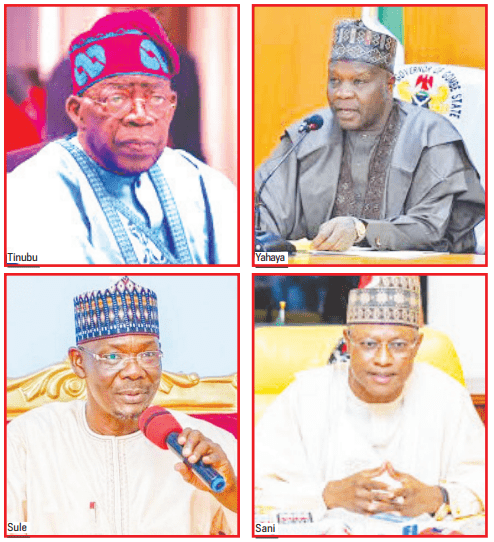
- Issues as northern govs move to tackle insecurity
ANAYO EZUGWU examines the move by the Northern Governors Forum and traditional rulers in the region to address unending killings, kidnapping and insecurity in that part of the country
As Nigerians begin the New Year, all eyes are on governors of the 19 states in the northern part of the country to end wanton killings, kidnappings and general insecurity in the region as the governors have vowed to tackle the region’s major challenges, primarily insecurity, poverty, and education.

It is believed that in many quarters that the decision of the governors to launch a regional security trust fund, push for state police, call for a suspension of mining due to its link to insecurity, and coordinating security strategies with traditional rulers and the federal government, will improve security in the region and enhance development and stability. President Bola Tinubu had on November 26, 2025, declared a national security emergency across the country.
He said ordered the Nigerian Army and Nigeria Police to recruit more men. He directed the Department of State Services (DSS) to immediately deploy forest guards to flush out terrorists in the country’s forests. Tinubu charged the National Assembly to put necessary machinery in motion to amend the laws to allow willing states to establish state police in their respective states.
He charged herders’ associations to surrender their illegal arms and end open grazing, saying ranching is the path forward for sustainable livestock farming and national harmony. The President also urged Nigerians to remain calm and vigilant, while not hesitating to report suspicious movements to the relevant authorities.
“Today, in view of the emerging security situation, I have decided to declare a nationwide security emergency and order additional recruitment into the Armed Forces. “By this declaration, the police and the army are authorised to recruit more personnel. The police will recruit an additional 20,000 officers, bringing the total to 50,000.
Although I had previously approved the nationwide upgrade of police training facilities, the police authorities are by this statement authorized to use various National Youth Service Corps camps as training depots.” Following the decision of the President, Northern governors met in Kaduna on December 1, and warned that the region stood on the brink of losing its future to escalating insecurity and deepening poverty, unless leaders took urgent, decisive action.
They also called for state police as a way out of the high level insecurity in the north, and asked for a 6-month ban on mining in the region. Speaking at a joint meeting of the governors’ and Northern Traditional Rulers Council, Chairman of the Forum and Gombe State Governor, Muhammadu Inuwa Yahaya, said the north was currently confronted with “the grim reality of insecurity and poverty that seek to undermine our very existence.”
The two-day meeting, held at Kaduna State Government House, drew 19 governors, traditional rulers, security chiefs and civil society representatives in what was described as a final push for a coordinated response to terrorism, banditry and social decay in the region. Governor Yahaya said future generations would judge today’s leaders not by the number of projects they commissioned but by whether they were able to bequeath to them a northern Nigeria they could truly call home.
He paid tribute to President Bola Tinubu, commending his “strong leadership and steadfast commitment to Nigeria’s security, sovereignty and territorial integrity,” especially in the rescue efforts for abducted schoolchildren. The governor extended condolences to families of pupils abducted in Kebbi, Kwara, Kogi, Kano, Niger and Sokoto states, as well as victims of recent Boko Haram attacks in Borno and Yobe states.
He insisted that attacks on education were an assault on the region’s destiny. Warning that insecurity spared no one, poor or rich, Muslim or Christian, Governor Yahaya sought an end to partisan bickering and a united stand to “ensure the very survival of the north and Nigeria at large.” He also called for the rejection of divisive narratives, saying the crisis was driven not only by crime but also by underdevelopment, illiteracy, poor resource management, climate change and the abandonment of millions of Almajiri and out-of-school children.
“An attack on education is a direct assault on our future. I urge us all to work with the Federal Government, security agencies, local and international stakeholders to ensure that all necessary measures are put in place to protect our schools and provide a safe and secure environment where our children can pursue their education and the rest of the society can carry out their livelihood activities without fear of molestation.
“The security situation in North ern Nigeria has escalated from a localised challenge to a national and existential threat. It endangers the present and mortgages the future of our region. This menace spares no one; it consumes the poor and the rich, Muslims and Christians, the young and the old.
“Now is not the time for politics; it is the time for a concerted action to ensure the very survival of the North and Nigeria at large. Let us be clear: without peace and security, there will be no politics to play, and no state or country to govern. “At this critical moment, we express our strong and unflinching support to President Bola Ahmed Tinubu. We commend the decisive efforts he is taking to secure our nation, especially in the face of heightened international pressure.
While we welcome constructive international cooperation in tackling our security challenges, such help must be offered in a manner that preserves Nigeria’s territorial integrity, dignity and sovereignty, while acknowledging our complexities. “The security challenges we are facing are multifaceted. Our people, Muslims and Christians alike, continue to suffer from these acts of terror and criminality. Members of our armed forces, drawn from every tribe and faith, have paid the supreme price and are working tirelessly to defeat our common enemies and protect our communities.
“We must, therefore, resist the urge to promote simplistic, divisive, and one-sided narratives that undermine national cohesion, entrench divisions, and ultimately harm our collective efforts. The objective of our enemies is to sow discord and distrust amongst us; we must not allow them to win. “While we confront these threats, we must acknowledge that they do not exist in a vacuum. As leaders, we must take full responsibility.
The roots of these crises lie in the deepseated problems of underdevelopment, illiteracy, crippling lack of opportunities, as well as the pressing challenges of climate change, environmental degradation, and poor resource management. These factors exacerbate existing tensions, fuel conflicts over dwindling resources, and deprive our rural communities of their very livelihoods.” Topping the agenda was a renewed call for the establishment of state police.
Reaffirming the May 10, 2025, communique of the NSGF, the governors said state policing remained “a critical and effective mechanism” to address today’s security challenges and urged the National Assembly to fast-track constitutional amendments required to make it a reality. Traditional rulers were tasked to deploy their influence as “stabilisers,” while religious leaders were urged to preach tolerance and avoid incendiary rhetoric. Political leaders, the forum warned, must desist from exploiting ethnic or religious differences for political gains.
Security agencies were equally encouraged to maintain proactive surveillance and timely responses, while the judiciary was called upon to ensure swift criminal justice delivery. In a joint declaration, the governors pledged to work closely with the federal government, under Tinubu, “to turn the tide and ensure lasting peace and stability for our region and the nation at large.”
This is even as Kaduna State Governor, Uba Sani, urged his colleagues and traditional rulers to close ranks and confront the region’s deepening security challenges with sincerity and collective resolve. He commended the forum’s chairman for what he described as steady and courageous leadership, while paying tribute to traditional rulers for their stabilising role, saying their guidance remained critical in a region battling multiple threats.
Sani warned that despite progress, the north was witnessing a disturbing trend where insecurity was being politicised by some opposition elements “seeking to amplify fear and weaken public trust.” He said: “We must resist this behaviour and work together to address the security situation. We have a President who understands the north, values the north, and consistently respects our perspectives.”
Reiterating his long-standing call for state police, Sani noted that Nigeria’s highly centralised policing structure was no longer effective for a country of over 230 million people with vast areas that remained difficult to secure. He urged northern leaders to have frank conversations, embrace bold reforms and demonstrate the visionary leadership their people expected.
“History will remember the choices we make in moments like this,” he said. Speaking on behalf of the traditional rulers, the Sultan of Sokoto, Alhaji Sa’ad Abubakar III, threw his weight behind the governors, urging them to intensify their efforts in tackling insecurity and socio-economic hardship. “As leaders, we need to really tell ourselves the truth. But I want to assure you, we are 100 per cent with you in this drive to make the north a better place because we don’t have any other place to be,’’ he said.
The Sultan said the region was at a defining moment that demanded honesty, courage and unwavering collaboration among political and traditional leaders. He said the meeting offered yet another chance to “deliberate seriously” on threats to the stability of the north and the unity of Nigeria, stressing that leaders must be truthful with one another and with citizens. Governor Abdullahi Sule of Nasarawa State has clarified the recent decision to suspend mining activities across the state.
Speaking on Monday in Lafia during a meeting of the State Executive Council, the governor explained that the action is not a total ban on mining for six months, but rather a temporary halt on issuing new licences pending the verification of genuine operators.
According to him, the verification exercise aims to identify legitimate miners and curb illegal mining activities, which contribute no revenue to the state and have been linked to rising insecurity. Governor Sule noted that illegal miners have aided bandits, kidnappers, and other criminal elements, making it necessary for the government to regulate the sector more effectively. He assured that the suspension will not deprive Nasarawa or any other affected state of revenue, emphasising that the measure is intended to strengthen oversight and enhance safety.
The decision of the Forum has continued to garner support among interest groups in the region. For instance, the Uba Sani Back2Back Movement (USB2B) has expressed full support for the sweeping security measures adopted by the Northern States Governors’ Forum and the Northern Traditional Rulers’ Council at their recent joint meeting in Kaduna, describing the resolutions as the most decisive regional security intervention in years.
The Director of Strategic Communications of the Movement, Khadija Mohammed, said USB2B had carefully reviewed the Kaduna Declaration Against Insecurity and concluded that it represents a bold and coordinated push to restore peace across the North. She welcomed the governors’ decision to suspend all mining activities for six months and revalidate existing licences, noting that illegal mining has long served as a major revenue source for criminal groups.
“For the first time, the North is taking a collective economic stand against those funding insecurity,” she said. Mohammed also praised the establishment of a N1 billion monthly Regional Security Trust Fund, describing it as a landmark step toward long-term regional stability. She noted that the unified funding structure would strengthen intelligence gathering, boost rapidresponse operations and improve cross-border coordination—areas where individual states have struggled due to fragmented strategies.
Reiterating the group’s longstanding stance, USB2B reaffirmed its support for the renewed call for state police, insisting that the North’s vast landmass and evolving security threats can no longer be effectively managed through a centralised policing system. “State policing is not only logical—it is now a survival imperative,” she said.
Mohammed further commended the leadership of Kaduna State Governor, Senator Uba Sani, whose strategic contributions, she said, helped shape the urgency and clarity of the Kaduna Declaration. She described him as “a regional stabiliser and a national voice on security reform.” The Movement pledged to mobilise public support for the implementation of the resolutions, while sustaining advocacy and monitoring to ensure the measures translate into visible improvements in affected communities. “The North is standing together,” Mohammed said. “Insecurity will no longer be tolerated, financed or enabled.”
As a result of the decision of the Northern Governors, two umbrella unions of stakeholders in the mining industry – the Miners Association of Nigeria (MAN) and the Nigerian Union of Mine Workers (NUMW) – have vehemently rejected the suggestion by Northern governors for mining exploration to be suspended in the region as a strategy for tackling banditry and insurgency.
They have therefore called on Tinubu and the National Assembly to outrightly discard the recommendation, saying the negatives of such an action overwhelmingly outweigh the positives. Miners Association of Nigeria is the umbrella body for all mineral title holders in the Nigerian Mining Ecosystem.
At the same time, the Nigerian Union of Mine Workers (NUMW) represents workers in Nigeria’s mining, quarry, energy, and related sectors. The unions insist that legal mining exploration is legitimate and that halting it would reverse the gains made by the present administration in revitalising the once-comatose mining industry.
The roots of these crises lie in the deep-seated problems of underdevelopment, illiteracy, lack of opportunities as well as the pressing challenges of climate change and poor resource management
In a statement entitled “Mining and Insecurity: Call for Suspension of Mining Activities in Northern Nigeria Not the Solution”, jointly signed by its national president, Mr Dele Ayanleke, and national secretary, Sulaiman Liman, the Miners Association faulted the NGF while acknowledging “the dire security situation” in the country.
The association noted that insecurity is a national malaise affecting all sectors, adding that the concentration of criminal activities in rural farming and mining corridors is due to the remote nature of these locations, which are far from well secured urban centres under the oversight of security agencies.
It argued that “a nexus has not been established between legal mining and terrorism, banditry and kidnapping,” stressing that it is disorderly illegal mining, conducted without licences or regulation, that leads to money laundering and fuels insecurity.
According to the Miners’ body, a clear distinction must be made between legal and illegal mining, stating that “stigmatising mining as the cause of insecurity is a misnomer.” “Going by antecedents, banning mining activities in Nigeria as a solution to curbing insecurity has not yielded any positive results.
For instance, in 2019, the government imposed a ban on mining operations in Zamfara State. Unfortunately, the waves of banditry, kidnappings, terrorism and illegal mining have been escalating, not only in Zamfara, but in adjoining states of Katsina, Kaduna, Niger, Kebbi and others.
“It should also be registered that the victims of the ban are legitimate industry stakeholders who are denied access to their minefields by overzealous security operatives, whereas illegal miners turned bandits and terrorists continue ‘feeding fat’ with the active support of their sponsors. This is made possible by the government’s lack of adequate logistics and personnel to enforce the ban,” the miners asked.
Also, the National Union of Mine Workers (NUMW) described the Northern governors’ call as “misleading and unwarranted.” Its president, Hamza Muhammad, speaking to journalists in Abuja at the weekend, said the call reflects “a leadership deficit at the level of states in the north” and urged governors to use the powers at their disposal to provide good governance and tackle insecurity. Mohammed called upon governors of states in northern Nigeria to summon the political will needed to tackle insecurity in their jurisdictions, adding that banning mining would worsen unemployment and insecurity