
- Lingering leadership crisis dims PDP’s
- Resurgence hope ahead 2027 elections
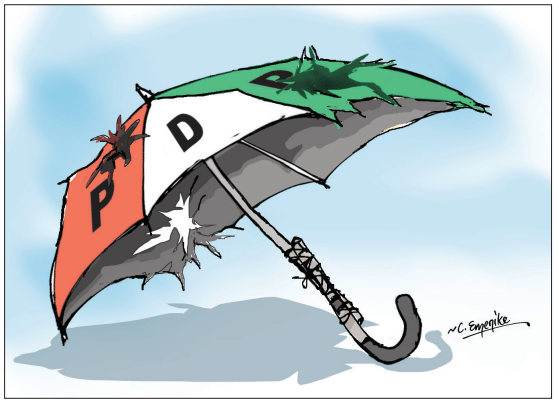
FELIX NWANERI writes on the crisis presently rocking the Peoples Democratic Party (PDP), which is a replay of internal squabble that usually rock the party whenever it is preparing for a major election
There is no doubt that the Peoples democratic Party (PDP) has remained one of the country’s dominant political parties in the present political dispensation, however, internal strife has been part of its chequered history since its formation in 1998. 
The party won the presidential elections in 1999, 2003, 2007 and 2011, but the 16 years it was in power was characterised by polarization over struggle for tickets, particularly among presidential aspirants; first term governors, who were bent on running for second terms and outgoing governors, who insisted on anointing their successors against the wishes of party members.

The power-play, which continued even after the party lost power in 2015, is already playing out ahead of the 2027 general election as the battle for the party’s national leadership and control of its structures, has not only pitted its chieftains against each other, but forced the police to seal the party’s national headquarters in Abuja, last week.
The decision by the police was after rival factions of the party – Kabiru Turaki-led National Working Committee (NWC) elected recently at the Ibadan national convention and the Abdulrahman Mohammed, faction loyal to the Minister of the Federal Capital Territory, Nyesom Wike – clashed over control of the Wadata Plaza as the PDP headquarters is known..
The Wike faction had earlier rejected Turaki’s emergence as Umar Damagum successor had earlier on the ground that the Ibadan convention violated an existing court order restraining it. Interestingly, it was at the same convention that Wike and other including Samuel Anyanwu (factional national secretary) and former Governor Ayo Fayose were expelled from the PDP.
The Wike-backed faction, in counterexpulsion announced after last week’s clash, announced the expulsion of Governors Seyi Makinde (Oyo State), Bala Mohammed (Bauchi State) and Dauda Lawal (Zamfara State), Also expelled are chairman of PDP BoT, Adolphus Wabara; former National deputy Chairman of the party, Bode George and Turaki.
2003 experience
The road being travelled by the PDP is not a new one. The party first experienced it in the build-up to the 2023 general election, following a plot by some governors of the party to draft then Vice-President Atiku Abubakar into the 2023 presidential race.
The plot, which was aimed at dislodging the then incumbent president, Chief Olusegun Obasanjo, raised so much dust within the PDP though Atiku later opted for a joint a ticket with his principal. It was a similar story in some state chapters of the party as those who contested the governorship primaries with then incumbent governors were forced to quit the PDP for the opposition parties to actualize their dreams.
Inclusion, not exclusion, is the tradition of the PDP. So, we must strive to bring all sides back to the table to save the PDP and save Nigeria’s democracy
However, majority of the defectors returned to the party shortly after the polls, with some of them offered juicy appointments to, perhaps, calm frayed nerves. But some political watchers posited then that the reconciliation was a make-believe one that would not stand the test of time given that the PDP is made up of politicians with divergent ideologies.
Polarization ahead of 2007 polls
As predicted, the bubble burst again in the build up to the 2007 general election as the PDP witnessed more polarization. Several state chapters of the party saw the emergence of factional executives that went as far as conducting their own congresses. The climax was the setting up of a factional national secretariat in Abuja by the Chief Solomon Lar-led faction. Lar (now late) was the first national chairman of the party.
The group went ahead to announce a National Executive Committee (NEC). Some then governors elected on the platform of the party masterminded the plot and they were backed by several members of the party in the National Assembly at the time, who stood against the alleged third term agenda of then President Olusegun Obasanjo.
Although the idea of a faction was said to have been considered as an option by the Lar group to win control of the party’s machinery from the Obasanjo/Ahmadu Ali (then national chairman) faction, the need to save the political careers of PDP members of the National Assembly was largely responsible for it.
The Ali group was said to have then concluded arrangements to expel the lawmakers over their refusal to support the stand of the party as regards the botched third term bid.
The expulsion was due to be announced before the Lar group struck. Also, the botched plot to stop Obasanjo from contesting the 2023 presidential election, which pitted him against Atiku, led to a cold war that degenerated to a bitter political battle by 2006, when Atiku declared his ambition to succeed Obasanjo.
Obasanjo’s insistence that Atiku will not succeed him forced the then vice president to leave the PDP for the defunct Action Congress (AC), which handed him its presidential ticket, but he host the poll to Obasanjo’s anointed candidate – Umaru Yar’Adua.
Row over ideology, presidential ticket in 2010
Reminiscent of the 2007 scenario and as believed by many that internal squabbles have become part of the PDP, whenever it is preparing for a major election, aggrieved members of the party under the aegis of PDP Reform Group, led by a former Senate President, Ken Nnamani, emerged on the political scene in April 2010, to demand for a return to the ideologies of the party’s founding fathers. The then leadership of the party under Prince Vincent Ogbulafor, however rose against the “rebels” by suspending them from the party.
Among those affected then alongside Nnamani were Senator Adolphus Wabara (also a former Senate President); former Speaker of the House of Representatives, Aminu Bello Masari; ex-Governors Peter Odili (Rivers) and Achike Udenwa (Imo). The party was faced with another challenge after the internal uprising.
This time, it was the battle for its presidential ticket for the 2011 general election. Initial calculation was the presidency will remain in the North for eight years (2007-2015), with Umaru YarÁdua emergence as Obasanjo’s successor, but power shifted unexpectedly to the South as Yar’Adua death in May 2010, saw his vice, Goodluck Jonathan, being sworn-in as president.
Jonathan’s declaration for the 2011 presidential election generated much controversy within the PDP. Although he was able to defeat his closest challenger, Atiku, in the PDP presidential primary election and went ahead to win the general election, his candidacy disrupted the party’s power sharing arrangement.
Revolt in 2013
While successive PDP leaderships were able to suppress the 2003, 2007 and 2010 revolts against the party; that of 2013 proved the last straw that broke the camels’ back. First, the face-off between the then National Chairman, Alhaji Bamanga Tukur and some governors led to the latter’s resignation on January 15, 2014. Tukur had before then insisted that he will not resign on the ground that it is only the party’s convention that can remove him.
With Tukur’s ouster, the PDP, settled for a former governor of Bauchi State, Adamu Mu’azu, as national chairman. His emergence as a consensus candidate followed series of meetings between then President Jonathan, PDP governors and other party bigwigs. Despite the change of guard, the crisis festered.
The party lost former Vice President Atiku Abubakar and four of its governors to the then opposition All Progressives Congress (APC) in one fell swoop. The monumental loss was over the party’s presidential ticket as Jonathan was granted an automatic for the 2015 elections.
The decision, which was hinged on the Right of First Refusal led to the affirmation of his candidacy at the party’s national convention despite insistence by some members of the party that the contest for the ticket be thrown open. Perhaps, the power play explained why the then ruling party went into the 2015 elections a divided house and was handed a shocking defeat.
The PDP, not only lost the ultimate prize – the presidency, but most of the states it hitherto controlled and its majority in the National Assembly. While the aftermath of the 2015 elections left the PDP with bruises, measures were put in place shortly after the polls to rebuild the party.
The rebuilding effort, however, turned a mirage, when the party got hijacked by a former governor of Borno State, Ali Modu Sheriff. Consequently, attention shifted on how to free the party from Sherrif’s grip. Report had it then that besides the chairmanship of the party, the former governor’s main target was the 2019 presidential ticket of the party.
However, Sheriff’s sack as national chairman at the party’s national convention on May 21, 2016, did not bring the envisaged peace. The battle for the soul of the PDP shifted to the courts as the Sheriff-led National Working Committee (NWC) and National Caretaker Committee led by a former Kaduna State governor, Ahmed Makarfi, respectively, claimed to be the authentic leadership of the party.
As a way out, some chieftains of the party advocated an out of court settlement but both camps remained adamant to such call. The legal battle got to a height ahead of the September 2016 governorship election in Ondo State and it was the Makarfi faction that triumphed after the Court of Appeal sitting in Abuja, recognised the winner of the primary election it conducted – Eyitayo Jegede – as PDP’s candidate for the poll.
Though the party lost the Ondo governorship election to the APC, members of the Makarfi faction viewed the judgement as one that affirmed their claim to the leadership of the PDP. Sheriff, however, appealed against the judgement and it was a setback for the Makarfi’s camp, when the Court of Appeal sitting in Port Harcourt, confirmed the former Borno governor as PDP national chairman. The battle later moved to the Supreme Court, which on July 12, 2017, reinstated Makarfi as the chairman of National Caretaker Committee of the party.
With Sherrif out of the way, the next battle was that for the party’s presidential ticket for the 2019 elections. Like in the past, party leaders and chieftains realigned tto push for the candidacy of their preferred aspirants. As expected, the realignment caused a division within the party.
For instance, the ambition of the then governor of Sokoto State, Aminu Tambuwal that had the endorsement of his then Rivers State counterpart, Wike, pitted their camp against that of Atiku. While the former vice president triumphed in a keenly contested presidential primary that held in Port Harcourt, the Rivers State capital, he lost the main election to the then president – Muhammadu Buhari.
Battle for structures pre-2023 polls
The PDP had what could be described as its worse internal wrangling during the build-up to the 2023 elections. The crisis began with the battle for the party’s structure that saw the removal of the then National Chairman, Prince Uche Secondus, in October 2021. The belief of those who spearheaded his ouster was that it will bring cohesion to the party ahead of the 2023 elections.
Whereas the Secondus must go campaigners led by then Governor Wike, reasoned that the then PDP chairman lacked what it takes to lead the party to victory in the 2023 polls, some discerning political minds expressed the view that the bone of contention was control of the party’s structure by those who had their eyes on the 2023 presidential ticket of the party.
The pro and anti-Secondus camps, however, reached a sort of compromise by bringing forward the national convention that was earlier scheduled for December 2021. But, in a twist, some members of the party approached a High Court in Rivers State, which granted an interim order that restrained Secondus from parading himself as the national chairman of the party. The party subsequently named Yemi Akinwonmi, Deputy National Chairman (South) as acting chairman.
Hours later, a Kebbi State High Court ordered the return of Secondus as national chairman. Before then, the PDP had announced October 30 and 31, 2021, as dates for the conduct of its national convention that saw the emergence of a former President of the Senate, Iyorchia Ayu, as national chairman. Ayu, a consensus candidate, took over the leadership of the PDP alongside 20 others elected into various positions of the NWC and it was envisaged that the party was on a good stead in its bid to return to power.
What however ensued was another round of infighting over the party’s presidential ticket for the 2023 general election. As expected, the May 28, 2022, presidential primary election of the party was characterised by high level politicking that pitted the aspirants against each other. The contest was however won by Atiku, who polled 371 votes to defeat his major challenger, Wike, who garnered 237 votes.
We will overcome the current problems and resolve the internal power struggle and PDP will rise again
While most of the presidential aspirants pledged to rally behind Atiku and work for the success of the party in the presidential election, there was no doubt that the PDP further suffered polarization thereafter. Matters became worse over Atiku’s choice of then governor of Delta State, Ifeanyi Okowa, as his running mate. Many had thought that Wike’s performance at the presidential primary would earn him the party’s vicepresidential ticket but that was not to be.
It was reported that 14 members of the 17-man panel set-up by the party to advise its leadership and Atiku on the choice of vice-presidential candidate, recommended Wike but Atiku opted for Okowa, an action that infuriated members of Wike’s camp, who insisted that Ayu must step down in line with a pre-convention agreement that he would step down if a presidential candidate emerged from the North.
Ayu, on his part, vowed not to resign. He insisted that he was elected based on laid down rules of the party and that the presidential candidacy of Atiku did not in any way affect his position as national chairman. He further argued that he stood for election and won a four-year term, wondering why some people would be calling for his resignation, when he was yet to spend even a year in office. Wike fired back at Ayu with a warning that he (Ayu) might cause the party to lose the presidential election.
However, despite Wike’s insistence on the pre-convention agreement that Ayu, who hails from Benue State (North Central) should resign as national chairman for a southerner to take over the position, some analysts then expressed the view that he was waging a battle against Atiku. Wike accused party stakeholders from the South of betrayal and later ruled out support for Atiku as long as Ayu remained in office as the party’s national chairman. Several meetings were held to reconcile both camps but nothing came out of them.
The aftermath of the crisis was that five of the party’s governors known as G5 – Wike, Okezie Ikpeazu (Abia), Ifeanyi Ugwuanyi (Enugu), Seyi Makinde (Oyo) and Samuel Ortom (Benue) – withdrew support for Atiku and there is no disputing the fact that the party went into the 2023 elections a divided house.
While the G5’s action, among other factors contributed to PDP’s loss of the presidential 2023 election, expectation after the poll was that the PDP leadership would put its house in order and rebuild ahead of the 2027 general election, however the pre-2023 elections crisis has continued to fester.
Besides the issue of Ayu’s continued stay in office as national chairman, the NWC’s suspension and expulsion of some chieftains of the party shortly after the elections triggered another round of crisis. Among those slammed with suspension include a former President of the Senate, Anyim Pius Anyim and ex-governor of Ekiti State, Ayo Fayose, while Ortom was referred to the party’s disciplinary committee for alleged anti-party activities.
The party had prior to the elections (February 10, 2023) expelled a former governor of Enugu State, Chimaroke Nnamani; Oluwajomiloju Fayose (son of ex-Governor Fayose0; Hon. Chris Ogbu (Imo), Ajijola Oladimeji (Ekiti), Olayinka Olalere (Ekiti), Akerele Oluyinka (Ekiti) and Emiola Adenike (Ekiti) over anti-party activities. The gale of suspension assumed another dimension, when the executive committee of the PDP in Igyorov Ward of Gboko Local Government Area of Benue State, on March 26, 2023, announced Ayu’s suspension with immediate effect.
Ayu was accuses of anti-party activities which contributed to PDP’s loss in his ward and local government in the governorship election. He was also accused Ayu of not paying his annual dues as enshrined by the party’s constitution and that he did not vote during the governorship and state Assembly elections held on March 18, 2023.
Ayu, not only dismissed the claims, but alleged that the executives of Igyorov Ward were doing the bidding of those he described as political gamblers. He maintained that the PDP constitution forbids any organ at the ward level from taking disciplinary measures against members of the party’s NEC.
In a counter-move, the Benue State Working Committee (SWC) of the PDP announced the suspension of the Igyorov ward. While many saw the action as a move to save Ayu, the cards crumbled, when a High Court in Makurdi, the Benue State capital, issued an interim injunction restraining Ayu from parading himself as PDP national chairman.
Reacting to the ruling, the PDP, on March 28, 2023, appointed its Deputy National Chairman (North), Damagum, as acting National Chairman. However, Damagum was continually under fire over what some members of the party described as rudderless leadership until the Ibadan convention that saw an end to his reign.
2027 rekindles another battle for party’s structure
There is no doubt that the crisis rocking the PDP at the moment is over control of the party’s structure between Wike’s camp and PDP governors led by Makinde and Mohammed ahead of the 2027 election, Wike, who was rewarded by President Bola Tinubu for his support for the APC in the 2023 presidential election, is said to be working to weaken the PDP given his endorsement of the President for a second term, while the governors under the aegis of PDP Governors’ Forum, on their part, are poised to have one of their own, possibly Makinde, emerge as the party’s presidential candidate.
It was against this backdrop that some analysts predicted a stormy session during the 98th National Executive Committee (NEC) meeting of the party in August last year. The belief ahead of the meeting was that the NEC would sanction members, who engaged in anti-party activities during the 2023 elections.
It was also believed that Damagum would revert to his position as Deputy National Chairman (North) to pave the way for election of national chairman, possibly from the North Central, where Ayu hails from. While the anticipated storm was carefully evaded by the PDP’s leadership and stakeholders apparently to save the party from implosion, there was no pretense on the need for genuine reconciliation hence the appointment a former Senate President and ex-governor of Kwara State, Dr. Bukola Saraki to lead the initiative.
The party, in the same vein, appointed a former governor of Akwa Ibom State, Udom Emmanuel, as chairman of the disciplinary committee to look into allegations of anti-party against some members during the last general election. Interestingly, little or nothing was heard about activities of the Saraki and Emmanuel committees and it was against this backdrop that many predicted that peace was not yet in sight.
As foretold, controversy greeted the state congress held in September 2024, with the leadership of the party confirming shortly after the exercise that it received complaints from 12 states. While intervention of some stakeholders of the party doused the dust over the state congresses, the party was enmeshed in another crisis over its national secretaryship, when Anyanwu and Sunday Ude-Okoye laid claim to the position.
The crisis stemmed from Anyanwu’s selection as the PDP governorship candidate for Imo State in 2023 and the party’s South-East caucus nominated Ude-Okoye to replace him. What later ensued was a legal battle that saw the PDP leadership in and out of the various levels of the court until a five-member panel of the Supreme Court ruled on the matter in favour of Anyanwu in May after the dispute had deepened divisions within the party.
No end in sight to crisis
As it stands, there seems to be no end in sight to the crisis rocking the PDP as the two warring factions continue to claim legitimacy. While the newly elected national chairman of the party (Turaki) has vowed not to surrender the party to those he described as “outsiders,” the Wike faction insisted that it will not recognize the Ibadan national convention.
Speaking on the escalating crisis, Turaki insisted he would not allow “outsiders” to take over the PDP. “We won’t give up our secretariat to outsiders, and we shall defend it with our lives,” he declared. However, it is hope amidst crisis as some chieftains of the PDP are confident that the former ruling party will overcome its current crisis.
This optimism is even when the party has lost four governors elected on its platform to the ruling APC. Governor Makinde, who is among those that believe that PDP is on the path to recovery, in his welcome address at the recently held national convention, said its outcome will turn the fortunes of the party’s national outlook.The party’s BoT chairman, Wabara, on his part, said PDP will not go into extinction.
A 2027 governorship aspirant in Oyo State, Chief Niyi Aborisade, who also believes that PDP will navigate through the crisis, said: “I still believe that we will overcome the current problems and resolve the internal power struggle. APC will soon see a mass departure of their members to PDP. When a lie runs for 20 years, one day the truth will catch up with it. Nemesis will soon catch up with APC and PDP will rise again,” he declared.
But a founding member of the party, Gbenga Olawepo-Hashim, insisted that the party’s revival depends on genuine unity and purposeful reconciliation. He warned that Nigeria’s democracy is at stake, if the main opposition party remains in crisis. “Inclusion, not exclusion, is the tradition of the PDP. So, we must strive to bring all sides back to the table to save the PDP and save Nigeria’s democracy,” he said, stressing that this is not the season to expel members but a season to reconcile and bring new members.