


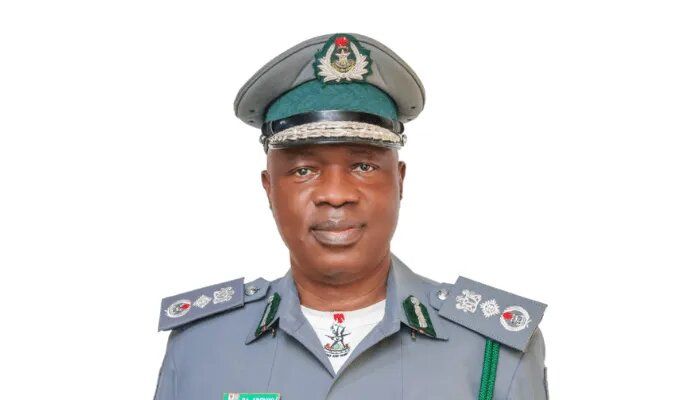
The newly elected president of the Nigeria Wrestling Federation, who is also the Comptroller General of the Nigeria Customs Service, Bashir Adewale Adeniyi, in an interview with New Telegraph’s CHARLES OGUNDIYA, said there are so many right people taking up the leadership of several sport federations in Nigeria. Excerpts…
Before coming to AFCON, what was your expectation of the Super Eagles?
Getting to the final is the basic minimum that I think Nigerians expected, especially after we crashed out of the World Cup. With those avoidable circumstances as they may be, naturally, Nigerians expect that we would have AFCON to redeem their image.
It was kind of a redemption expectation. Before, we used to see AFCON as a kind of birthright, that we are the giants of Africa. Playing in the semifinal was not just enough for us in AFCON. We’ve always thought that we should be knocking on the doors of Egypt, Cameroon and see how we can close the gap between us.
Logically, Nigerians were expecting that we would be in the final and like I’ve always said, being in the final of AFCON means that at one time or another, you have to show that you’re better than the host.
During the group stage, there were some kind of calculations here and there to ensure we do not square up against them in the early stages, so that neither of the two teams will take an early exit. It became inevitable that we had to confront them in the semifinals at that stage. I think it would have been easier to beat them in the final, but it is what it is. We had to succumb to circumstances, which we did, and that is quite unfortunate.
What are the lessons gained from the Super Eagles’ participation in this tournament?
There are some learning points for us that provide us with an opportunity for learning, which we take from this tournament. There are three key ones.
The first is that the AFCON window provides African countries, not just Nigeria, the opportunity to gather for quite some time. In the last two years or so, this is the first time that we kept our team together for a period of two to three weeks.
So, most of the time when we have World Cup qualifier matches, they come from the airport, go to the training pitch, train once or twice, and then they play a major match. The benefit of this is that we also had the opportunity to have a training match even before AFCON itself. We could have the opportunity to build a team to infuse some character, strength, and strategy into our team.
The second one is that moving forward, we must try to ensure that things that will create distractions are dealt with well ahead of time. These guys are professionals; they face these kinds of issues in their teams, and they have a way of ensuring that it doesn’t create problems for them, and you don’t hear things like allowances.
The third, and more importantly, is that our players, when they are in this kind of competition, must learn to avoid things that will make the technical team bring formations that are strange to the team. In a way, when you see your critical players getting yellow cards and some of them are very avoidable, and then you’re forced to make these adjustments here and there, it creates problems.
What has been your motivation coming into sport?
In terms of what is happening around the sports ecosystem, it’s not in isolation from the reforms from the president. We’ve seen far-reaching reforms, the economy, the petroleum industry, foreign exchange and things like that. We see those kinds of fundamental reforms in the sports industry, too.
The sports sector has not been left out in terms of reforms that are not only fundamental, but we are beginning to see their results. First is taking sports administration out of mainstream civil service and creating an autonomous commission for it that reports directly to the president, and that is being manned by sports professionals.
So we are beginning to see that the right kind of people, not some people somewhere who know next to nothing about sports, and then you bring them there to manage sports, and they run into difficult situations. I think everything speaks to that.
The moment they know their onions, the chairman, director general and some key professionals know their onions, and they are working with the federation. I happen to chair one of the federations, and these are federations that have people who have an interest in developing the sports. They invest their time, their resources.
These are not jobbers who do not have anything to do or those in sports administration who make a living. We are already beginning to see some positive developments out of these. I can’t wait for the major international tournaments; Commonwealth, African Games and hopefully the Olympics.
My federation, the wrestling federation, is already targeting what we are going to do in the Olympics. We are already building the set of wrestlers that we will send. I had conversations with some other sports federations, and I know that they are keeping an eye on it.
And I know that they are also having their eyes on the long-term goals. This is what I think is happening, and this is why we are also having that kind of thing in the Super Eagles. We now have a national team that is now having character, that is feared by so many countries, that is loved across the continent because of what we bring to the ecosystem.









