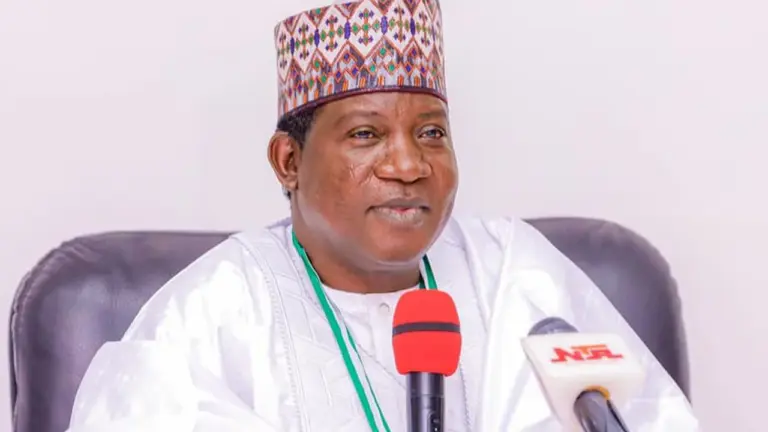



Chairman of the Independent National Electoral Commission (INEC), Prof. Joash Amupitan, SAN, has said he will not resign based on the demand by the African Democratic Congress (ADC) concerning the interpretation of the Court of Appeal judgement on the leadership tussle of the party.
INEC, in a statement by its Chief Press Secretary, Adedayo Oketola, drew the attention of ADC to the appointment, tenure, and removal of the Chairman and National Commissioners, pointing out that they are strictly governed by Section 157 of the 1999 Constitution (as amended).
“The Chairman does not hold office at the pleasure of any political party or interest group.
“Any call for removal outside the established constitutional process is not only a distraction but a direct assault on the independence of the nation’s electoral umpire,” Prof. Amupitan stated.
He explained that the INEC decided to comply with the judgement of the Court of Appeal to avert a situation that occurred in Zamfara State and Plateau State, where elected officials were removed by the Election Tribunal on account of the disobedience of the Court judgement.
“In addition, the commission did not want to disobey the preservative order of the court not to do anything or take any step that would render the processes already filed at the Federal High Court nugatory.
“Proceeding to monitor the congress and convention of the David Mark-led ADC would amount to a disobedience of that order since the relief claimed in the originating summons and other court processes filed include an order restraining INEC from monitoring any meeting, congress and convention of the party,” he said.
Prof. Amupitan stated that it was only on September 9, 2025, that INEC accepted and approved David Mark’s exco, which was seven days after the matter was filed at the Federal High Court.
“The order to maintain status quo ante bellum means the position of the parties before the beginning of hostilities.
“It is either that INEC obey the order of the Court of Appeal fully or refuse to obey it.
“Section 287(2) of the Constitution of Nigeria, 1999 mandates every person and authority in Nigeria not only to obey the judgement of the Court of Appeal but also to enforce such judgement,” he added.
Prof. Amupitan denied that he is undermining the multi-party system in Nigeria, explaining that he is rather expanding the democratic space.
He pointed at the recent registration and recognition of the Democratic Leadership Alliance (DLA), the Nigeria Democratic Congress (NDC) and the National Democratic Party (NDP), as an example, which he said, brought the number of active political parties in Nigeria to 22.
“INEC remains a neutral regulator, not a participant in political competition,” he assured.
Prof. Amupitan also defended the planned nationwide voter revalidation exercise by the commission, and the decision pre-dates his appointment as INEC Chairman.
“The proposed nationwide voter revalidation exercise is a professional necessity to strengthen the integrity of the national register of voters,” he explained.
He noted that the current register includes data spanning from 2011 to 2024, adding that the exercise is designed to sanitise the register and is to be executed in phases.
“The revalidation is intended to confirm the status of registered voters, address issues arising from transfers, multiple registrations and deceased persons, and enhance the reliability of voter data in Nigeria.
“It is an administrative audit, not a fresh registration.
“It is not targeted at any region, party, or demographic. It is a uniform, transparent process that will be conducted across all Local Government Areas and polling units, with robust digital options for ease of access. All the stakeholders will be carried along on this issue,” he further explaned