

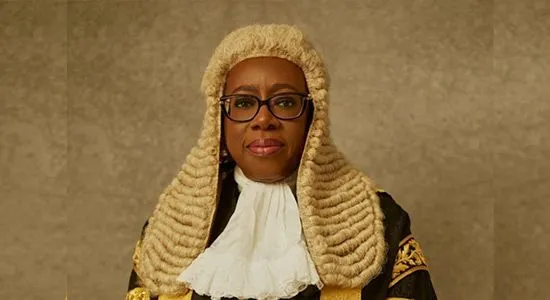
AKEEM NAFIU writes that lawyers have hailed Justice Kudirat Kekere-Ekun’s performance in the last 17 months of being at the helm as the Chief Justice of Nigeria
Some senior lawyers have thumbed-up efforts by the Chief Justice of Nigeria (CJN), Justice Kudirat Kekere-Ekun, to return the nation’s judiciary to its past glory. The lawyers, while assessing the CJN’s performance in the last 17 months of being at the pinnacle of decisions in the third arm of government aligned themselves with Justice Kekere-Ekun’s policies of charting a new course for the judiciary.
They said the CJN’s performance is a pointer to the fact that she had stood by all she said while taking the oath of office. In a media chat after her swearing-in as Acting CJN on August 23, 2024 by President Tinubu, Justice Kudirat Kekere-Ekun promised to take the judiciary to new heights, improve its reputation, and sustain public confidence in the judicial system.
She said: ”We will make sure that people have more confidence in the judiciary, and I believe that it is not a one-man job. We all have to be on board because we all see the areas that are in need of improvement. ”I believe that there will be maximum cooperation because we all want to see a better judiciary.
”A better judiciary is for the benefit of the entire nation. Whatever the shortcomings that we see today are, we are all members of the society. So, if we want to see a better society, if we want to see improvement, let the improvement start with each and every one of us and our approach to justice.
”Let us all have faith in the system and then also be particular about the process of appointment, I know it is a source of a lot of concern; the issue of discipline on the Bench and at the Bar as well. ”All of these things are aspects that we will look into and I believe that by the grace of God, at the end of my tenure, we should be able to have a judiciary that we will all be proud of”.
Seventeen months on, the CJN’s tenure has been characterized by efforts at restoring public confidence in the judiciary through institutional restructuring. The reforms cut across judicial discipline, the reorganization of the Supreme Court, technological innovation, judicial independence, staff welfare, among others
Reforms in Judicial appointments
As the Chairman of the National Judicial Council (NJC), Justice Kekere-Ekun is implementing sweeping reforms in judicial appointments, prioritizing merit, integrity and public participation to restore confidence in the judiciary. Key changes include allowing public input, strengthening screening, and creating provisional, meritbased shortlists to ensure only qualified candidates are selected.
The recent nomination of Justice Olubunmi Kayode Oyewole into the Supreme Court Bench by the NJC and his eventual confirmation by the Senate is seen by many as one of the results of the CJN’s reform regarding judicial appointment.
At his screening by the red chamber, the jurist was described as a “square peg in a square hole” by the Senate President, Godswill Akpabio. “I want to commend President Tinubu for nominating a square peg in a square hole. The absence of controversy surrounding the nomination made it possible for the Senate to unanimously adopt it”, Akpabio said.
Presenting the screening report at plenary, the Chairman of Senate’s Committee on Judiciary, Human Rights and Legal Matters, Senator Adeniyi Adegbonmire, SAN said the nominee was thoroughly screened and found qualified for elevation to the apex court. “The committee screened the nominee and asked him questions, which he answered intelligently.
The CJN has performed creditably well since assuming office
The panel was satisfied with Oyewole’s competence, experience and judicial temperament, and consequently recommended his confirmation”, Adegbonmire added. Justice Oyewole’s elevation to the apex court was sequel to a rigorous and competitive screening process conducted by the National Judicial Council (NJC).
Many stakeholders in the justice sector linked Justice Oyewole’s appointment into the Supreme Court Bench to his impeccable record and unquestionable integrity, judicial courage, consistent fearless and unflinching disposition in tackling matters of conscience, and deep acumen and knowledge of law shown in his handling of high profile cases since becoming a judge on May 24, 2001.
He presided over several landmark and high-profile cases prior to his appointment to the Supreme Court Bench. In 2005, as an High Court judge, he convicted and sentenced Emmanuel Odinigwe Nwude, Nzeribe Edeh Okoli, and Mrs Amaka Martina Anajemba for conspiring to defraud a Brazilian bank of $242 million under the guise of constructing a fictitious airport.
On January 11, 2007, Justice Oyewole sentenced Reverend King (Chukwuemeka Ezeugo) to death by hanging for the murder of a member of his church, Ann Uzoh. His judgements have always passed the ‘litmus test’ of legal scrutiny when they are reviewed at appellate courts as none have ever been upturned. An evidence to his acuity, impartiality, and legal knowledge.
Restoring public confidence
Kekere-Ekun has equally re-energised NJC to be more alive to its responsibilities. Petitions against judicial officers are now treated with dispatch. Within 17 months, scores of petitions have been reviewed, frivolous complaints dismissed, while substantiated allegations led to serious disciplinary measures.
This has gone a long way in reassuring the general public, as well as stakeholders in the justice sector that judicial misconduct will no longer be swept under the carpet. The CJN has equally been vocal in defending judicial independence as was seen through her interventions in Imo and Benue states.
In Imo State, an attempt by Governor Hope Uzodinma to dump constitutional seniority in appointing an Acting Chief Judge was halted by the CJN. She also thwarted moves by the Benue State House of Assembly to remove the State Chief Judge.
Supreme Court reorganization
Upon becoming the Chief Justice of Nigeria, Justice KekereEkun was confronted with a Supreme Court that was battling many inefficiencies like cases of missing files, unexplained adjournments, as well as allegations of corruption against registrars of the apex court. In tackling the problem, the CJN constituted a review committee whose recommendations laid the foundation for a sweeping reorganization of the Supreme Court.
The previously fragmented Process, Records, and File Units were merged into a single Court Records Processing Unit, to ensure better case management thus drastically reducing missing files. A central Information Unit was also created to give lawyers and litigants real-time access to case information. To ensure continuity, a Case Continuation Unit now enables seamless retrieval of adjourned matters.
The Receiving and Data Entry Units were also merged and digitised for greater efficiency, while the Registry Units that sit with justices in panel were reorganised for accountability. In an unprecedented move, a Disposal Unit was created to archive decided matters and transmit them to the National Archives, while an Exhibits and Judgement.
Pasting Unit was set up to ensure digitisation of exhibits and judgements into retrievable soft copies. Case listing is now transparent and handled in open court by the Justices themselves on a first-come, first-served basis. With this, lawyers no longer need to bribe staff to move files, while incidences of missing processes are increasingly reduced owing to new tracking systems. A physical audit of pending cases is ongoing, paving the way for full electronic filing.
Tech-driven reforms
The CJN had equally taken several landmark steps in the pursuit of embracing technology as a tool for transparency and efficiency. One of such steps is the introduction of Supreme Court Rules 2024. These rules impose strict deadlines for filing briefs: 45 days for appellants, 30 days for respondents, and 14 days for reply briefs.
Unlike the old regime, late filing now attracts default fees, with no further indulgence. This has dismantled the culture of perpetual adjournments and endless delay that once plagued appeals. With the upward review of filing fees and strict adherence to deadlines, the Supreme Court generated N347.8 million during the 2024/2025 Legal Year, compared to just N4.8 million in the previous year. The enrolment of new lawyers is now digitised, as against the chaotic and paper-based old system.
Details of successful Law School candidates are uploaded online, with candidates completing enrolment digitally and receiving their enrolment numbers electronically. Applications for appointment as Notary Public have also been moved online. Under the amended Notary Public Act, electronic notarisation is being implemented, with a digital register of notaries created and linked to embassies for verification. This has eliminated quackery and introduced transparency into a process once riddled with abuse.
Welfare of Judges, Judicial Staff
Under Justice Kekere-Ekun, salaries are now paid promptly, while regular training sessions are organised to enhance competence, in contrast to decades of poor remuneration and low morale which were seen as fertile ground for corruption among court workers. By prioritising welfare of judges and judicial staff, the CJN has struck at the root of sharp practices. Judicial officers now feel better supported to resist external pressures and uphold their oath of office.
Lawyers speak
In the meantime, some senior lawyers have lauded the performance of the Chief Justice of Nigeria (CJN), Justice Kudirat KekereEkun, while at the helm in the last 17 months. The lawyers noted that despite coming on board at a time when public confidence in the judiciary was at an all-time low, with allegations of corruption and inefficiency dominating discussions, the CJN has been able to turn the tide, creating an impression that it is no longer business as usual.
In their various assessment of Justice Kekere-Ekun’s performance so far, the lawyers commended the CJN for hitting the ground running, saying her policies have impacted positively on the justice sector. In his assessment, a former National President of the Committee for the Defence of Human Rights (CDHR), Malachy Ugwummadu, noted that 17 months down the line, Justice Kudirat Kekere-Ekun has walked the talk.
Ugwummadu said: “It’s a fact that my lord, the Honorable Chief Justice of Nigeria, Justice Kudirat Kekere-Ekun, did infact indicate that she was going to take measures enough to restore public confidence in the judiciary. That was a very welcome development, an instructive statement and one that has the capacity to turn around the lot of the judiciary.
“About 17 months down the line, the question is how far, how well? I would say that the rots in the society, particularly in the judiciary, is so huge that it will take a longer period than we have witnessed to clean. You will appreciate that the judiciary was at an all-time low in terms of public perception when Justice Kekere-Ekun took over. “However, my lord Justice Kekere-Ekun set out to deal with that situation. She went beyond the rhetorics and took steps that clearly indicates that she want to turn a new leaf.
And being one that rose from the ranks, she has seen it all. In fairness to my lord, she has always been a very discreet person, someone that performs more than she talks and we have seen that. “Take for instance, the disqualification of over twenty judicial officers whose credentials were not ust interrogated, but properly investigated in a way that enabled the system fish out some undeserving judicial officers.
That’s not just remarkable, it seems to be unprecedented, particularly in the number of persons who would otherwise have passed through the process: and then found their way to the Bench, causing all manner of havoc. “You could also discuss the reforms that she has embarked on, as well as the efforts being made to motivate judicial officers. But, what could still be lacking is in the area of funding. Quite a lot has happened in the recent past, but you know that it’s never enough.
There must be a corresponding training and re-training of judicial officers. “Besides, there must be equipping of their chambers with cutting-edge technologies and modern IT infrastructure; enough to lessen the burden of adjudication generally. The public must also begin to see concrete retribution apportioned to offending judicial officers, in the same way that those who are upright are rewarded. “These are so crucial because the notion of justice takes a flight not at the point when you lose or win a case, but at the point where the public loses that confidence in the judiciary.
It is very important for the health of the nation and growth of the judiciary that public confidence is restored”. Speaking in the same vein, a rights activist, Kabir Akingbolu, also lauded the CJN’s performance in office in the last 17 months. “The promise of the CJN, Justice Kudirat Kekere-Ekun, is a good one and to a very large extent, her lordship has performed creditably since assuming office. Her lordship has introduced a lot of innovative ideas to the justice sector.
This has tremendously increased the level of public confidence in the nation’s judiciary. The judges are now working in an environment where confidence is being reposed. “Since her lordship took over as CJN, there has been increment in the salaries of judicial officers. She has equally brought a lof of changes to the judiciary, especially in the area of discipline. She has not sacrificed merit for mediocrity. So, in all fronts, I think the CJN has been fantastic and she must be praised. However, I believe more can still be done.
A number of farreaching innovations can still be introduced to the justice system”, Akingbolu said. In his views, a senior lawyer, Ige Asemudara, described the approach of Justice Kekere-Ekun since assuming office as steady and reform-focused, saying she has been laying the foundation for a more efficient judiciary without the drama of political timelines.
Asemudara said: “I can tell you that there have been great strides in improving the justice system since Justice KekereEkun took over as the Chief Justice. There has been visible reforms in judicial processes and leadership stability.
“The CJN’s approach has been steady and reform-focused. She has been laying the foundation for a more efficient judiciary without the drama of political timelines. “The progress we are seeing is more about institutional strengthening than political scoring, and that is the way it should be”.
Asessing the CJN’s performance in office, a former Special Prosecutor, Special Presidential Investigation Panel for Recovery of Public Properties, Tosin Ojaomo, noted that her lordship has made sweeping reforms in the justice sector.
He was of the view that public confidence in the judiciary will be restored when court desist from hearing of political cases. He suggested the setting up of Special Tribunal for the hearing of political cases. Ojaomo said: “The Chief Justice of Nigeria (CJN), Justice Kudirat Kekere-Ekun, has made some sweeping reforms in the judiciary.
But the unfortunate situation is that the only way to fully restore public confidence in our judiciary in Nigeria is to remove election matters from the court. “There should be a Special Tribunal which can be manned by lawyers and members of the publc with proven integrity to determine election matters. “Election matters have brought serious ridicule to our judiciary, and the only way out is to take them away from the corridors of our court system.
“Politicians in Nigeria are so desperate that they can do anything to put a judge sitting on their matter in their pockets because most of them are desperate for power. Since election involves the popular consent of the people, they should be allowed to drive the process from the beginning to the end. It should not be the business of our judges to be tallying votes”.