


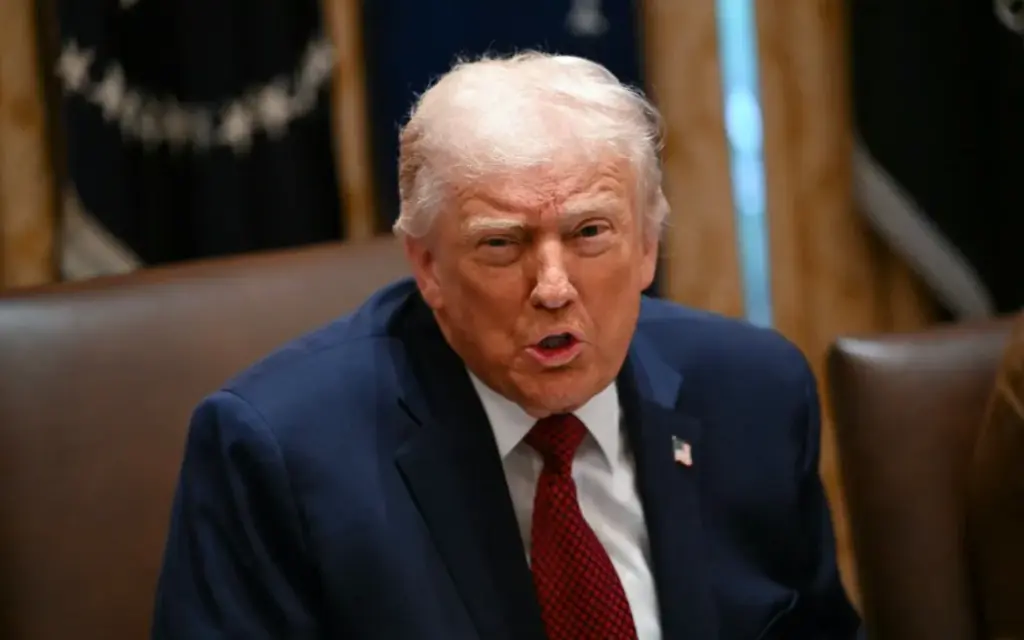
As the war rages on between the US/Israel and Iran, the US President, Donald Trump has warned it would be “very bad for the future of NATO” if allies don’t help him secure the Strait of Hormuz – a critical waterway for global oil shipping.
In an interview with the Financial Times, Trump said he also expects China to help unblock the strait and could delay a summit with Chinese leader Xi Jinping if it doesn’t. Also speaking yesterday aboard Air Force One, the US President also said he is speaking to “about seven” countries about “policing” the strait, adding that he “will remember” if they do not help. Meanwhile, flights were temporarily suspended at Dubai International Airport early yesterday after a drone struck a fuel tank and sparked a fire, authorities said.
Civil defence crews later contained the blaze, the Dubai Media Office said, adding that no injuries were reported. The Dubai Civil Aviation Authority said the flight suspension was taken as a precaution. The incident comes as Iran has fired hundreds of missiles and drones toward Gulf countries hosting US military assets since the war began, including strikes toward the United Arab Emirates.
Emirati authorities say most have been intercepted by air defences, though debris and some drones have fallen inside the country. Iranian officials have recently accused the UAE of allowing its territory to be used for attacks against Iran, allegations Emirati officials have rejected as misleading, saying the country’s actions have been defensive. This is the third time the airport has been hit since the start of the war on February 28.
A number of flights already in the air heading towards the airport from a number of countries, including Britain, had to be turned back in mid-flight due to the airport’s closure. Meanwhile Emirates has told passengers to avoid going to the airport after flights were temporarily suspended. The Middle East’s largest airline sent the update on X and said it will share updates as they’re available.
Dubai authorities earlier said flights at the major international travel hub were halted after a drone struck a fuel tank and started a fire. The Dubai Media Office said some flights are being diverted to Dubai World Central (DWC) – Al Maktoum International. DWC sits on the southern end of Dubai and typically handles cargo, charter and seasonal flights.
Drone attacks from Iran have also struck the Fujairah Oil Industry Zone (FOIZ), the United Arab Emirates’ (UAE) biggest port and oil storage facility, sparking a fire. No casualties were reported in yesterday’s incident as the Fujairah media office said specialised teams were immediately dispatched to handle the situation. Fujairah sits on the UAE’s eastern coast, on the Gulf of Oman – rather than the Persian Gulf – and so vessels do not need to navigate the Strait of Hormuz to reach it.
Meanwhile, Israeli strikes have deepened Lebanon’s humanitarian crisis, with more than 800 people killed and over 850,000 displaced. Israel confirmed that it has begun “limited and targeted ground operations” against Iran-backed Hezbollah in southern Lebanon. Heavy bombing has been reported in Tehran, while Iran and Hezbollah have launched missiles at Israel; Saudi Arabia said it downed dozens of drones overnight.
And in another development, a UK minister, Pat McFadden, has said the US-Israeli attack on Iran is not a NATO war. Speaking on BBC Radio 4’s Today programme yesterday, the Work and Pensions Minister said the NATO defence alliance was not conceived with the “kind of situation that we’re seeing in the Middle East” in mind. McFadden echoed the position taken by former UK Chief of Defence Staff – Gen Sir Nick Carter – who said NATO “is not an alliance that was designed for one of the allies to go on a war of choice and then oblige everyone else to follow”.
McFadden backed Gen Carter saying he is “right” and described the current conflict as “not a NATO war” but “US-Israeli action”. This perhaps explains why the NATO allies have shown a lukewarm attitude to getting involved in the war and providing assistance in policing the Strait of Hormuz. However, speaking late yesterday, UK Prime Minister Keir Starmer said his country is working with allies on a plan to reopen the crucial shipping route.
And in another development, Iran has criticised the recent resolution adopted by the United Nations Security Council condemning its actions in the Gulf region, describing the measure as one-sided and politically motivated. Last Wednesday, the council adopted a resolution condemning Iran’s attacks on countries in the Gulf region and Jordan, urging Tehran to immediately halt hostilities.
The resolution, presented by Bahrain and co-sponsored by 135 member states of the United Nations, was adopted with 13 votes in favour, while Russia and China abstained. However, speaking yesterday, Gholamreza Raja, Iran’s ambassador to Nigeria, said the resolution failed to reflect the realities surrounding the crisis and ignored “acts of aggression” against Iran.
The envoy noted that the measure, which called for an immediate halt to hostilities and condemned Iran’s alleged targeting of critical infrastructure across the Gulf region, did not address the root causes of the conflict. And also yesterday, Iran’s Islamic Revolutionary Guard Corps (IRGC) urged the United States to evacuate personnel from US-linked industrial facilities across the region, warning of imminent attacks.