
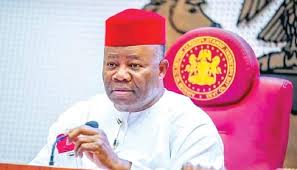
The President of the Senate, Senator Godswill Akpabio, yesterday, asserted that great nations are not built by perfect conditions, but by leaders who make hard choices together.
Akpabio made this assertion in his speech, titled “Planting The Future Together,” which he read during the presentation of the N58.18 2026 budget to the joint session of the National Assembly by President Bola Tinubu.
This was as President Tinubu ignored the appeal made by the National Assembly, seeking a reversal to the withdrawal of police aides attached to members of the apex parliament.
He observed that many Nigerians view the patriotic collaborative work between the National Assembly and the Executive Arm as a sellout by the Parliament, stressing that nations advance when the Executive and the Legislature work in concert, and they falter when the two become locked in hostility.
His speech reads in part: “Mr. President, your presence before Parliament today underscores a fundamental truth of democratic governance: that progress is forged when institutions work in concert; when authority is exercised with accountability; and when leadership listens, engages, and leads with courage and clarity of purpose.
“Many in our country view the patriotic collaborative work between the National Assembly and the Executive Arm as a sell-out by the Parliament. But history is unambiguous on one enduring lesson: nations advance when the Executive and the Legislature work in concert, and they falter when the two become locked in hostility.
Akpabio insisted that nations make more progress when the different arms of government work in collaboration rather than in confrontation with one another.
“Across history and continents, the pattern remains consistent: when the organs of state treat each other as CHANGE AND CONFIRMATION OF NAME adversaries, the nation pays the price; but when they act as partners under the constitution, stability deepens, reforms take root, and progress becomes possible.
It is within this spirit of constitutional partnership—not rivalry or servility—that great national decisions (like budgeting) acquire meaning and momentum. “Budgets tell a story. Show me a nation’s budget, and I will tell you its priorities, its fears, and its hopes.
They reveal what a nation truly values, expose what it is prepared to confront, and chart the future it seeks to build. The 2026 Appropriation Bill you are about to present is therefore far more than a compilation of figures.
It should be a statement of intent—a reflection of priorities, a record of difficult choices, and a roadmap for the next phase of Nigeria’s national renewal. “Over the past year, our country has navigated a period of significant transition in the midst of challenges.
Families have felt the strain of rising costs. Businesses have adjusted to a changing economic environment. Young Nigerians have asked hard and legitimate questions about opportunity, fairness, and their place in the nation’s future.
Insecurity has tested our collective resolve and reminded us that peace is not a gift we inherit, but a responsibility we must constantly defend.