

Communities across Kwara State have begun adopting locally developed social charters and grassroots response systems to address Gender-Based Violence (GBV), with growing evidence of community ownership and behavioural change.
At the centre of the intervention is a model supported by the Brain Builders Youth Development Initiative (BBYDI), which has enabled communities to co-create and enforce social charters that define acceptable behaviour and outline consequences for abuse, particularly within marriage.
In communities such as Alalubosa, Agbarere and Ganmo, these charters; developed with the involvement of traditional, religious, youth and women leaders are now actively shaping community norms and responses to GBV.
Women in several of these communities have also begun organising themselves into informal clusters where they openly discuss marital abuse identified as one of the most prevalent forms of GBV and collectively explore pathways for support, reporting and prevention.
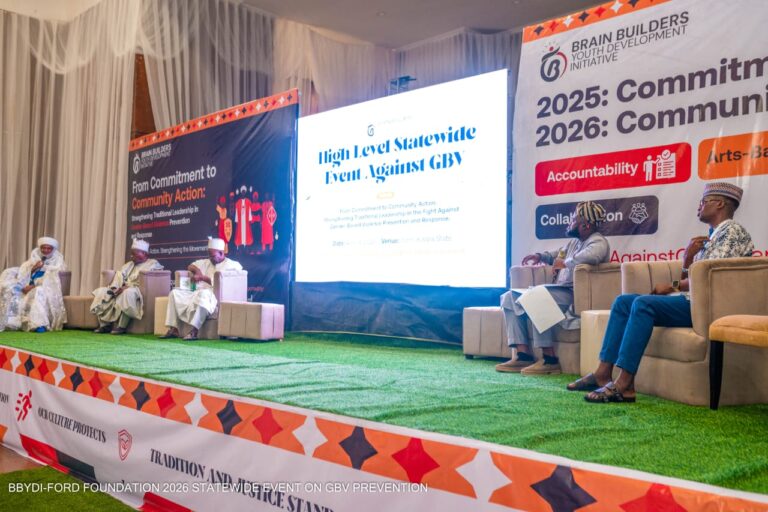
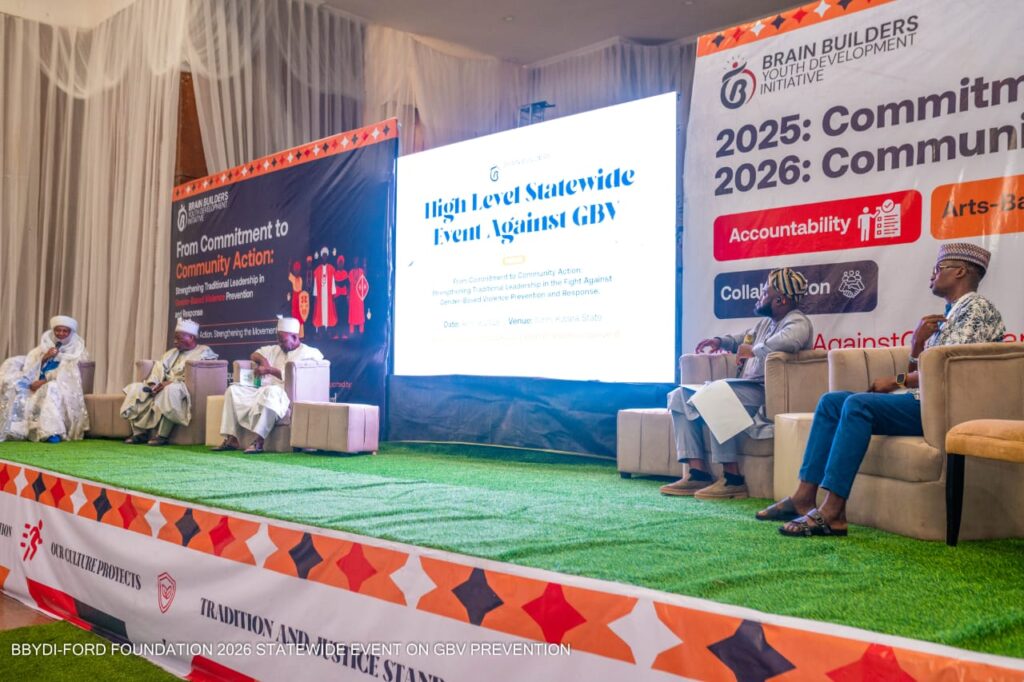
These developments were highlighted at the second GBV Prevention Statewide Event held in Ilorin, where BBYDI unveiled a documentary chronicling two years of engagement with traditional institutions and grassroots actors across the state.
The organisation also launched a suite of knowledge products, including a Yoruba-translated version of its GBV Prevention Advocacy Toolkit, with plans to extend translations into other local languages to deepen accessibility and impact.
The Emir of Ilorin, Alhaji (Dr.) Ibrahim Sulu-Gambari, CFR, was represented by Dr. Usman Atolagbe Abubakar Jos, the Balogun Alanamu of Ilorin Emirate, who reaffirmed the Emirate’s support for sustained community-led action against GBV and the importance of upholding accountability within traditional systems.
Also speaking, the Emir of Ilesha Baruba, His Royal Highness Prof. Halidu Abubakar, stressed the responsibility of traditional institutions to preserve cultural values while actively rejecting harmful practices that enable violence.
Similarly, the Olomu of Omu-Aran, His Royal Highness Oba Abdulraheem Adeoti, called for stronger collaboration between traditional rulers, government and civil society, noting that community-driven resolutions must be backed by consistent enforcement to achieve lasting change.
In her keynote address, Professor Saudat Salah Abdulbaqi, FNIPR, Dean of the Faculty of Communication and Information Sciences, University of Ilorin, emphasised the unique influence of traditional leaders in shaping social norms, noting that most survivors first seek help within their communities.
“What leaders tolerate becomes culture, and what they condemn begins to change,” she said, urging traditional rulers to use their positions to challenge harmful norms and promote protection for women and girls.
Also speaking, Izeduwa Derex-Briggs, Programme Officer for Gender, Racial and Ethnic Justice at the Ford Foundation West Africa Office, said the Foundation’s support is rooted in prevention.
“At Ford Foundation, we do not wait for violence to happen. We are invested in ensuring that GBV does not happen,” she said.
BBYDI’s Executive Director, Nurah Jimoh-Sanni, said the intervention has moved communities beyond dialogue to concrete action, with residents now establishing reporting structures, enforcing agreed norms and supporting survivors.
“This is no longer about awareness alone. Communities are defining their own standards and taking responsibility for enforcement,” she said.
Over 200 stakeholders, including policymakers, security agencies, development partners and 21 traditional rulers, attended the event to review progress and chart the next phase of the intervention.
The programme, supported by the Ford Foundation, is now set to scale its community-led model, strengthen coordination and address emerging forms of violence, including those facilitated by technology.
The event concluded with participants signing a public commitment board and recording advocacy messages to sustain momentum against GBV across Kwara State.