

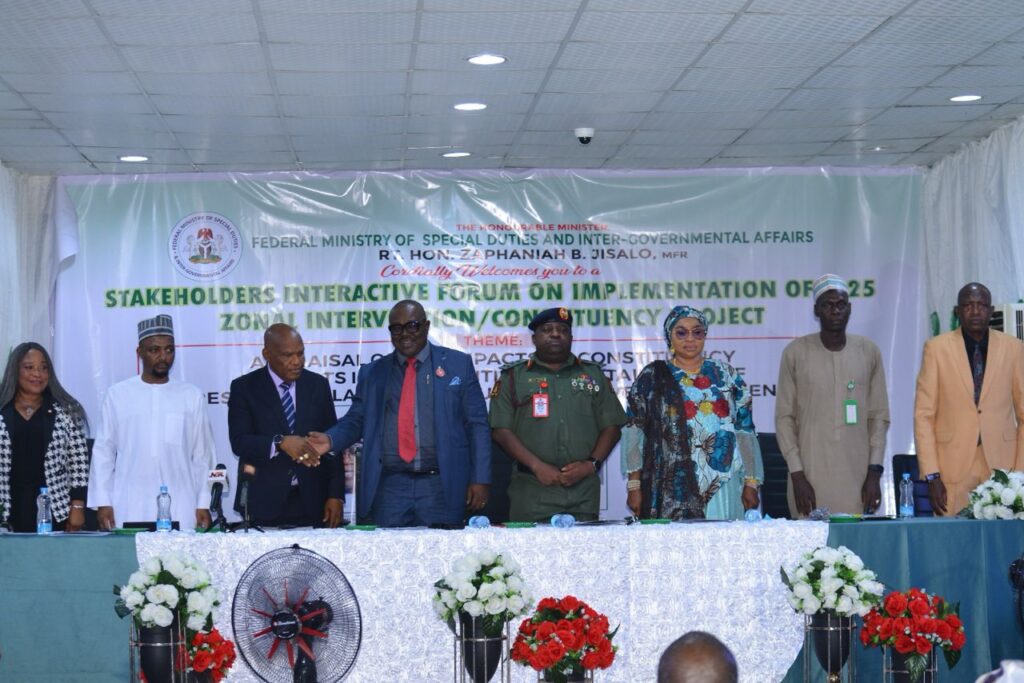
The Federal Ministry of Special Duties and Inter-Governmental Affairs on Thursday convened a high-level stakeholders’ forum in Abuja to enhance transparency, accountability, and coordination in the execution of N4.7 trillion Zonal Intervention and Constituency Projects outlined in the 2025 budget.
The forum brought together dignitaries from the National Assembly, diplomatic community, and key Ministries, Departments, and Agencies (MDAs) to assess challenges in project delivery and strengthen institutional frameworks to ensure communities benefit fully from government interventions.
Delivering the keynote address, Minister of Special Duties and Inter-Governmental Affairs, Rt. Hon. Zephaniah Jisalo, represented by the Permanent Secretary, Dr. Onwusoro Maduka, revealed that 110 projects across all six geopolitical zones had been verified and certified in the third quarter of 2025. These include school renovations, boreholes, agricultural empowerment initiatives, medical outreach programmes, and street lighting.
Jisalo reiterated President Bola Ahmed Tinubu’s directive for deeper community engagement, stressing that beneficiary ownership is key to sustainability, transparency, and real impact. Non-compliant MDAs were warned that defaulters would face prosecution by EFCC, ICPC, and other anti-graft agencies.
Speaker of the House of Representatives, Rt. Hon. Tajudeen Abbas, praised the Ministry’s initiative, highlighting the need for synergy between MDAs and lawmakers to ensure rural communities receive essential infrastructure and social amenities.
Guest speaker Prof. Abdullahi Saleh Bashir, Dean of the Faculty of Communication and Media Studies at the University of Abuja, emphasized that effective monitoring, transparency, and community ownership are crucial for constituency projects to support the Renewed Hope Agenda, including economic reforms, infrastructure development, security, job creation, SME support, and education improvements.
Participants agreed on the importance of timely project execution, robust community feedback mechanisms, and enhanced collaboration between lawmakers and implementing agencies.
A communiqué detailing action steps, implementation timelines, and monitoring strategies is expected at the conclusion of the forum.