
The Nigerian government has spent a total sum of N26.71 trillion of its 12 years budgets allocation to contain insecurity and defend the country against attacks, analysis of the country’s budget from 2015 to 2026 revealed. Nigeria’s territorial landscape comes under attacks from internal uprising by members of Islamic terrorist sects operating across the North, and in the Eastern axis by a separatist group of members of Indigenous People of Biafra (IPOB). There is also an internal uprising orchestrated by bandits, kidnap pers and herdsmen.
These groups are terrorising Nigeria’s peace and tranquility. The government has had to devote a sizable chunk of its yearly budget to defending and securing the country. An insight into the defence and security budgets over time revealed that in 2015, the government allocated N969 billion of its budget to defence.
In 2016, the budget for defence was scaled higher to N1.063 trillion, moved up to N1.142 trillion in 2017, N1.323 trillion in 2018, N1.328 trillion in 2019, N974.91 billion in 2020 and N121 billion in 2021. In the 2022 budget, the Federal Government voted N2.41 trillion for defence, N1.55 trillion in 2023, increased to N3.85 trillion in 2024 and was upped to N6.57 trillion in 2025. The trend was upheld in the recently presented 2026 budget of N58.18 trillion.
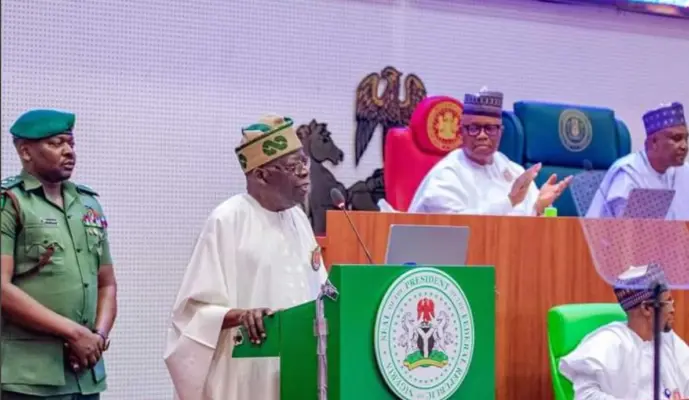
The government budgeted N5.41 trillion on defence and securing the country. Despite allocating the largest chunk of the budget to defence and security, insecurity is at high stakes across the country. Amid persistent scaling up in insecurity across the country, President Bola Tinubu reaffirmed his administration’s commitment to strengthening Nigeria’s security architecture in 2026 through deeper cooperation with regional and global partners, while advancing reforms aimed at tackling terrorism, banditry, and other security threats.
In his New Year’s address to the nation on January 1, the President said that security and intelligence agencies would intensify their collaboration with international allies to eliminate all threats to national security. He stressed that protecting lives, property, and Nigeria’s territorial integrity remains a top priority of his government.
Tinubu noted that while economic reforms were critical, sustainable development cannot be achieved without peace and stability. He said the government would continue to adopt a comprehensive security approach that combines intelligence-led operations, international partnerships, and institutional reforms.
“In 2026, our security and intelligence agencies will deepen cooperation with regional and global partners to eliminate all threats to national security. “We remain resolute in protecting lives, property, and the territorial integrity of our country.
I continue to believe that a decentralised policing system, with appropriate safeguards, complemented by properly regulated forest guards and anchored on accountability, is critical to effectively addressing terrorism, banditry, and related security challenges. “We must stand together in unity and purpose, uphold patriotism, and serve our country with honour and integrity in our respective roles.
Let us resolve to be better citizens, better neighbours, and better stewards of our nation,” he averred. Tinubu reiterated his support for a decentralised policing system, describing it as essential to addressing Nigeria’s complex security challenges.