



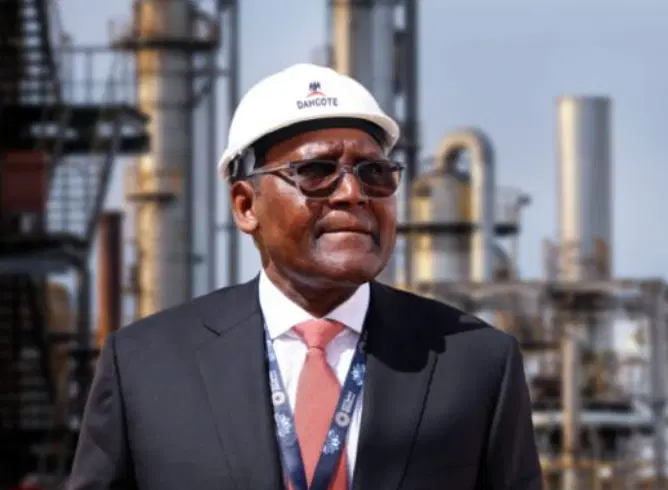
The Dangote Petroleum Refinery on Thursday cut the gantry price of Premium Motor Spirit (PMS) for the 20th time in 2025, reducing it by 15.58 per cent from ₦828 to ₦699 per litre, effective December 11.
Beyond its festive-season timing, analysts say the move underscores a fundamental shift in Nigeria’s downstream petroleum market, with local refining increasingly setting the pricing agenda once dominated by imports. The price reduction, announced as Nigerians prepare for peak Christmas travel, has sent fresh signals to transporters, marketers and policymakers that the market is entering a new phase one driven more by domestic supply efficiency than foreign exchange volatility.
Strategic timing, macro impact
A senior official of the Lekki based refinery said the cut was informed by rising transport demand and the need to ease pressure on consumers and logistics operators.
“December is when fuel demand and transport costs peak. The adjustment is designed to reduce that pressure and support economic activity during the festive period,” the official said. Energy economist, Dr. Kelvin Emmanuel, chief executive of Dairy Hills Energy Advisors, said the timing could help dampen inflationary pressures.
“Transport costs feed directly into food prices and services. Any reduction at the gantry level during a high-demand season has a broader macroeconomic effect,” Emmanuel noted.
Dangote’s pricing play
Aliko Dangote, president of the Dangote Group, has maintained that petrol prices should increasingly reflect the economics of local refining rather than global price swings and currency risk.
Speaking after a recent meeting with President Bola Tinubu, he said competition from domestic production was beginning to work. “Prices are coming down because we are producing locally and competing efficiently,” Dangote said, noting that petrol sells for ₦1,500–₦1,600 per litre in some neighbouring West African countries reliant on imports. According to Mr. Olatide Jeremiah, downstream analyst at PetroleumPrice.ng, the ₦699 gantry price is a key benchmark for the market.
“It lowers the pricing ceiling for marketers. Even after distribution and retail margins, there is less room for excessive pricing, especially in coastal states,” he said.
Market reactions: Gains and pains
Transport operators have welcomed the development.Mr. Tajudeen Baruwa, National President of the National Union of Road Transport Workers (NURTW), said fuel costs remain the single largest expense for operators. “Any reduction at source gives room for moderation in fares, even if other costs still affect pricing,”
Baruwa said. Independent marketers, however, expressed caution. Mr. Chinedu Okoronkwo, chairman of the Independent Petroleum Marketers Association of Nigeria (IPMAN), Lagos Zone, said frequent price changes expose operators to inventory losses.
“When prices drop sharply, marketers holding older stock bought at higher prices are affected. The market is adjusting, but the transition is not without pain,” Okoronkwo said. Larger marketers appear better positioned. Mrs. Winifred Akpani, managing director of Northwest Petroleum, said firms with stronger balance sheets and direct refinery access can respond faster.
“The structure is changing. Direct supply and quicker price transmission are replacing the old import-driven delays,” she said.
Erosion of the old consortium model
Industry experts say one of the most significant effects of Dangote Refinery’s pricing strategy is the weakening of the marketers’ consortium system that once dominated bulk petrol imports.
“This is deregulation in practice,” said Prof. Wumi Iledare, president of the Nigerian Association for Energy Economics (NAEE). “Aggressive local pricing breaks coordinated behaviour and forces efficiency across the value chain.”
Regional effects and consumers
While the ₦699 gantry price is uniform, pump prices will vary by region due to haulage costs. Coastal and South-West states are expected to see faster reductions than inland areas. For consumers, even marginal declines matter.
Mrs. Funke Adebola, a trader at Mile 12 Market in Lagos, said transport costs strongly influence food prices.