

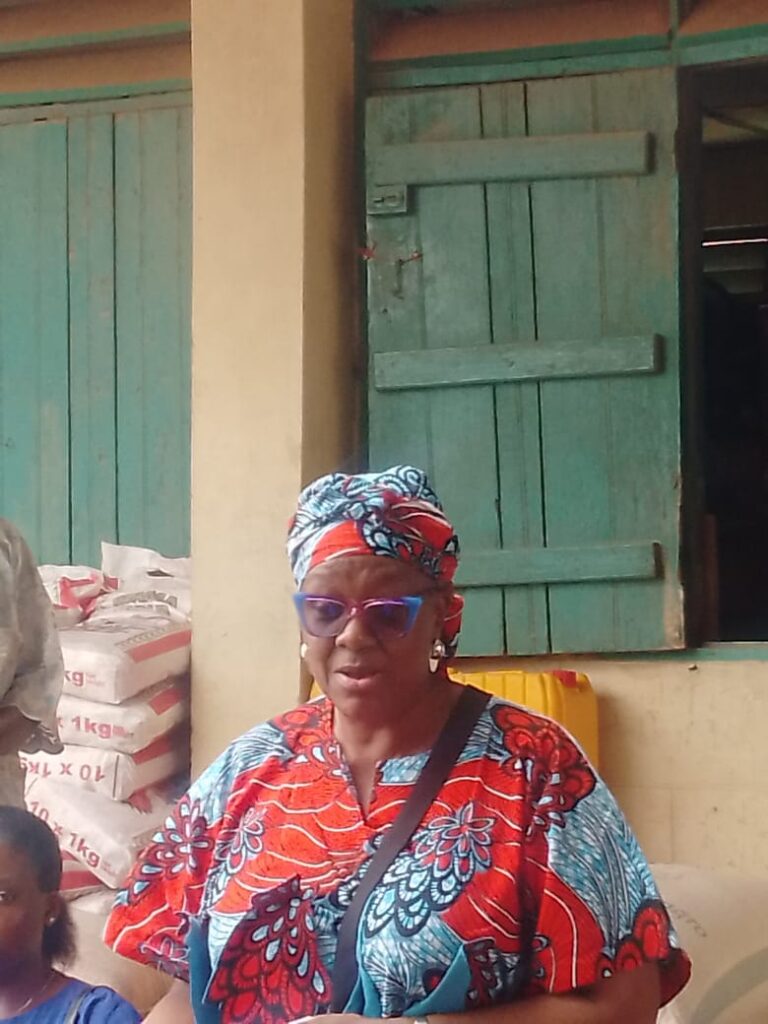
The widow of former Oyo State Governor Adebayo Alao-Akala, Chief (Mrs.) Oluwakemi Alao-Akala, has urged Nigerians to embrace a culture of consistent giving to the less privileged, insisting that physical disability should never be mistaken for inability.
She made the call during a humanitarian visit to the Nigeria Training Centre for the Blind and the Oyo State Special Basic School in Ogbomoso North Local Government Area of Oyo State.
During the outreach, Mrs. Alao-Akala donated foodstuffs and essential supplies, including bags of rice, beans, maize, kegs of palm oil, spaghetti, sanitary pads, cartons of toiletries, typing sheets, and cardboard materials for learning.
While explaining that the gesture forms part of her routine monthly interventions, she said: “I do things like this every month. I just like to make life a little easier for people. Any community, any association, anybody who needs help, I feel I should help everybody, even though it’s not always possible.”
She disclosed that the school management had earlier forwarded a list of pressing needs. “Before I came, I got a list from them of what they needed, and we are here to do our bit. They need a lot of things, and whatever I can do, I will continue to do,” she said, adding that plans were underway to provide uniforms for the pupils after tailors take their measurements.
Reflecting on her late husband’s legacy, she noted that public office holders would one day give account of their stewardship before God. “Whatever position we find ourselves in, at the end of the day, we are going to be accountable. God will ask us, what did you do when you were there?” she said.
She also prayed for political leaders across the country, saying, “It’s a lot of work to lead. We have been there before. My prayer is that God will teach our leaders and give them wisdom. With our prayers, God will help them to deliver for the people.”
Addressing the visually impaired pupils, she encouraged them to remain confident and speak positively about their future. “They should confess positively about their situation. There is power in the tongue. When you speak positively, it works. Let us say every day, ‘God bless Nigeria, God bless Oyo State,’ and pray for our leaders,” she advised, urging women in particular to speak uplifting words over their homes and children.
Meanwhile, the Headmistress of Oyo State Special Basic School, Mrs. Oyedokun Janet Olabimpe, appealed to the Oyo State Government to increase funding to enable the institution to cater adequately for its 82 primary pupils, many of whom are in boarding facilities.
“Our pupils are in the boarding house, and some of them don’t have anybody to cater for them. It is only what the government provides that we use, and we are managing it,” she said.
She explained that running a special school requires additional attention and resources. “You know you are dealing with the visually impaired here. Their administration is quite different. How you direct and give attention to them is not the same as in regular schools,” she noted.
According to her, funds allocated to the school are often stretched thin due to minor projects and urgent needs. “The money given to us cannot cover everything. Whenever we have little projects to execute, we still have to withdraw from the same allocation. That is why it is not enough to cater for the pupils,” she said, pleading with the government to review the allocation upward.
A special educator at the school, Mr. Ogunleke Simeon, said the institution, located within the same compound as the training centre, runs primary, secondary, and vocational sections with a population fluctuating between 80 and 98 learners.
“Our main objective is to train the visually impaired on how to read and write in Braille, type, use computers, and navigate their environment safely. Some are also integrated into craft workshops where they learn skills with their hands,” he said.
He explained that the school admits both those born blind and those who lost their sight later in life. “For those who became blind after going through primary or secondary school, all hope is not lost. They only need to come and learn Braille and typing. After that, they can register for examinations like WAEC and NECO under the visually impaired section,” he stated.
Tracing the history of the institution, he noted that its vocational arm dates back to 1958, while the formal school for the blind was established in 1977 after discovering the academic potential of some young learners.
“Since then, we have produced graduates who now hold master’s degrees in Law, lecturers, teachers, and self-employed professionals,” he said, stressing that “disability is not inability. There is ability in every disability.”
Despite the successes recorded, he lamented the high cost of specialised materials such as Braille machines, slates and stylus, guide canes, and talking computer software. He also decried an abandoned three-classroom block left at lintel level for about 15 years.
On feeding, he revealed that the state government provides N300 per child daily for three meals. “In the present economic situation, it is not enough. We appeal to philanthropists to support us with food items like rice, beans, spaghetti, and palm oil to augment what the government is providing,” he said.
He called on well-meaning Nigerians to see the institution as fertile ground for investment in human capital. “People should see this place as a mission ground where they can sow into the lives of these children. In the nearest future, they will be proud to see them become useful to themselves, their families, and society at large,” he added.