



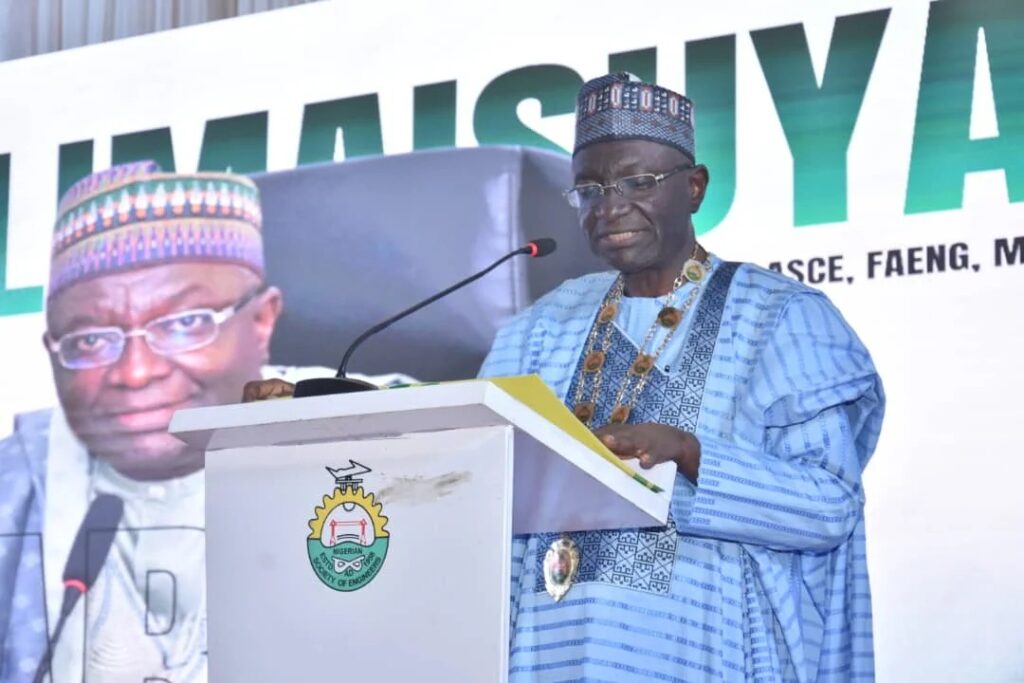
Against the backdrop of President Bola Ahmed Tinubu’s Renewed Hope agenda and the push for a “Buy Nigeria First” policy, the Nigerian Society of Engineers (NSE) has called for the placement of engineers at the heart of national development, while supporting the initiative.
The 35th President of the NSE, Engr Ali Alimasuya Rabiu, made it clear in a statement on Monday that his investiture as the new president of the society was not a routine change of guard but a defining moment for the profession.
While commenting on President Tinubu‘s Renewed Hope Agenda, he said that it offers a rare opportunity to reclaim engineering as the backbone of Nigeria’s industrial growth, stressing that no nation can build sustainably while sidelining its own professionals.
The new NSE President praised the immediate past President, Engr. Margaret Oguntala, for restoring visibility and professionalism to the Society, but warned that the next phase must go further, aligning engineering practice firmly with national priorities and public policy.
Drawing from his experience as a former President of COREN, Engr. Rabiu said that his return to leadership was driven by concern that the Society had drifted from its founding ideals.
He pledged to rebuild the NSE into a standards-driven, ideas-led institution capable of shaping policy, driving innovation and delivering real value to both members and the nation.
He added in the statement that central to his vision was strong backing for the “Buy Nigeria First” policy, which he described as a historic chance to reposition Nigeria as Africa’s infrastructure and industrial hub.
While noting that laws such as the COREN Act and Executive Order 5 already support this direction, he expressed concern that many government projects running into trillions of naira still exclude Nigerian engineers, often with costly consequences.
“It may shock Mr President to know that MDAs, especially infrastructure-related Ministries such as the Federal Ministries of Works, Power, Water Resources, and the Federal Capital Territory Administration, have largely observed these laws in the breach,” he said.
He warned that weak enforcement has led to poor-quality delivery and inflated costs, and urged the President to ensure that Nigerian engineering consultants are compulsorily engaged in the design, supervision and certification of all major projects.
According to him, engineering deserves the same level of institutional respect accorded to law and accounting in national decision-making.
“Mr President, engineering training and practice are regulated by the COREN Act, and the Council is under the supervision of the Honourable Minister responsible for Works. But Sir, this arrangement appears to have become an albatross: the Federal Ministry of Works has failed or neglected to discharge its responsibilities towards building a sustainable engineering practice,” he said.
Beyond advocacy, the new NSE President outlined plans to strengthen professional capacity, support technical and vocational education and restore engineering’s influence in national planning and budgeting.
The NSE President welcomed the Federal Government’s move to upgrade technical colleges nationwide, pledging the Society’s full support to develop skills, empower youths and reduce dependence on foreign technical labour.
Engr. Rabiu called for unity, urging engineers to rise with a renewed sense of purpose.
He said that the reset of the Nigerian Society of Engineers is ultimately about delivering Nigerian solutions by Nigerian professionals, and for Nigeria’s future.
He said, “In a related development, the Federal Government’s recent announcement on the upgrade and inauguration of 38 technical colleges represents a bold and timely step toward rebuilding Nigeria’s skills infrastructure.
“This initiative, under the broader national education reform agenda, is commendable, not just for its scale, but for its focus on equipping young Nigerians with globally competitive, industry-relevant competencies that meet both local demand and international benchmarks.
“The Nigerian Society of Engineers (NSE) has long championed Technical and Vocational Education and Training (TVET) as a critical pathway for addressing the widening skills gap, tackling youth unemployment, and reducing Nigeria’s overdependence on foreign technical labour.
“The initiative is therefore strongly aligned with our mission to build technical capacity at all levels of society.”
The statement added that Eng Rabiu said further at the investiture that in support of “this national effort, the NSE hereby affirms its readiness to collaborate with the Federal Government to deepen the impact and sustainability of this programme.
“Already, we have directed our Young Engineers’ Forum across relevant branches, especially those near the new technical colleges, to mobilise and provide curriculum-aligned support services on a pro bono basis.
“This reflects our enduring commitment to capacity building, grassroots empowerment, and national service.”