



- Lawyers: Conflicting orders eroding public confidence in judiciary
AKEEM NAFIU writes that lawyers have made a passionate appeal to the National Judicial Council (NJC) to promptly intervene in the growing trend of conflicting orders from courts of coordinate jurisdictions which again reared its ugly head recently over the elective national convention of the Peoples Democratic Party (PDP)
Some senior lawyers have expressed deep concerns over the incessant cases of conflicting court orders from courts of coordinate jurisdictions, saying it is capable of eroding public trust in the judiciary.
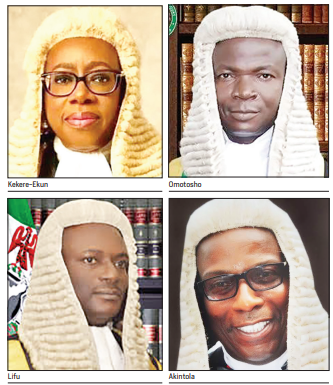
Apparently angered by the recent events wherein three courts of coordinate jurisdiction, within twelve days, gave conflicting orders on the elective national convention of the Peoples Democratic Party (PDP), the lawyers called on the National Judicial Council (NJC) to urgently arrest the ugly trend. It all started on October 11, 2025 when Justice James Omotosho of a Federal High Court in Abuja ordered the Peoples Democratic Party (PDP) to maintain the ‘status quo’ regarding its planned convention scheduled for November 15 and 16, 2025.
The judge gave the directive in a ruling over a suit marked FHC/ ABJ/CS/2120/2025, filed by Austine Nwachukwu (PDP Chairman, Imo State); Amah Abraham Nnanna (PDP Chairman, Abia State); and Turnah George (Secretary, PDP South-South). The trio, had in the suit, queried the propriety of the national convention and urged the court to, among other reliefs, order the PDP to comply with its constitution and other relevant laws before it could hold any convention.
Following the hearing of the suit, the judge delivered judgement on the 31st of October, 2025, wherein he restrained the PDP from proceeding with the convention until it complied with the provisions of its constitution, the Nigerian Constitution, and the Electoral Act. The judge also barred the Independent National Electoral Commission (INEC) from monitoring the convention until the PDP complied with the relevant laws pertaining to such an exercise.
Four days later, Justice Ladiran Akintola of an Oyo State High Court, overruled Justice Omotosho’s judgement and approved the convention. The judge, via an ex-parte order cleared the PDP to proceed with the convention. The court also ordered INEC to monitor the exercise. On November 11, Justice Peter Lifu of a Federal High Court in Abuja, also issued an order of interim injunction stopping the PDP from proceeding with the convention.
The judge issued the directive in a ruling on a suit filed by a former Governor of Jigawa State, Sule Lamido, who alleged that he was unlawfully excluded from contesting for the PDP’s chairmanship position. About forty-eight hours to the convention, Justice Akintola re-emphasised his earlier order approving the convention, while also directing INEC to monitor the exercise.
NBA’s concern
In the meantime, the Nigerian Bar Association (NBA) has expressed deep concerns over the growing trend of conflicting court orders in the country, warning that the development undermines public confidence in the judiciary and risks turning the justice system into “a mockery.”
Speaking against the backdrop of multiple cases filed by interested parties over the recently held PDP National Convention and the attendant conflicting orders from courts of coordinate jurisdiction, NBA President, Mazi Afam Osigwe (SAN), frowned at the development, saying it portends great danger for the legal system. Osigwe while questioning the rationale behind the conflicting court orders, said the action create confusion in the polity and cast doubt on the credibility of judicial processes.
The judiciary should embrace clearer practice directions to forestall conflicting orders
The NBA President added that the court has a responsibility to avoid issuing directives that could destabilise political processes or give the impression that justice could be purchased. He said: “In which country have you heard one court say don’t hold a convention, and another court says do the convention?
Which one do you obey? “As a Bar Association, we should say that our courts should be wary of the type of orders they make. They should not issue orders that create confusion in the polity, put the judicial process to wrong use, or give the impression that justice is for the highest bidder. People have courts where they can get favourable decisions”.
Petition against Justice Akintola In the aftermath of the conflicting orders, three chieftains of the Peoples Democratic Party (PDP) reportedly petitioned the Chief Justice of Nigeria (CJN), Kudirat KekereEkun, over what they described as “acts of judicial recklessness, impunity and disregard for due process” by Justice Ladiran Akintola of Oyo State High Court.
In the petition dated 5th November, 2025, the petitioners; Austine Nwachukwu, Amah Abraham Nnanna, and Turnah Alabh George, said Justice Akintola’s ruling approving the convention is a direct contradiction of an earlier and still subsisting judgement delivered on October 31, 2025 in suit No. FHC/ ABJ/CS/2120/2025 by Justice James Omotosho of a Federal High Court in Abuja which had restrained the party from holding its convention on the 15th and 16th of November, 2025.
They further argued that Justice Akintola’s decision is akin to sitting on appeal over a judgement delivered by another court of coordinate jurisdiction, an act that not only violates the established judicial hierarchy but also threatens the sanctity of the rule of law. “Such judicial overreach, if unchecked, could set a dangerous precedent capable of eroding public confidence in the justice system and undermining the credibility of the courts”, the petitioners added.
They further urged the National Judicial Council (NJC) to urgently investigate and sanction Justice Akintola in the same manner it acted in previous instances involving judges accused of misconduct in Rivers, Imo and other states. They maintained that the NJC must demonstrate its commitment to discipline, impartiality, and the preservation of judicial integrity by ensuring that errant judicial officers are held accountable without delay.
“The Nigerian judiciary must remain the last hope of the common man and not a tool in the hands of those seeking to subvert justice for political expediency. The NJC’s swift and transparent action on the petition would help restore faith in the judiciary and reinforce the principle that no one is above the law”, they further stated.
NJC’s denial
Meanwhile, the National Judicial Council (NJC) has denied receiving any petition regarding the conflicting orders issued by courts of coordinate jurisdiction on the PDP’s convention. Speaking on the issue, NJC’s Deputy Director of Information, Kemi Ogedengbe, exonerated the judges of any blame, saying litigants were responsible for the conflicting orders.
She queried the rationale behind the filing of fresh suit by dissatisfied parties, when they are supposed to pursue an appeal at the appellate court in line with the laid down procedures for address ing such conflicts. “When a high court delivers a judgement and a party is dissatisfied, the right thing is to approach the Court of Appeal, not another trial court.
The litigants know the proper steps, but chose otherwise. How can the NJC query judges when litigants themselves refuse to exercise their rights? “NJC couldn’t intervene unless due process is followed. No petition has been submitted before the council in relation to the matter”, Ogedengbe said.
Adejumo’s views
A former President of the National Industrial Court and the Administrator of the National Judicial Institute, Justice Babatunde Adejumo, has described conflicting court orders as an inherent feature of the legal system that aids the evolution and clarification of the law. He said conflicting court orders should not be seen as a failure of the judiciary, but as judges’ varying interpretations of facts and evidence, guided by their understanding of the law and the peculiarities of each case.
Adejumo, while speaking at an interactive session ahead of the 2025 All Nigerian Judges’ Conference in Abuja, said such divergences are natural and are usually resolved through the hierarchy of court. “Judges give judgements based on the facts presented before them and the evidence presented.
Even in the United States, which has one of the oldest and most sophisticated judicial systems, state courts often give different opinions on similar issues. “If two or three courts give conflicting decisions on the same subject matter, the appellate courts exist to resolve them. Whatever the Supreme Court decides becomes final and binding.
“Once the Supreme Court has spoken, no division of the Court of Appeal or lower court should issue a contrary decision, except to clarify ambiguities in interpretation”, he said. On how to minimize incidents of conflicting court orders, Adejumo said; “litigants should be required to swear an affidavit affirming that the same matter has not been filed before another court — a breach of which would amount to perjury”.
Lawyers speak
In his comments, a former National President of the Committee for the Defence of Human Rights (CDHR), Malachy Ugwummadu, called for an enhanced technological infrastructure and management to keep track of judicial decisions.
and pronouncements, as a way of stemming the ugly trend of conflicting orders. Ugwummadu said: “Certainly, conflicting orders has the potentials of undermining public confidence in the judiciary and the judicial processes in Nigeria and has, in fact, been eroding the confidence of the Nigerian people in the Nigerian judicial system. “Unfortunately, justice itself, as an integral society component and the first condition of peace is rooted in the confidence of the public. It (justice) disappears when the public loses faith and confidence in the judicial system. Thus, it’s quite serious and dangerous.
“To reverse the incidents of conflicting judgement by courts of coordinate jurisdiction, we need to focus on firm judicial policy position which has been issued and given in the past by heads of the judiciary, but needs to be reinforced and followed through with repercussions for disobedience “Improved technological infrastructure and management to keep track of judicial decisions and pronouncements. Disciplinary measures and checks by the National Judicial Institute. “Sanctions and discipline by the Disciplinary Committee of the NBA.
Training, retraining and more trainings for judicial officers in this area “Reward systems for judicial officers who are able to resist this situation, but strikes the delicate balance of serving the end of justice” Speaking in the same vein, a Professor of Media Law and Mass Communication, Dr. Fassy Yusuf, also called for the introduction of a mechanism that will make the pendency of a particular case known to all courts of coordinate jurisdiction.
“The unabated cases of conflicting orders by courts of coordinate jurisdiction is of great concern to all stakeholders in the justice delivery arena. It is very painful, lamentable and regrettable that such a thing could still be happening despite the warnings of the National Judicial Council (NJC).
The NJC must intensify disciplinary scrutiny and sanctions against erring judicial officers
“The solution, to my mind, is one, the priests in the temple of justice must see their responsibility as being sacrosanct. Above all, there is need for a mechanism or technology that will make the pendency of a particular case known to all the courts of coordinate jurisdiction.
“Although, one can argue that ignorance is not the best defence, but I believed some of these judges would claim that they are unaware of an existing judgement and that it was not brought to their attention. Besides, legal practitioners and litigants must also come out clean and depose to an affidavit that they are not involved in multiplicity of cases. Justice should not be mocked and people’s belief in the judiciary must be sacrosanct”, Yusuf said.
In his views, a rights activist, Kabir Akingbolu, called for a strong and effective legal framework to ensure that lawyers who indulge in forum shopping are punished accordingly. He said: “It’s not the first time that the NBA will be talking like this. The NBA is becoming a toothless bulldog as far as I am concerned. It’s all talk without action. Besides, who are those that are involved in duplication of cases? Are they not lawyers?
What mechanisms are in place by the NBA to discipline erring lawyers? “We shouldn’t be blaming judges everytime for conflicting orders, lawyers were also involved. When we criticize judges, we must also condemn lawyers that were involved. “So, I think the NBA should set up a panel that will be saddled with the responsibility of discipline erring lawyers irrespective of their status. We need a strong and effective legal framework to ensure that lawyers who indulge in forum shopping are punished accordingly.
This is because if lawyers stay away from filing multiple cases on the same subject matter, there would be no conflicting court orders” In his submissions, an Abujabased lawyer, Emmanuel Ekwe, noted that a judiciary that speaks with discordant voices cannot effectively serve as the stabilizing arm of government expected to protect rights, resolve disputes, and uphold constitutional order. “The Nigerian Bar Association (NBA) is right to express deep concern over the growing incidence of conflicting orders issued by courts of coordinate jurisdiction across the country.
Such judicial inconsistencies not only erode public confidence in the judiciary, but also weaken the rule of law, portraying our justice system as susceptible to forum shopping, undue influence and procedural abuse. “To end this trend, there must be a firm reassertion of judicial discipline among judicial officers. Judges of coordinate jurisdiction are constitutionally bound to respect established precedents and refrain from issuing orders on matters already seized by courts of equal status.
“Where concerns arise regarding the propriety or fairness of a pending decision, the proper remedy lies in appellate review, not parallel intervention. The National Judicial Council (NJC) must therefore intensify disciplinary scrutiny and impose deterrent sanctions on judicial officers who, without lawful justification, entertain and determine matters already before another court. “Additionally, there is an urgent need for procedural reforms that eliminate the opportunities for litigants to shop for “favourable courts.”
The Chief Judges of the various courts should ensure strict case-assignment protocols, mandatory disclosure of related cases, and enhanced digital case-tracking systems to prevent multiple filings over the same subject matter. ” Lawyers who facilitate or encourage such abuses must also face disciplinary consequences, as the integrity of the justice system is a shared professional responsibility.
“Finally, the judiciary should embrace clearer practice directions that expressly prohibit the issuance of ex parte or interim orders capable of conflicting with existing rulings of coordinate courts. Coupled with regular judicial training and a renewed commitment to ethical adjudication, these measures will help restore coherence, credibility, and public trust in the Nigerian judicial process. The era of conflicting judgments must not only be condemned—it must be decisively brought to an end”, Ekwe said.
A senior lawyer, Timilehin Ojo, was of the opinion that the responsibility for ending the era of conflicting judgements by courts of coordinate jurisdiction lies with both lawyers and the courts. Ojo said: “Lawyers, however, bear a significant part of the blame. They are often aware of existing orders, yet still pursue fresh applications for contradictory orders before coordinate courts. In some cases, this occurs because the first court allowed itself to be used to issue questionable or irregular orders.
As a result, a subsequent order may sometimes reflect the correct position of the law and serve as a corrective measure. “Beyond lawyers conducting themselves with the highest level of professionalism, courts must also earn the respect they deserve by being impartial, consistent, and transparent.
When courts uphold these principles, there will be fewer opportunities for lawyers to seek or obtain such questionable orders. “Furthermore, both erring lawyers and courts must be held accountable through effective disciplinary procedures and appropriate sanctions. This is essential to restoring integrity and ensuring coherence in judicial processes”









