




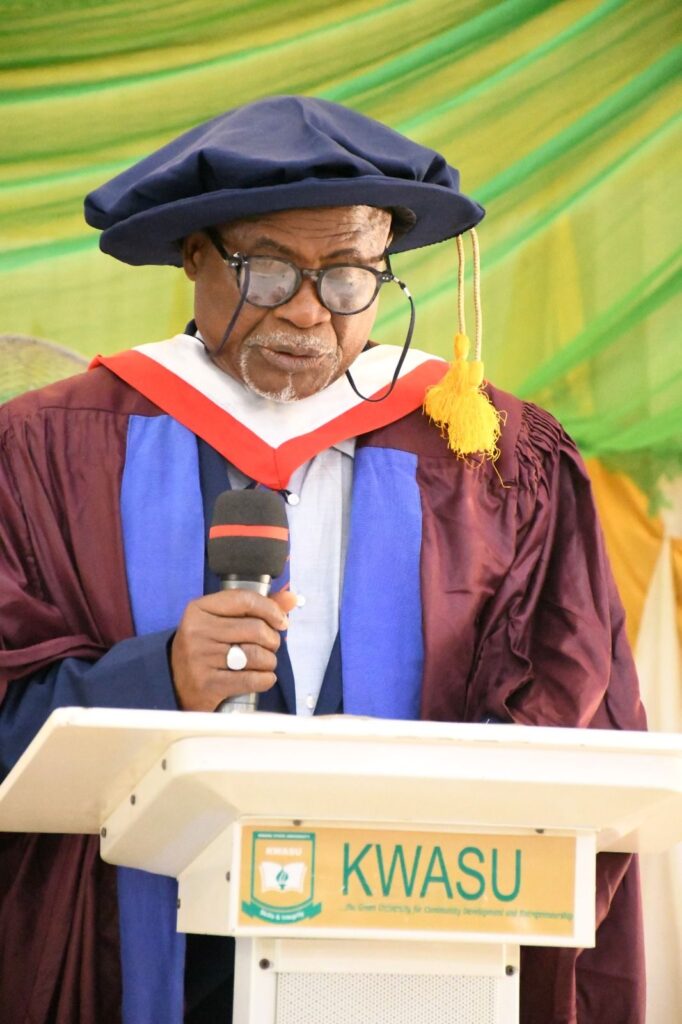
A Professor of Comparative Law at the Kwara State University (KWASU), Malete, Professor Najeem Adeyemi Ijaiya, has called for far-reaching legal reforms to stop what he described as systemic discrimination against polygyny and its adherents in Nigeria’s legal framework.
Professor Ijaiya made this call on Tuesday while delivering the 2nd Valedictory Lecture of the Department of Islamic Law at the KWASU Mini Convocation Arena, Malete, ahead of his retirement from academic service. The lecture was titled Law as an Instrument of Social Change: Any Hope for Polygyny?
Speaking before a distinguished audience that included members of the university management, legal practitioners, judges, scholars and students, the senior academic argued that Nigerian law has largely favoured monogamy inherited from English common law, to the detriment of marriages conducted under Islamic and customary law.
“As a product of polygyny myself, I am deeply concerned that polygyny is being painted negatively in Nigeria, not only by civilisation but also through legal instruments,” Ijaiya said. “Yet, law is meant to be an instrument of social change. The question is: why has the law turned against polygyny in a plural society like ours?”
He noted that Nigeria operates a plural legal system that recognises customary law, Islamic law and received English law, but lamented that statutory provisions have elevated monogamous marriage above other lawful marriage systems.
According to him, constitutional and statutory provisions have created an uneven playing field by conferring what he described as “national status” on monogamous marriages while localising Islamic and customary marriages, under which polygyny is practised.
“The validity of marriage systems under Islamic and customary law should not depend on the nod of common law,” he said. “It is unjustifiable for the law to criminalise a man who switches from monogamy to polygyny through the offence of bigamy, while applauding a man who abandons polygyny for monogamy.”
Ijaiya also faulted policies such as the National Health Insurance Scheme, which he said were designed with monogamous families in mind, thereby disadvantaging polygynous families with larger household sizes.
He further criticised inheritance practices that exclude children from polygynous unions contracted after a statutory marriage, describing them as unconstitutional and contrary to the spirit of equality guaranteed by the 1999 Constitution.
However, the professor said recent judicial decisions offered renewed hope, citing the 2024 Court of Appeal judgment in Mohammad v. Mohammad, which affirmed the inheritance rights of wives and children from subsequent Islamic marriages.
“The court has made it clear that a marriage under the Marriage Act cannot vitiate a subsequent marriage under Islamic law,” he said. “This decision shows that law can indeed serve as an instrument of social change, even for polygyny.”
Addressing concerns about gender equality, Ijaiya argued that polygyny should not be condemned wholesale, stressing that abuse can occur in both monogamous and polygynous unions.
“What the law should do is not to criminalise polygyny, but to regulate it,” he said. “Women in polygynous marriages deserve protection, dignity, property rights and enforceable maintenance, just like women in monogamous marriages.”
He proposed several reforms, including equal legal recognition for polygynous marriages, optional civil registration of such unions, review of bigamy laws, harmonisation of marriage certification, and the enactment of Islamic and customary marriage laws by states to complement the Marriage Act.
Ijaiya also proposed the establishment of a Centre for Law and Social Change at KWASU to drive research and policy advocacy on pressing social issues.
In his remarks, the Vice-Chancellor of KWASU, Professor Shaykh-Luqman Alade Jimoh, commended the valedictory lecturer for his decades of scholarship and service to legal education, describing the lecture as intellectually stimulating and socially relevant.
The event marked a significant milestone for the Faculty of Law, as Professor Ijaiya reflected on an academic career spanning nearly three decades across the University of Ibadan, University of Ilorin and Kwara State University.
“Polygyny is not an aberration to be tolerated in silence,” he concluded. “It is a legitimate expression of cultural diversity and marital choice. Law must rise above prejudice and reflect the plural values of Nigerian society.”
Deputy Senate Leader, Senator Lola Ashiru, and Hon. Justice Isa Ayo Salami, Former President Court of Appeal Nigeria (Rtd) CFR, were among the dignitaries in attendance.









