



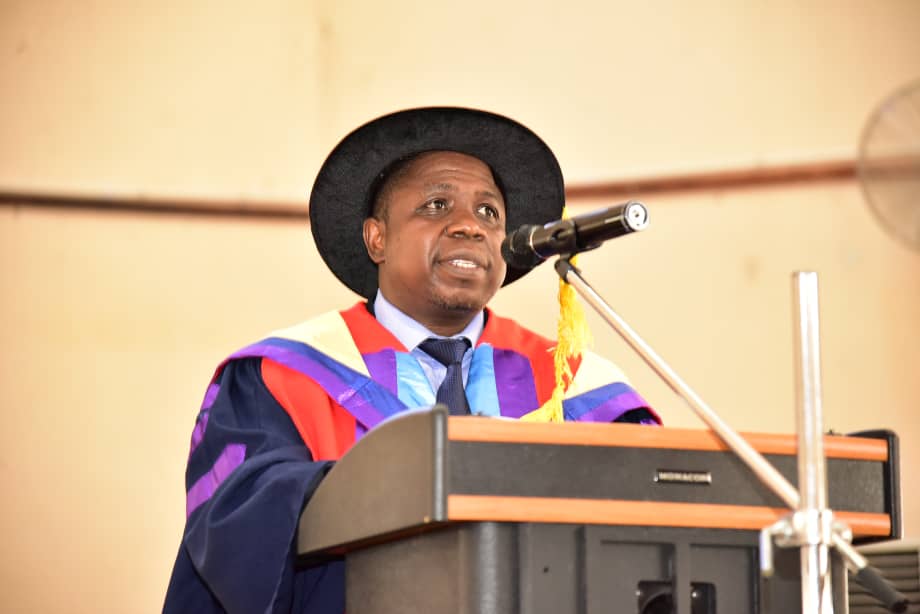
A Professor of Air Quality Forecasting and Climate Change at the Federal University of Technology, Akure (FUTA), Professor Ayodeji Oluleye, has called on nations of the World including Nigeria, to deliberately manage the atmosphere to harness its benefits while averting potential environmental disasters.
Delivering the 191st Inaugural Lecture of the university, Professor Oluleye stressed that achieving balance in the atmosphere requires integrated strategies.
These include transitioning to renewable energy and cleaner transportation, regulating industrial and agricultural emissions, expanding air quality monitoring and modelling capacity, and promoting regional collaboration in data sharing and mitigation efforts.
Professor Oluleye emphasised that understanding the chemistry of pollution is not merely academic but essential for effective policy formulation and environmental stewardship.
He noted that since human activities now play a decisive role in shaping weather outcomes, scientific knowledge must be matched with responsibility to improve air quality, promote cleaner energy systems, stabilise weather patterns, reduce extreme events, and ensure environmental sustainability.
Speaking on the topic “Wonders of Weather in a Polluted World,” the don explained that weather is one of the most immediate ways humans experience the planet, noting that every cloud, wind current, and rainfall event now bears traces of human influence.
According to him, tiny particles from aerosols, industrial emissions, vehicle exhaust, agricultural burning, and wildfires act as cloud condensation nuclei, altering cloud structures by increasing the number of droplets while reducing their size.
He explained that this process can cause clouds to persist longer but produce less rainfall, leading to prolonged dry spells in some regions. Conversely, under certain conditions, such altered clouds may release intense rainfall over short periods, increasing the risk of flash floods.
He further stated that humanity stands at a defining moment in its relationship with the atmosphere, observing that once predictable weather rhythms are becoming increasingly erratic as the climate balance weakens under human pressure.
The warming of the planet—driven by greenhouse gas emissions, deforestation, and industrialisation—has intensified extreme events such as floods, droughts, heat waves, and tropical cyclones across continents.
Focusing on Africa, Professor Oluleye noted that atmospheric stewardship holds special significance for the continent. Despite contributing the least to global emissions, Africa bears a disproportionate share of the consequences, including heat waves, floods, and air pollution that threaten human health and food security. He described stewardship as both a moral responsibility and a development imperative.
To address these challenges, he proposed integrating air quality education into school curricula and community outreach programmes.
He also encouraged citizen-led data collection using low-cost sensors and smartphone applications, alongside behavioural changes such as reducing open burning, conserving energy, and adopting green mobility options. According to him, every citizen is a stakeholder in atmospheric stewardship.
Oluleye, who is the University’s Dean of the School of Earth and Mineral Sciences, further recommended key policy directions for Nigeria, including the development of national emission inventories and sectoral reduction targets; integration of air quality forecasting into the National Early Warning System (EWS); increased investment in renewable energy, sustainable transportation, and research-based climate adaptation; as well as strengthening the Nigerian Meteorological Agency (NiMet) for improved air quality prediction and public communication.
The Vice-Chancellor, Professor Adenike Oladiji, as chairman of the occasion, represented by the Deputy Vice-Chancellor (Academic), Professor Taiwo Amos, underscored the importance of studying climate change impacts to mitigate the adverse effects of pollution. She described the lecture as timely, commending Professor Oluleye for what she called a cerebral and intellectually stimulating delivery.