


…says Nigerians make bold statement in cultural diplomacy
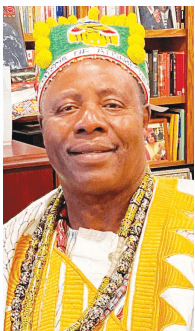
Prof Fonkem Achankeng is a distinguished scholar at the University of Wisconsin, Oshkosh, in the United States, and the traditional ruler of Atoabechied Kingdom in Southern Cameroon. The alumnus of the University of Benin, and the first to graduate with first class honours in the Faculty of Arts in this interview with BIYI ADEGOROYE reminisces on Nigerian culture and the impact the university has made on his life.
How would you react to the honour bestowed on you by the Council of the University of Benin Alumni Association?
My reaction to this honour can only be one of profound gratitude and humility. The Distinguished Alumnus Award is a very great honour from the Council of the Alumni Association of the University of Benin. To have the Distinguished Alumnus Award of any institution, and particularly a great institution like the University of Benin bestowed on anyone, is a very big honour and, indeed, a big blessing to be recognised.
In that regard, I consider this award a celebration of the individual I am, my scholarship from UNIBEN and beyond and other numerous accomplishments made possible by God’s grace. I would like to recall that the honour was revealed to me by the President of UNIBEN Alumni Association Worldwide (UBAA) exactly a month after the City of Appleton in Wisconsin where I live proclaimed me as “a Celebrated Appletonian.” And before that proclamation, the University of Wisconsin where I am a full professor had awarded me the John McNaughton Rosebush University Professorship.
This honour bestowed on me by UBAA, therefore, comes to add to other distinguished awards I continue to receive. The honour, I would say, represents the individual God created and how the world perceives me. I am forever most grateful to God Almighty for His numerous blessings and the possibility of recognition.
What are some of the fond memories of your university days?
The fond memories I have of my student days at UNIBEN are numerous. They are in the areas of knowledge acquisition, student union politics, and campus traditions. UNIBEN was always a great place to learn as the authorities spiced the curriculum in the different disciplines with all kinds of activities to expose students to knowledge production and acquisition. One specific area in this regard was student clubs and club activities. Members of different clubs on campus were encouraged by UNIBEN to organise many activities, including invitations to guest speakers, to promote the image of the respective clubs and to enhance learning.
I did learn a great deal of new knowledge from sitting in different lectures by many guest speakers of the different clubs on campus. Student Union politics in UNIBEN when the seasons came, there were very interesting events and great apprentice- ship opportunities in terms of planning, organising, campaigning, strategising and conducting elections. Although something unpleasant nearly always happened to those who were elected presidents in my time as they were usually sanctioned, I found student union politics to be great arenas for learning about winning and losing as well as avenues for tolerance. Great UNIBEN showed how great the University always was in 1983 or 1984, for example, when the University’s Senate withheld the degree of a student for 10 years.
The student in question, a Pharmacy major, had distributed acid to be used on opponents in the season of politics that year, and the University considered that the behavior did not represent the image of UNIBEN. Let me commend campus traditions and values at UNIBEN. If the University of Benin did not have all kinds of facilities on campus as it had, I might have missed admission at the very last moment, to begin with.
I arrived at the main gate from JAMB and Lagos with my admission papers about 6:00 pm on Tuesday, December 9, 1980, when matriculation was scheduled for the following morning, Wednesday, December 10. I did not miss that last admission opportunity only because every component of campus tradition was within the walls of the campus – staff quarters, student halls, staff clubs, restaurants, banks, churches, hair salons, recreation facilities, staff schools, etc.
The University of Benin Campus was virtually a complete campus in the traditional sense of a university, and students like me benefitted much from that completeness consid- ering that we could find everything we needed on campus without stepping out of the walls and gates of the University. One other memory that stands out for me comes up clearly in this story. Having known I had made a first class in 1984, that fact emboldened me to show up at the Student Services Office. When I got there, I asked to meet the officer in charge of student services. I introduced myself and requested to be given the opportunity to do the Valedictory Speech of that year.
Little did I know that preparations for graduation must have been made long in advance of graduation itself. What was most striking to me to today, was the response I got from the officer. He said, ‘My friend from the Cameroons, this University is not interested in triangular students. We cannot give you that opportunity.’ Before then I had never heard of the concept of a ‘triangular student.’ That was great new learning for me.
I bowed my head and walked away in some amount of shame. What the officer meant was that the University of Benin was not just in the business of making first rate intellectuals but was also more concerned with molding holistic individ- uals. With the benefit of hindsight, I think the officer was very correct. In my time in UNIBEN, for example, no one had heard of me in sports and games, student union politics or other aspects of campus life although my results were outstanding.
Could you name some of your colleagues while at UNIBEN?
I still remember many of my course mates although I do not quite know their current stations in life. Beginning with my two fellow UNIBEN Scholars (1981-1984), Raphael Okoje and Ogunsakin, many of my course mates like Efeyinwua, Bisi Adegbola, Joy Ihetu, Veronique Ufoegbune, Bernadette Okafor, Marie Priye Amadi, Bill Igwe, Bennett Anyanwu, Innocent Kalu, Onyishi, Edwin Nwuche, Andrew Ogbonna, Chinenye, Bose, Afishetu, Michael Ediru, Florence Endeley, Johnson Takang, Adebayo, etc. have attained great heights in their respective spheres in life. I would like to dedicate this award to many of them and especially those that have transitioned to the next world.
As a Cameroonian, how did you come to have your varsity education in Nigeria?
I was born and raised in British Southern Cameroons, a West African territory which was appended by British colonialism to Nigeria after WW I, the League of Nations, and precisely from 1922 to 1961. For those who may wish to know, the NCNC Party of Dr. Nnamdi Azikiwe stood for National Council of Nigeria and Cameroons.
That part of today’s Cameroon had representation in the Eastern House in Enugu and in the Federal House in Lagos in the 1950s. I grew up hearing of great Nigerian universities, including Ibadan, Lagos, Zaria, Nsukka, Ife, Benin where many prominent people from the territory studied as well as other major Anglo-Saxon institutions like Fourrah Bay in Sierra Leone, Cape Coast and Legon in Ghana, and Makerere in Uganda.
I always had a desire to study in one of these great institutions. It was that desire that led me to apply through JAMB for admission to UNIBEN. Well, I can also state that by 1980, I was teaching for the Government of Gongola State at GSS Jalingo, and also at the Advanced Teachers College Jalingo, which is today the University of Jalingo, in Taraba State. From Jalingo in then Gongola State, it was easy to come to the University of Benin.
What has been your relationship with Nigeria and Nigerians since then?
Since coming to Nigeria and gaining admission through JAMB to the University of Benin in December 1980, I can state with no equivocation that my relationship with Nigeria and Nigerians has always been very close. Some of my best friends and mentors are Nigerians.
First, I want to pay tribute to Professor Noureini Tidjani-Serpos, Professor & Department Chair, who went over and beyond to secure my admission into UNIBEN on Matriculation Day in 1980. As a student, I always got the best advice from many of my professors who spotted talent in me and encouraged me to continue to work hard. One of my Professors, a Haitian, told me how ‘a good academic record follows a student all his or her life.’ I since kept that advice very close to my chest and have used the advice in training my own students and raising my children, some of whom are very successful as well. One other Professor, Emeritus Professor Ray Elaho, a mentor who also supervised my long essay, gave me life-saving advice in 1981 when Nigeria and Cameroon almost went to war over a tragic incident in Bakassi.
In life, I have kept my association with some of my professors, some eminent Nigerians including traditional authorities, and with Nigeria, the country I consider Africa’s foremost nation. Although Professors Tidjani-Serpos and Peter Okeh cannot be here today, a few of my other professors and their spouses are kind enough to be with me on this Award occasion. I want to seize this opportunity to thank them immensely for standing by me and leading by example from December 1980 when they first knew me. I continue to look up to them as great examples to emulate.
They were the first to tell the University of Benin and the world out there that Fonkem Achankeng had talent. Today, they have been proven right from the day they found me fit to be the first First Class graduate of the Faculty of Arts, University of Benin in 1984, fourteen years into the history of the University. Among the eminent Nigerian friends of mine are the Great Chief and Distinguished Professor Toyin Falola of the University of Texas at Austin, Professors Sati Fwatchak of the University of Jos, OlaJumoke Yaoub-Haliso of Brandeis University, Anthony Asiwaju of UNILAG, Ngozi Nwogwugwu and Goodnews Osah of Babcock University, Kelechi Obiakwata of Babcock University, Adewale Adepoju of Tai Solarin University, Oluwale Agunbiade, a recent PhD from Babcock University, Inioluwa Ogunseye of Ajayi Crowther University, etc.
I have also met and associated with eminent Nigerian traditional rulers, including the Alake of Egbaland, the Olota of Ota Kingdom, the Ikpo Mene-Senewo- IkpoBari Dumletam of Ogoniland, the Oba of Erimope-Ekiti, the Oba of Ilishan-Remo, and many others.
As a traditional ruler, what excites you most about Nigerian culture?
The culture of every nation is its underlying distinguishing factor. In this regard, Nigeria stands out very proudly across the globe. Wherever Nigerians find themselves they bring their food, their dress patterns and their music. It is very easy to spot Nigerians outside of Nigeria because of the way they dress and/or speak.
Before I ascended the throne of my people 28 years ago, that is in October 1997, I used to work as a diplomat many years ago and was always intrigued by the way Nigerian Diplomats dressed wherever they went and wherever they worked. Unlike other diplomats who would be dressed in Western cut suits, Nigerians had no complex appearing in their traditional outfits.
That was and remains a source of pride to me. And I see such cultural promotion as bold statements in cultural diplomacy. In addition to music, fashion and food, no one can today deny the fact that film and education are also the greatest ambassadors of Nigeria. Many households across the world watch Nigerian films and one can easily find a Nigerian professor everywhere in the world. As a traditional ruler, I feel very proud of the contributions of Nigerian culture to the global cultural space.
I want to add that I dedicate this award to all my course mates and professors, all who studied at UNIBEN from 1980 to 1984, my fellow University of Benin Scholars (1981-1984), and finally my people of Atoabechied Kingdom and family represented at this award ceremony by the Olori, Dr. Patience Eweli Fonkem, the Ngwinkongho’o of Atoabechied.









