
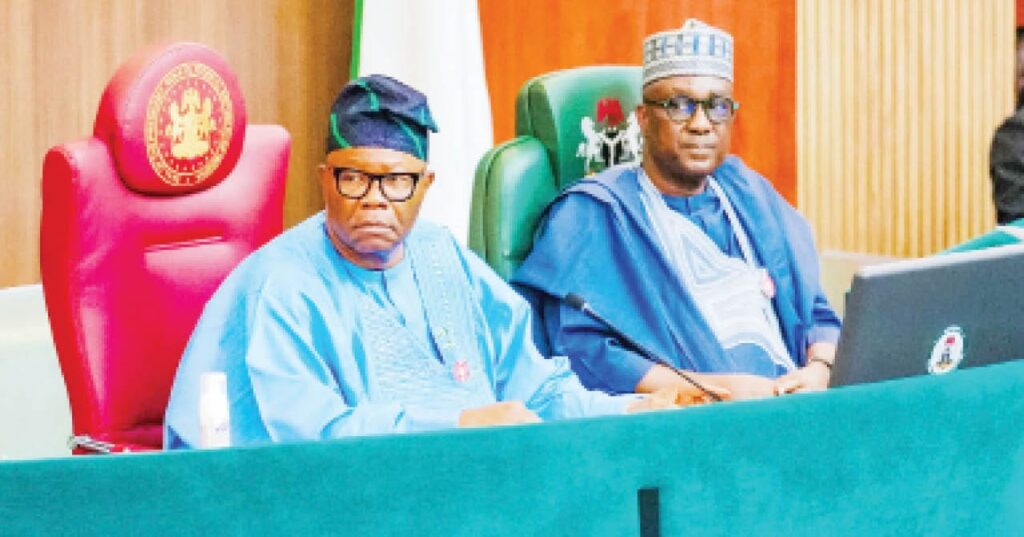
President Bola Ahmed Tinubu on Friday presented a N58.18 trillion 2026 Appropriation Bill to the National Assembly, ushering in what his administration dubs the “Budget of Consolidation, Renewed Resilience and Shared Prosperity.”
Yet the proposal’s heavy reliance on debt financing and rising debt-service costs quickly drew sharp economic scrutiny. Under the plan, N15.52 trillion roughly 26.7 per cent of total expenditure is earmarked for debt servicing, making it one of the largest single items in the budget.
This figure surpasses allocations for several key sectors, underscoring growing fiscal strain from rising interest and principal repayments on Nigeria’s expanding debt stock. Total revenue is projected at N34.33 trillion, with recurrent non-debt costs of N15.25 trillion and capital spending of N26.08 trillion, leaving a yawning deficit of N23.85 trillion, or about 4.28 per cent of GDP.
To bridge the gap, the Federal Government is seeking fresh borrowing of about N17.89 trillion in 2026 — a 72 per cent increase from the N10.42 trillion planned for 2025 with about 80 per cent of new loans expected to come from domestic markets. Economists warned that such debt pressures could undermine medium-term fiscal health.
Muda Yusuf, Chief Executive Officer of the Centre for the Promotion of Private Enterprise (CPPE), cautioned that, “elevated deficit financing could destabilise inflation, exchange-rate conditions, and private-sector competitiveness,” adding that “Nigeria risks falling into a debt trap” if the debt path continues without stronger revenue.
Similarly, Dr Yemisi Ayinde, a researcher at Covenant University, stressed the gravity of current debt dynamics. She described recent figures showing debt servicing and wages consuming more than 100 per cent of government revenue as “deeply troubling,” noting that, “debt servicing alone exceeded total federal revenue, forcing the government to rely on fresh borrowing merely to meet existing obligations, a classic sign of fiscal stress.”
The debt burden has become a political flashpoint. The Peoples Democratic Party (PDP) has derided the budget as a “budget of consolidated renewed sufferings,” arguing that it deepens hardship and offers little for economic inclusion or poverty alleviation. Critics contend that persistent high inflation and unemployment, despite reported GDP growth, belie claims of stabilisation.
Former presidential candidate, Peter Obi, also weighed in, describing the planned borrowing as fiscally reckless. Obi warned that taking on roughly N20 trillion in new loans amid projections that debt servicing could consume nearly half of national revenue, “raises urgent questions about transparency and fiscal responsibility,” and said that, “we cannot keep mortgaging the future of our children through thoughtless borrowing.”
These concerns arrive against a backdrop of a swelling national debt. Latest data from the Debt Management Office and National Bureau of Statistics show total public debt at approximately N152.39 trillion as of June 30, 2025, up from around N149.39 trillion earlier.
External and domestic obligations now loom over public finances, with external debt at about N71.84 trillion and domestic debt at N80.55 trillion. Observers note that Nigeria’s debt-to-GDP ratio is above 50 per cent, well above the government’s legal limit of 40 per cent, raising questions about sustainability.