

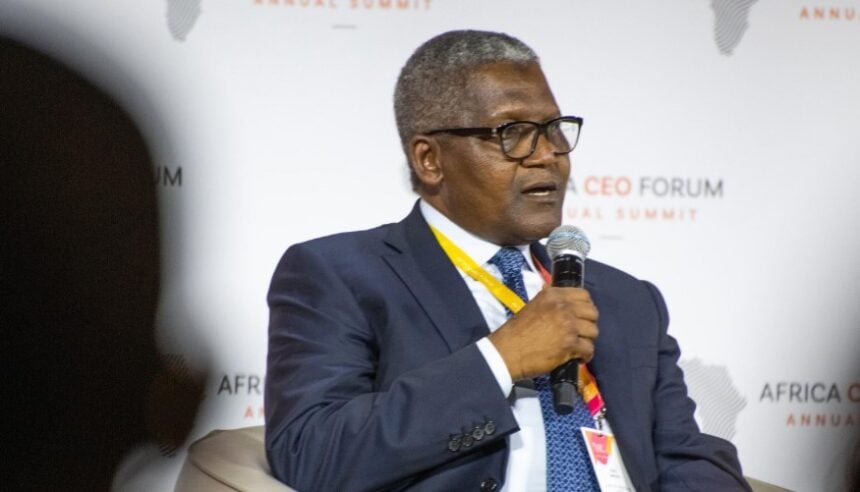
The Chairman of Dangote Group, Aliko Dangote, has called for increased local production and stronger backward integration as critical steps toward positioning Nigeria as Africa’s leading manufacturing hub, stressing that the country must reduce its dependence on imports to achieve sustainable industrial growth.
Dangote made this observation during a fireside chat at the Lagos Business School Breakfast Club, according to a statement on Monday. The event was held under the theme ‘Challenges and Opportunities for Making Nigeria the Leading Manufacturing and Services Hub in Africa’.
The PUNCH reports that the Lagos Business School Breakfast Club brought together senior executives and industry leaders for strategic dialogue, including sessions like this recent event focused on Nigeria’s prospects as Africa’s manufacturing and services hub.
During the fireside chat moderated by Professor Olawale Ajai of Lagos Business School, Dangote emphasised the importance of backward integration and local production in driving sustainable industrial growth.
“If Nigeria truly wants to become a manufacturing hub, we must produce more locally and reduce our dependence on imports,” he said. “Backward integration remains a critical foundation for competitive industries.”
He also highlighted the opportunities presented by the African Continental Free Trade Area, while stressing the need for efficiency and competitiveness.
“AfCFTA gives Nigerian businesses access to a large continental market, but only those that are efficient and cost-competitive will benefit,” Dangote added.
The event opened with a presentation on Nigeria’s 2026 Economic Outlook by the Managing Director of Financial Derivatives Company, Mr Bismarck Rewane, who analysed macroeconomic trends, policy indicators and market dynamics critical to long-term growth strategies.
Rewane noted that “Nigeria’s industrial expansion will depend largely on the alignment of macroeconomic stability with policies that support productivity, investment and private-sector confidence.”
Participants engaged in an interactive question-and-answer session that addressed issues such as supply chain resilience, innovation and private-sector-led growth. The discussions underscored the need for stronger alignment between policy, infrastructure development and investment to unlock Nigeria’s industrial potential.
Commenting on the session, Professor Ajai said innovation and skills development would play a decisive role in Nigeria’s competitiveness.
“Technology, innovation and human capital will determine whether Nigeria leads Africa’s manufacturing and services sectors,” he said.
LBS added that by convening critical conversations on Nigeria’s economic future, the Breakfast Club continues to reinforce the school’s mission to develop responsible leaders capable of shaping sustainable growth across the continent.
The event was supported by First Bank of Nigeria, Optimus Bank, Cowry Asset Management Limited and Afrinvest Limited, partners committed to advancing executive education and fostering a robust business environment in Africa.