



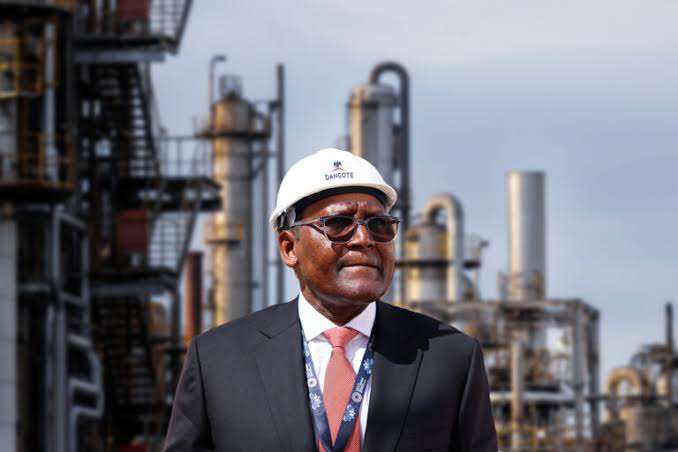
Ch a i r m a n of Dangote Group, Aliko Dangote, has called on the Federal Government to urgently convene a national forum dedicated to resolving Nigeria’s chronic power crisis, warning that no meaningful industrial growth or job creation is possible without a stable electricity supply.
Africa’s richest man made the passionate appeal yesterday in Abuja at the launch of Nigeria’s Industrial Policy, themed: ‘From Policy to Productiv- ity: Implementing Nigeria’s Industrial Future’, where he addressed Vice President Kashim Shettima and other senior govern- ment officials along- side leading industry players.
“I want to advise, Your Excellency, Mr. Vice President, to form a national forum where we’ll have a day or two days of retreat and resolve the issues of power,” Dangote said. “Because with- out power, there is no way in any country you can create growth or you can create jobs. Power means growth. No power, no growth.”
The billionaire in- dustrialist painted a damning picture of the energy burden faced by Nigerian manufacturers, not- ing that many fac- tories are forced to spend more money generating their own electricity than on actual production — maintaining both a primary power plant and a standby genera- tor as backup.
“That doesn’t make sense,” he said. “When you look at some facto- ries, you spend more money generating power. It means you have to have power, you set up your own power plant, then you also set up another standby.” He added that while he would personally profit from higher diesel sales, the cur- rent situation was unsustainable. “I would love to sell more diesel, but that’s not the right way.”
At its core, the policy focuses on sectors where Nigeria pos- sesses real compara- tive and competitive advantages; agroprocessing, textiles and garments, petrochemicals, pharma- ceuticals, light manu- facturing, metals, and technology-enabled industries.
Dangote’s call was backed by Manufacturers Association of Nigeria (MAN), and the Nigerian Associa- tion of Chambers of Commerce, Industry, Mines, and Agricul- ture (NACCIMA) and other players in the manufacturing sec- tor who said the new policy would make the right impact if it’s well implemented.
Director-General of MAN, Otunba Francis Meshioye said with- out a very effective implementation, the new policy might be like all other green books Nigeria has had in the past. “We want a proper implementation, an effective one. And we should be just on the ground running. And it should mean to pro- mote indigenous en- trepreneurship. This is very important, just like Alaji Dangote has said.
It is important to find a way to promote indigenous entrepre- neurship.” Dangote also high- lighted Nigeria’s unique economic posi- tion on the continent, noting that the pri- vate sector accounts for nearly 90 per cent of the country’s GDP — a statistic he said positions Nigeria to drive massive domestic consumption and industrialisation, if the enabling environment is right.
“Nigeria is the only country in Africa where the private sector is bigger than the government,” he said, adding that the country should manufacture everything it consumes rather than rely on imports. The industrialist expressed optimism about the naira’s trajectory, predicting it could strengthen to as low as N1,100 to the dollar before year-end if current policies on import restriction are sustained.








