




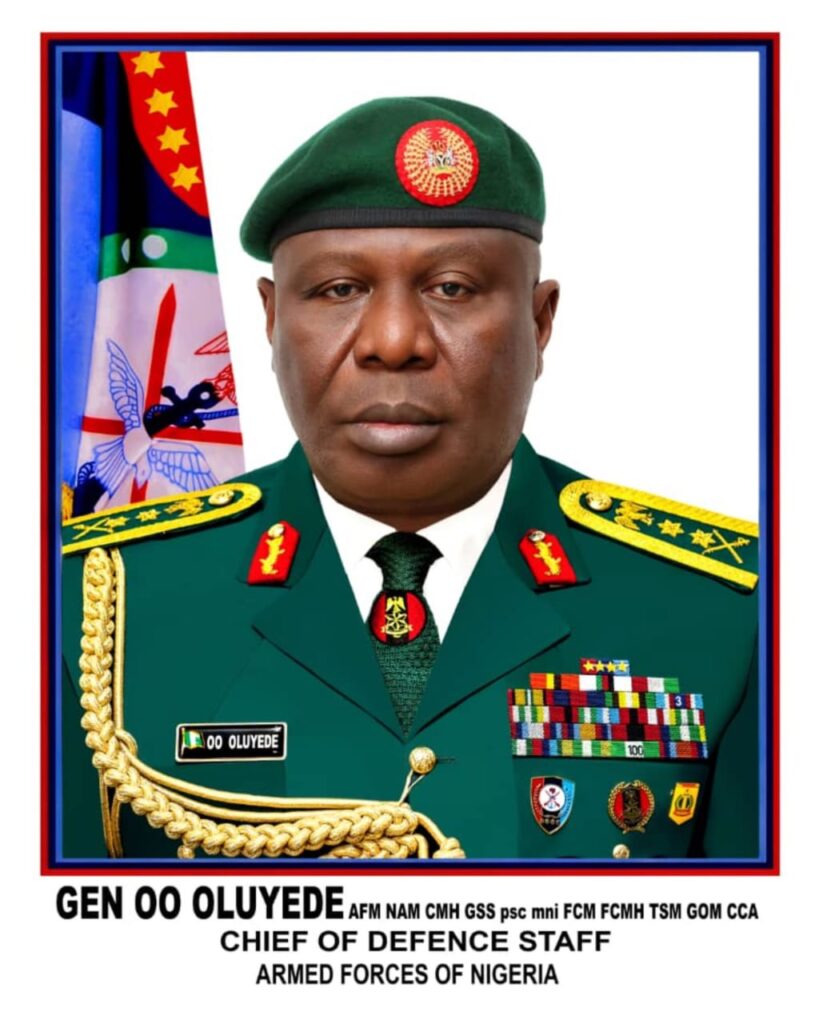
On Friday, the Chief of Defence Staff, Olufemi Oluyede, said the structured rehabilitation and reintegration of repentant terrorists are essential to sustaining battlefield successes and ending the cycle of violence.
Oluyede made this remark at a high-level stakeholders’ meeting in Abuja convened to finalise arrangements for transferring rehabilitated beneficiaries to federal and state authorities for full reintegration into the society.
The meeting assembled representatives of federal ministries, the Office of the National Security Adviser, state governments, and regional partners from Burkina Faso, Chad, Niger and Cameroon.
in attendance were delegates from the European Union (EU), the Commonwealth, the International Committee of the Red Cross, the International Organization for Migration and other development organisations.
READ ALSO:
Oluyede, in a statement released by the Director of Defence Information, Major General Samaila Uba, the CDS — represented by the Chief of Defence Operations, Major General Jamal Abdusalam — reiterated Nigeria’s commitment to a whole-of-government and whole-of-society strategy for peacebuilding and national recovery.
He described Operation SAFE CORRIDOR as a vital and strategic component of Nigeria’s security framework, explaining that while combat operations weaken insurgent groups, rehabilitation and reintegration efforts ensure lasting stability.
“Since its inception in 2016, Operation SAFE CORRIDOR has processed thousands of clients through a controlled and integrity-driven Disarmament, Rehabilitation and Reintegration framework.
“When properly screened and coordinated, surrender pathways degrade insurgent cohesion, generate actionable intelligence, and support long-term stability,” he said.
The Coordinator of Operation SAFE CORRIDOR, Brigadier General Y. Ali, noted that the programme’s progress aligns with the CDS’s philosophy of improved joint operations, personnel welfare and sound administration within a whole-of-government structure.
He characterised the initiative as a multi-agency humanitarian stabilisation programme grounded in Nigeria’s Constitution and relevant international humanitarian and human rights instruments. According to him, personnel are drawn from 17 Services, Ministries, Departments and Agencies.
Ali noted that the programme has continued to strengthen its screening procedures, enhance ideological disengagement modules, improve psychosocial support systems and deepen inter-agency collaboration.
He maintained that the initiative operates under strict integrity safeguards, with emphasis on accountability, behavioural reform and sustainable reintegration.
Providing updates, Ali disclosed that 117 participants from Borno State recently completed the Disarmament, Rehabilitation and Reintegration process at Mallam Sidi Camp, reflecting improved federal–state coordination in post-rehabilitation monitoring and community reintegration.
He added that the expansion of the programme to the North West — including the establishment of a DRR camp in February last year — marked a significant stabilisation step. Ongoing discussions with Zamfara State, he said, are aimed at repositioning the facility into a comprehensive Victim Healing, Rehabilitation and Reintegration centre focused on psychosocial recovery, reconciliation, livelihood support and structured oversight.
In the North Central region, Ali revealed that Benue State has formally sought the establishment of a DRR camp. The Defence Headquarters has inspected proposed locations and advised that any approval must align with national standards on infrastructure, security and long-term sustainability.








